What's inside
As an Amazon Associate I earn from qualifying purchases. This post may contain affiliate links at no extra cost to you.
Drilling a straight hole through deep stock is difficult with a cordless drill because the bit can wander before its cutting edges are fully supported. The problem gets worse as the hole gets deeper: a small angle at the entry becomes a large error at the exit. A 1/16-inch deviation over a short board may not matter, but a hole through a 4-inch post can miss its exit point by 1/8 inch or more.
The best solution is a drill press. When the workpiece is too large, already installed, or too awkward to move, you can still get accurate results with the right bit, a guide, and a controlled drilling technique.
Our Top Picks
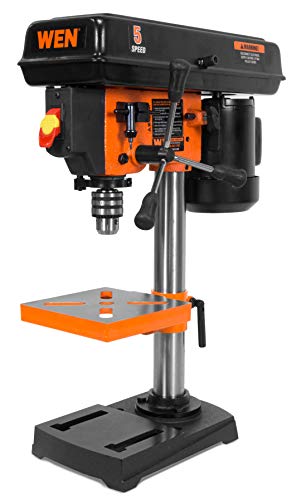 WEN 2.3-Amp 8-Inch 5-Speed Cast Iron Benchtop Drill16.88 x 8.63 x 22.88 inches32 poundsCheck on Amazon

Choose the Right Bit for Deep Stock
Bit choice matters more than most people expect. A standard jobber-length twist bit is a poor choice for deep, straight holes in wood. Its pointed tip can wander, its flutes clog with chips, and its long, thin body flexes easily.
| Bit type | Best use | Strength | Limitation |
|---|---|---|---|
| Brad-point bit | Clean holes in ordinary lumber | Center spur starts accurately | Long sizes can flex; not ideal for very deep holes |
| Auger bit | Deep holes in softwood and framing lumber | Screw point pulls the bit straight and clears chips | Can be aggressive and may split thin stock |
| Installer bit | Long holes through studs, cabinets, and trim | Long reach and a flexible shaft that can be guided | Less clean entry and exit; can bend under pressure |
| Self-feed bit | Large holes in thick wood | Fast cutting with a center pilot | Requires a powerful drill and careful control |
For most deep holes in wood, start with an auger bit rather than simply buying a longer twist bit. A screw point helps the bit begin at the marked location, while the flutes carry chips out of the hole. For clean furniture work, a brad-point bit is usually better, but use the shortest bit that reaches the required depth.
If you need a long bit for wiring or pipework, an extended-length wood auger bit set is generally more useful than a set of extra-long jobber bits.
Make the First Half Inch Count
Most crooked holes are already crooked before the bit reaches 1/2 inch. Put the workpiece on a flat surface, mark both faces when possible, and use a sharp bit. A dull bit needs more force, and that force makes the drill harder to hold square.
Place a small square beside the drill chuck or use a magnetic drill-angle guide to check the tool from two directions. A square viewed from only one side can hide a left-to-right error. Start at low speed with light pressure. Let the center point or lead screw establish the path before increasing speed.
For a through-hole, drill from one side until the pilot point just breaks through the far face. Stop, turn the workpiece over, and finish from the opposite side using the small pilot hole as your guide. This prevents the bit from tearing out a large section of wood as it exits. It also reduces the visible effect of a small angle error.
Use a Guide Instead of Eyeballing the Drill
Holding a cordless drill vertical by eye is acceptable for a shallow hole. It is not a reliable method for a hole 3 inches or more deep. A portable drill guide clamps to the drill and uses guide rods or a base to keep the tool perpendicular. It adds setup time, but it is the most practical upgrade when a drill press cannot reach the work.
A portable drill guide for a cordless drill works best on flat stock with enough room for its base. Check the guide for play before drilling. Even 1/16 inch of looseness at the guide can become a noticeable error at the bottom of a deep hole.
For round posts or narrow pieces, make a simple guide block from hardwood or plywood. Drill a hole through the block on a drill press, then clamp the block over the workpiece. The guide hole should closely match the bit diameter without rubbing. A guide block is inexpensive and can be more stable than a universal drill guide, but it only works for the size and angle it was made for.
Control Depth, Speed, and Chips
Deep holes fail when chips pack into the flutes. Packed chips increase friction, heat the bit, and force the drill off line. Withdraw the bit regularly to clear debris. In softwood, pull it out every 1 to 2 inches. In hardwood, withdraw it more often, especially with a large bit.
Do not bury the entire fluted section at once. Drill 1/2 to 1 inch, back out while the bit is still rotating, then re-enter. Use moderate speed rather than maximum speed. Large bits should turn slower than small bits; a 1-inch self-feed bit in a cordless drill should not be run at the same setting as a 1/4-inch bit.
Set the clutch to drill mode only when necessary, and keep both hands on the drill. A clutch setting can slip during a deep hole, changing the feed rate and damaging the work. If the bit catches, release the trigger immediately. The reaction can twist your wrist or pull the drill sideways.
Support the Work and the Drill
Clamp the stock firmly to a bench or saw horses. Never try to hold a long board against your knee while drilling. The bit can grab at breakthrough, spin the board, and pull the drill off line. Use sacrificial wood under the exit face to reduce tear-out and keep the workpiece from shifting.
If the stock is too deep for the bit’s useful cutting length, drill from both sides rather than forcing a flexible bit farther. Mark the center of the opposite face carefully. A small pilot hole from the first side gives you a reference, but it will not correct a badly angled first cut.
Know When a Drill Press Is the Cheaper Option
A benchtop drill press is the right purchase if you regularly drill accurate holes in parts that fit under its quill. Its table and quill keep the bit square far better than a handheld drill, and depth stops make repeated holes consistent.
However, a small drill press has limited throat depth and spindle travel. It may not handle a 6-inch-wide post or a hole running through a long cabinet side. For one occasional project, a sharp auger bit, a simple guide block, and careful drilling are usually cheaper and adequate. For repeated joinery, dowel holes, or holes that must align across several parts, the drill press quickly earns its cost.
Before drilling, test the setup on scrap of the same thickness. Measure the exit location, check for tear-out, and inspect the bit for bending. That short test is cheaper than discovering that a deep hole is off line after the finished part is assembled.