What's inside
As an Amazon Associate I earn from qualifying purchases. This post may contain affiliate links at no extra cost to you.
Finishing small brass components calls for control, not brute force. A needle file can clean a burr inside a slot, fit a small shoulder, or smooth a freshly cut edge without removing too much material in one pass. The best set is usually a matched group of fine-cut files with comfortable handles and useful shapes—not the largest set with the most pieces.
As an Amazon Associate we earn from qualifying purchases at no extra cost to you.


Our Top Picks


What Matters in a Needle File Set
For brass, look for hardened high-carbon steel files with a fine or second cut. A fine cut removes material slowly enough to control a close fit, while still cutting faster than a diamond file on ordinary brass. The teeth should be cleanly formed and consistent along the working length. Uneven teeth can leave scratches or chatter marks that take longer to remove than the original burr.
Most useful needle files are 100 to 160 mm long overall, with working surfaces around 50 to 80 mm. Smaller files fit tight parts but flex more easily. Longer files give better control on flat edges. A set with six to ten shapes is generally more useful than a 20-piece assortment containing several nearly identical files.
Handles are not mandatory, but they make repetitive work less tiring. A bare tang gives better access in a narrow recess and lets you add a small handle later. For general bench work, choose files with textured plastic or rubber handles that do not rotate in your fingers. Avoid thick handles on very small parts; they can block your view of the cutting edge.
Best Set for Most Brass Work
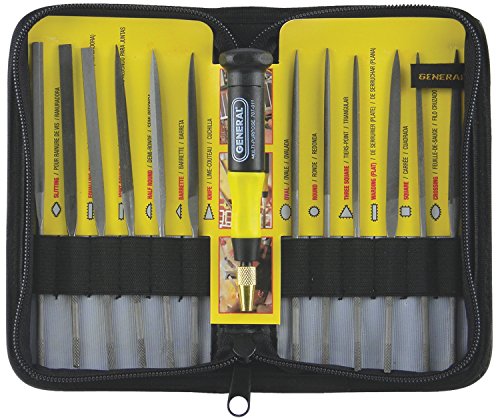
For most modelmaking, clock repair, instrument work, and small fabrication jobs, a ten-piece fine-cut set is the sensible choice. It should include flat, half-round, round, square, and three-square files, plus a barrette or knife-edge file. These shapes cover outside edges, inside corners, holes, V-grooves, and narrow slots.
A good starting point is a fine-cut 10-piece needle file set. Spend more for accurately machined teeth, better handles, and a protective roll if you use the files regularly. The cheaper option is fine for occasional deburring, especially when the work will later be polished or painted.
| Set type | Best use | Advantages | Limitations |
|---|---|---|---|
| Basic six-piece needle file set | Occasional deburring and hobby work | Low cost, compact, enough common shapes | Usually fewer cuts and weaker handles |
| Fine-cut 10-piece set | General brass component finishing | Good shape coverage and control | Costs more; still limited for mirror polishing |
| Precision Swiss-pattern set | Close-fitting and visible parts | Consistent teeth, smooth finish, better control | Slower cutting and higher price |
| Diamond needle file set | Hardened materials, ceramics, tiny abrasive work | Works on materials ordinary files cannot | Can clog on soft brass and leaves a different finish |
Swiss-Pattern Versus Standard Files
Swiss-pattern files have finer teeth and a slimmer profile than common hobby needle files. They are the better choice when a brass component has a visible face, a close-tolerance slot, or a thin wall that can be damaged easily. They remove less metal per stroke, so expect more passes. That slower action is useful: it reduces the chance of overshooting a scribed line.
Standard needle files are adequate for removing casting flash, breaking sharp corners, and enlarging a hole by a small amount. They are also the better bargain when the brass will receive heavy sanding, plating, or paint. If a set feels rough and aggressive, reserve it for initial shaping and use a finer file for the last few strokes.
For small precision parts, a Swiss-pattern fine-cut needle file set is worth the extra cost. The difference is most obvious on flat faces and narrow slots, where coarse teeth can dig in and create deep parallel scratches.
Which Shapes You Actually Need
The flat file is the workhorse for straight edges and broad faces. A half-round file handles concave curves and can still work on a flat surface. Use a round file for holes and radiused channels; its diameter matters, so a set spanning roughly 1.5 to 4 mm is more useful than one with only large rounds.
A three-square file cleans V-shaped grooves and sharp internal corners. A square file is useful for rectangular slots, but it can cut too aggressively at the corners if you twist it. A barrette file has one safe, uncut face and is excellent when you need to file beside a finished surface without marking it. A knife-edge file is helpful for narrow slots but is easier to bend or break.
If most of your work involves drilled holes, choose a set with several round and half-round sizes rather than buying a large general assortment. For slots and keyways, prioritize square, three-square, and knife-edge shapes. A precision needle file assortment with common shapes is usually a better buy than a set advertised mainly by its piece count.
How to File Brass Without Damage
Clamp the component close to the area being filed, using soft jaws or thin card to prevent dents. Leave only the necessary amount exposed. Use light pressure on the forward stroke and lift the file on the return stroke. Dragging it backward can dull the teeth and polish debris into the work.
Brass produces chips that can pack between fine teeth. Brush the file frequently with a file card or stiff nylon brush. Do not use oil as a cure for clogging; it can turn brass dust into a paste. If the teeth load up, rub a brass file-cleaning brush across the file in the direction of the grooves.
File to within about 0.1 mm of a marked final dimension, then switch to lighter strokes and check often with calipers. For a visible edge, finish with 400- to 800-grit abrasive paper backed by a small flat block. A file cannot reliably create a polished surface by itself, and excessive filing can round edges that should remain square.
Common Failure Modes
The most common mistake is using a round file to enlarge a hole while rocking it. That creates a bell-mouthed opening. Keep the file aligned with the hole and rotate it gently, or use a reamer when roundness matters. Another mistake is filing unsupported sheet brass; it flexes, chatters, and develops a wavy edge.
Cheap files also fail when their tangs are poorly fitted. A loose handle is a safety problem and makes precise pressure difficult. Reject any file with cracked teeth, a bent blade, or a handle that shifts under moderate force. Store the files separately in a roll or divided case so their cutting edges do not strike one another.
For occasional brass work, the inexpensive six-piece set is enough. Choose the finer Swiss-pattern set when the component is small, visible, thin, or expensive to replace. That is where consistent teeth and better control save more time than the initial price difference.