What's inside
As an Amazon Associate I earn from qualifying purchases. This post may contain affiliate links at no extra cost to you.
Internal slots are awkward to deburr because the tool must remove a sharp edge without rounding the slot, enlarging its width, or scratching the surrounding face. The right file shape depends on the slot’s width, depth, corner radius, and whether the edge is straight or curved. A flat file is not automatically the best choice: its width, safe edges, and thickness matter just as much as its cut.
Match the file to the slot
Start by measuring the slot with calipers. For a slot about 6 mm (1/4 inch) wide, a file that is 4 to 5 mm wide leaves enough clearance for controlled strokes. A file nearly as wide as the slot can wedge, mark the walls, and remove material from both sides unevenly. For a narrow slot, use a file smaller than the opening rather than forcing a large one through it.
| Slot feature | Best starting shape | Main advantage | Common risk |
|---|---|---|---|
| Straight slot with square corners | Small flat file | Deburrs the floor and straight edges predictably | Rounds corners if the file is rocked |
| Rounded or semicircular slot | Half-round file | Matches the curved wall | Removes too much from the radius if oversized |
| Very narrow slot | Needle file or precision file | Fits restricted openings | Slow cutting and easy flexing |
| Deep, narrow slot | Thin warding file | Reaches the bottom without excessive width | Can twist or bend under pressure |
| V-shaped or angled groove | Three-square file | Fits angled sides and internal corners | Can change the groove angle quickly |
Flat files for straight slots
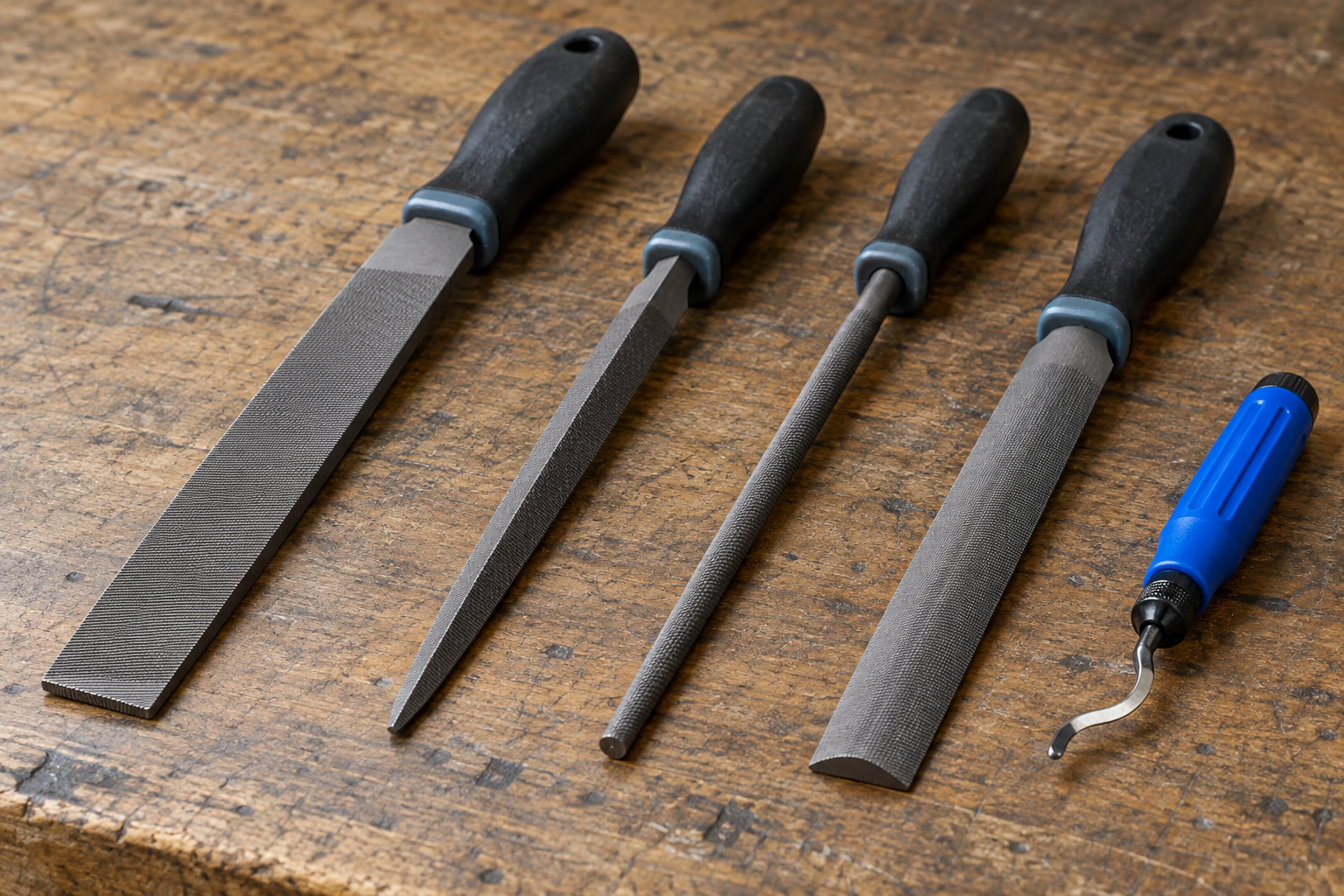
A small flat file is the most useful general-purpose choice for a rectangular slot. Its broad face can remove the burr from the floor, while its edges can reach the slot shoulders. Choose a file with a thickness comfortably below the slot width. A 4-inch or 6-inch file is usually easier to control than a long shop file when working on a small part.
For a slot that must retain square corners, look for a file with one or two “safe” edges. A safe edge has no teeth, so you can place it against a finished wall without cutting into it. This is especially useful when deburring a keyway, mounting slot, or machined aluminum part. A double-cut file removes material quickly but leaves a rougher finish; a single-cut file cuts more slowly and gives better control for a light finishing pass.
A small flat file with a safe edge is the sensible first purchase for occasional work. The cheaper option is fine if you only need to break an edge on mild steel, aluminum, or brass. Avoid bargain files with visibly uneven teeth or soft tangs; they skate, clog, and make consistent pressure difficult.
When a half-round file is better
Use a half-round file when the slot has a curved bottom, radiused end, or semicircular cross-section. The curved face contacts more of the wall than a flat file, so it can deburr the surface without digging a narrow groove. Turn the file so the curve matches the slot rather than using the curved face in a rectangular slot simply because it is available.
Size is critical. The curved face should be smaller than the slot’s radius. If it is too large, its edges contact first and can widen the opening. A half-round file is also a poor choice for preserving a sharp internal corner: its profile naturally removes that corner as you work.
For light work on plastic or soft aluminum, a small fine-cut half-round file offers better control than a coarse file. Fine teeth are slower, but they reduce chatter and leave fewer deep scratches that need sanding.
Needle and precision files
Needle files suit slots roughly 2 to 5 mm wide, especially in thin brackets, small mechanisms, and instrument parts. Their narrow profiles fit where a standard file cannot, but they remove little material per stroke. That is an advantage for final deburring, not for correcting a badly undersized or misaligned slot.
A needle file’s small handle and slender tang make it easy to apply too much force. Use short strokes with light pressure. If the file bends, stop and change the approach. Bending can make the file spring sideways, leaving a gouge at the slot entrance. A set containing flat, half-round, square, and three-square profiles is often better value than buying one specialized shape.
Choose a fine-cut needle file set when you work on several slot shapes. The cheaper single file is fine when the job is occasional and the slot is straight, but a set prevents using the wrong profile just to avoid another purchase.
Warding and three-square files
Warding files are thin, flat files designed for narrow openings. They are useful for deep slots where a normal flat file is too thick. Select one with a working width that leaves clearance on both sides. Because the blade is thin, keep the file aligned with the slot and use minimal force. Twisting it can permanently bend the file or bell-mouth the slot entrance.
A three-square file, also called a triangular file, belongs in the toolbox when the groove has angled sides or a sharp internal V. It can clean a V-groove more accurately than a flat file. It is not a general substitute for a flat file: its corners concentrate pressure and can create deep scratches or change a shallow groove into a wider one.
Cut and grit selection
Use a coarse cut only when you need to remove a noticeable burr or a small amount of excess material. For a simple edge break of about 0.1 to 0.3 mm, a second-cut or fine file is easier to control. On aluminum, chalk rubbed into the teeth can reduce clogging; clean the file with a file card or soft brush rather than scraping across the teeth with hardened steel.
For a clean cosmetic finish, file first, then use abrasive paper wrapped around a thin shim. Do not use a power rotary tool as the default solution. A small abrasive wheel can remove metal quickly, but it also rounds slot entrances, overheats plastic, and throws abrasive dust into moving mechanisms. A diamond needle file set is useful for hardened steel or delicate finishing, though it is slower for heavy burrs and costs more than ordinary high-carbon files.
A controlled deburring method
Clamp the part so the slot is visible and supported. Hold the file level, take two or three light strokes in one direction, and inspect the edge under bright light. You are looking for the shiny burr to disappear, not for a wide bevel. A small chamfer of about 0.2 to 0.5 mm is usually enough for handling safety; larger chamfers can affect fit or expose clearance problems.
Break the entrance edge last, using a single light stroke at roughly 45 degrees if a chamfer is acceptable. Test the slot with the actual pin, key, bolt, or mating part. If it binds, identify where it touches before filing more. Repeatedly sweeping a file back and forth without inspection is the fastest way to make a slot oversize.