What's inside
As an Amazon Associate I earn from qualifying purchases. This post may contain affiliate links at no extra cost to you.
How to Choose Reciprocating Saw Blade Length for Demolition Work
Blade length is one of the easiest reciprocating-saw specifications to get wrong. A blade that is too short may not cut through the material, while an unnecessarily long blade can flex, chatter, snag, and bend teeth. For demolition work, the best choice is usually the shortest blade that gives you enough usable stroke and clearance to finish the cut safely.
Most demolition reciprocating-saw blades measure between 6 and 12 inches. The stated length is the blade’s full length, not the amount cutting beyond the saw’s shoe. A 9-inch blade may provide only about 6 or 7 inches of practical reach, depending on the saw and how far the blade is inserted.
Quick blade-length guide
| Blade length | Best use | Main advantage | Main drawback |
|---|---|---|---|
| 6 inches | Flush cuts, thin lumber, tight spaces | Good control and low flex | Limited reach and cutting depth |
| 8 inches | General demolition and plumbing work | Useful balance of reach and control | May be short for thick beams or stacked material |
| 9 to 10 inches | Framing lumber, roof work, metal pipe | More clearance and depth | More vibration and bending when pushed hard |
| 12 inches | Deep cuts, large timbers, bundled material | Maximum reach | Harder to control and easier to damage |
Match blade length to the material
For ordinary 2×4 and 2×6 demolition, a 6- or 8-inch blade is normally enough. A 2×4 is actually 1 1/2 inches thick, so even a shorter blade can pass through it comfortably. An 8-inch blade is often the best general-purpose choice because it leaves room to work around nails, studs, and awkward angles without becoming excessively flexible.
Choose a 9- or 10-inch blade when you are cutting 4×4 posts, doubled studs, roof decking, or several layers of material at once. For a 4×4, the blade needs to cut through 3 1/2 inches of wood, but the extra length also helps when the saw cannot sit squarely against the workpiece. A 12-inch blade is useful for large timbers, thick roots, and deep cuts where a shorter blade simply cannot maintain contact.
Longer is not automatically better. If only 2 inches of blade are engaged in a cut, the unused portion can whip from side to side. That movement makes the saw less accurate and increases the chance of catching a nail or pinching the blade. In many cases, an 8-inch reciprocating saw demolition blade will cut faster than a 12-inch blade because it wastes less motion flexing.
Allow for clearance around the cut
Blade length is also about access, not just material thickness. When cutting a pipe against a wall, a flush-cutting blade needs enough exposed length to reach behind the pipe without the saw body hitting the wall. A longer blade can help in this situation, but a flexible blade designed for flush cuts is usually more important than extra inches.
For cutting out wall studs, begin with an 8-inch blade unless the stud is buried behind several layers of drywall, tile, or siding. If you must reach through a wall opening or work around plumbing, move to a 10-inch blade. Keep the saw shoe against the surface whenever possible. The shoe controls the blade’s movement; operating with the shoe floating makes a long blade particularly difficult to manage.
When cutting between closely spaced studs, a shorter 6-inch blade is often easier to steer. It reduces the chance of striking hidden wiring or plumbing beyond the target. That does not make it safe to cut blindly: use a detector, inspect from both sides, and shut off relevant circuits before opening walls.
Length cannot compensate for the wrong blade
Blade tooth count and construction matter at least as much as length. Wood demolition blades commonly use around 5 to 8 teeth per inch, with larger gullets that clear chips quickly. For nail-embedded lumber, use a bi-metal demolition blade rather than a basic high-carbon steel blade. Bi-metal blades cost more, but they tolerate nails and hardened fasteners far better.
For clean wood with few fasteners, cheaper high-carbon blades can be perfectly adequate. They are a sensible choice for tearing out old shelving, cutting scrap lumber, or handling a small weekend project. Expect them to dull quickly if they hit nails. For mixed wood and metal, an bi-metal reciprocating saw blade set for wood and metal is the better buy.
Metal-cutting blades usually have finer teeth, commonly 14 to 24 teeth per inch. Use a blade long enough to pass completely through the pipe or sheet while keeping several teeth engaged. If only one or two teeth contact the metal, the blade can snag and strip teeth. For thin sheet metal, a 6-inch blade is generally easier to control than a longer one.
Prevent flex, binding, and broken blades
A blade should extend beyond the workpiece by roughly 1 to 2 inches during a normal cut. More clearance is useful when the material is uneven, but excessive exposed length increases flex. If the blade bends visibly during each stroke, reduce pressure, change your cutting angle, or use a shorter blade.
Binding is common when a long blade is pushed too hard through thick wood. The kerf closes behind the teeth, the saw twists, and the blade can bend or break near the clamp. Let the saw’s stroke do the work. For thick lumber, start the cut slowly, keep the shoe planted, and reposition rather than forcing the tool through a crooked kerf.
Blade length also affects vibration. A 12-inch blade moving at high speed can produce substantially more whip than a 6-inch blade, especially on a compact cordless saw. If your saw has orbital action, use it for fast wood demolition, but turn orbital action off for metal, finish cuts, and situations where control matters more than speed.
A practical buying strategy
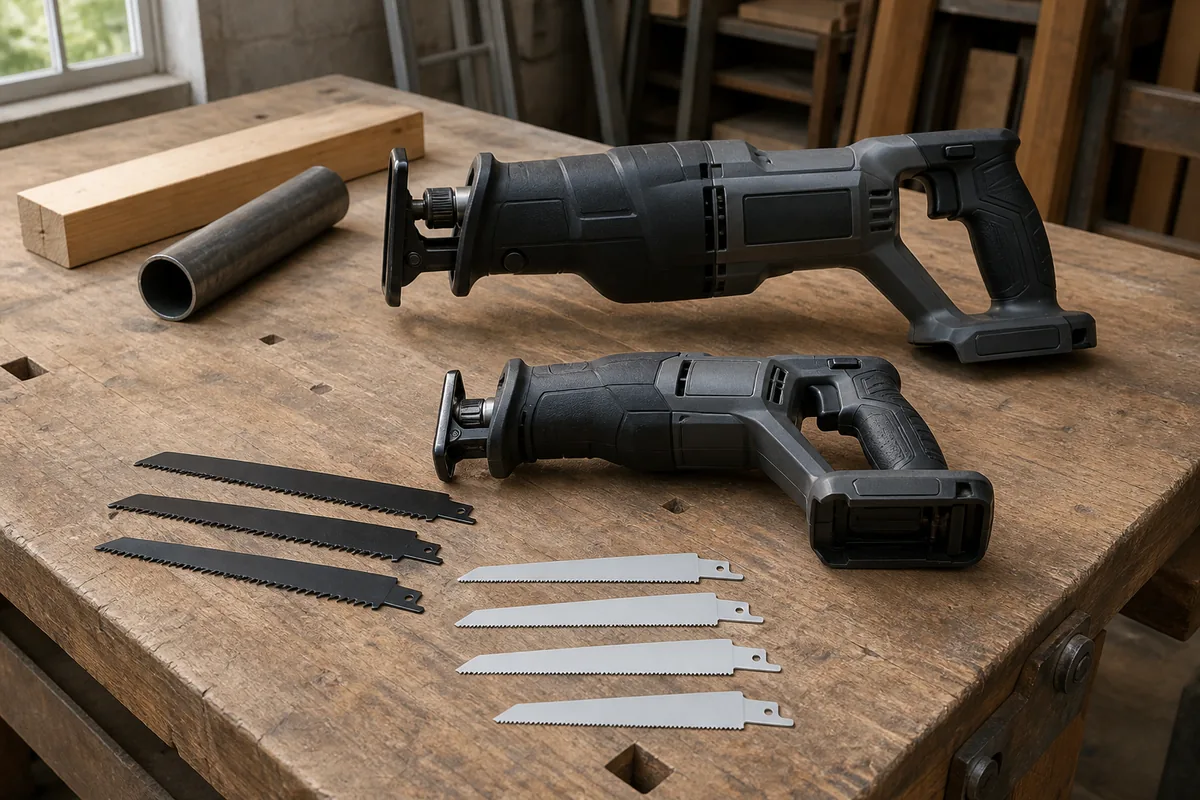
For most demolition kits, start with 6- and 8-inch blades, then add a 10- or 12-inch blade only when your work regularly involves thick stock or difficult access. A mixed reciprocating saw blade assortment for demolition is usually more useful than a large pack of one length.
Buy the blade for the cut you are making, not for the maximum thickness printed on the package. The cheapest blade is fine for clean, occasional wood. Spend more on bi-metal or carbide-tooth blades when demolition includes nails, screws, cast iron, stainless steel, or repeated daily use. In practice, correct length, planted shoe contact, and the right tooth pattern prevent more failed cuts than simply buying the longest blade available.