What's inside
As an Amazon Associate I earn from qualifying purchases. This post may contain affiliate links at no extra cost to you.
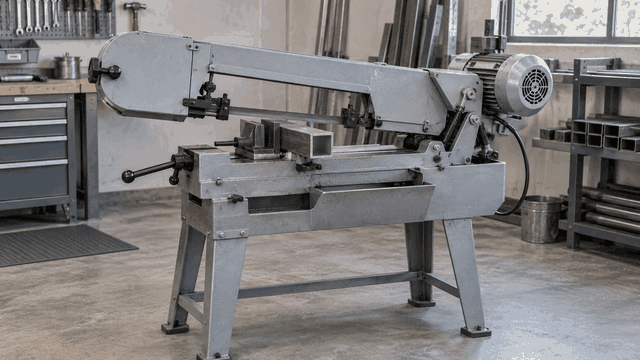
A band saw can make clean, square cuts in steel, aluminum, and other metals, but only if the blade tracks correctly on the wheels. A blade that drifts toward the wheel flange, climbs the wheel rim, or wanders between the guides will produce angled cuts, damaged teeth, and premature blade failure. Tracking adjustment is usually straightforward, but it must be done in the right order.
What Blade Tracking Means
Blade tracking is the blade’s position on the band saw wheels. On most metal-cutting band saws, the blade should run with its teeth just beyond the wheel’s rim rather than rubbing the wheel flange. The exact position varies by machine, but the blade should sit consistently in the same location as the wheels turn.
Tracking is different from blade tension, guide alignment, and vise alignment. A blade can track correctly and still cut crooked because the guides are loose, the vise is out of square, or the blade is dull. Check all of these before blaming the tracking adjustment.
Always unplug a stationary saw before opening its wheel covers. On a cordless or portable saw, remove the battery. Wear gloves when handling the blade, but never wear gloves near a moving blade. A metal blade can have sharp, hooked teeth even when it looks dull.
Check These Problems First
Install the correct blade before adjusting anything. For general steel, a variable-pitch bi-metal blade in the roughly 10/14 or 14/18 teeth-per-inch range is a sensible starting point. Thin-wall tubing needs finer teeth; thick solid stock needs coarser teeth. At least three teeth should remain engaged in the work at all times.
Inspect the blade for missing teeth, side wear, cracks, and a visibly twisted back edge. A damaged blade will not track reliably. Clean chips and packed cutting fluid from the wheels, especially around the wheel shoulders. Chips can make the blade appear to track incorrectly and can force it sideways.
Check the wheel bearings and blade guides for play. If you can move a wheel sideways by hand or rock a guide bearing noticeably, tracking adjustment will not solve the problem. Also verify that the vise jaws are square to the blade path. A square blade cutting into a crooked vise can still produce a mitered cut.
How to Adjust the Tracking
1. Release blade tension. Open the wheel covers and back off the tension enough to remove the blade if necessary. If the blade is already installed, leave only enough tension to keep it seated while making a preliminary adjustment.
2. Inspect the wheels. Most metal-cutting band saws use one driven wheel and one idler wheel. The idler wheel normally has the tracking adjustment, often a threaded bolt or eccentric mechanism. Do not assume the adjustment location; consult the saw’s manual if the mechanism is not obvious.
3. Turn the wheel by hand. Slowly rotate the wheel in the normal cutting direction and watch the blade position. Keep your fingers outside the blade loop. The blade should remain stable instead of moving progressively toward the flange or rim.
4. Make very small adjustments. Loosen the tracking locknut if fitted, then turn the tracking screw only a fraction of a turn—about one-eighth turn is plenty to start. One direction moves the blade toward the wheel flange; the other moves it away. If the blade moves the wrong way, reverse the adjustment.
5. Recheck through a full rotation. Turn the wheel several revolutions. Do not judge tracking from one spot on the wheel; a bent blade, warped wheel, or dirty wheel can create a high point. Stop if the blade climbs the flange, drops off the wheel, or contacts the wheel side.
6. Tighten the locknut and tension the blade. After the blade runs steadily, set tension according to the saw manufacturer’s specification. Many machines specify tension in pounds per square inch, while others use a built-in indicator. Avoid guessing with extreme tension: too little allows wandering, while too much can damage bearings, wheels, and the blade.
Align the Guides and Verify the Cut
Tracking alone does not guarantee a straight cut. Set the side guide bearings close to the blade without clamping it. On many saws, a gap around 0.001 to 0.003 inch is appropriate, but the machine manual takes priority. The back guide bearing should contact the blade lightly only when cutting pressure pushes the blade rearward.
Keep the guides as close to the work as practical. A large exposed section of blade can flex, especially when cutting narrow bar or tubing. Set the vise firmly against the work and support long stock so its weight does not twist the cut.
Use the saw’s recommended blade speed. A blade running too fast in steel generates heat and can strip teeth; too slow can cause vibration and rough cutting. Apply cutting fluid suited to the material, but do not flood a portable saw unless it is designed for wet cutting.
Make a test cut through a piece of inexpensive square stock. Measure both ends of the cut with a machinist’s square or combination square. If the cut is square at the front but angled at the back, check blade deflection, guide clearance, and vise alignment before making another tracking adjustment.
Tracking Symptoms and Likely Causes
| Symptom | Likely cause | What to check |
|---|---|---|
| Blade walks toward the wheel flange | Tracking is set too far inward, or the blade is twisted | Tracking screw, blade condition, wheel cleanliness |
| Blade falls off the wheel | Insufficient tension, loose tracking, or damaged wheel flange | Tension setting, locknut, wheel and bearings |
| Cut drifts sideways | Dull blade, excessive feed pressure, or loose guides | Teeth, guide bearings, feed pressure |
| Cut is consistently out of square | Vise or guide alignment problem | Vise jaws, guide arm, test cut |
| Blade vibrates or makes a rhythmic noise | Damaged blade, dirty wheel, or wheel runout | Blade weld, wheel surface, wheel bearings |
Choosing Equipment That Makes Tracking Easier
If you are replacing blades, a bi-metal metal-cutting band saw blade is usually worth the extra cost over a basic carbon-steel blade. Bi-metal blades tolerate heat and interrupted cuts better, particularly in angle iron and square tubing. The cheaper blade is fine for occasional thin-wall aluminum or light-duty steel if the tooth pitch is appropriate.
For portable work, a portable metal band saw is convenient but offers less support and adjustment than a stationary saw. It is a good choice for cutting conduit, threaded rod, and small stock at an installation site. A stationary horizontal saw is the better buy for repeated production cuts, heavier material, and easier vise alignment.
A band saw blade tension gauge can help when the saw has no reliable tension indicator, but it is not essential for occasional work. The practical priorities are a rigid frame, sound wheel bearings, usable guide adjustment, and readily available blades. A cheap saw with loose wheels will never track as well as a modest saw kept clean and properly adjusted.
When Adjustment Is Not the Answer
Stop adjusting if the blade position changes dramatically during one wheel revolution, if the tracking screw has little effect, or if the blade repeatedly climbs the wheel after correct tension is set. Those symptoms point to a bent blade, warped wheel, worn bearing, damaged flange, or frame misalignment. Replace the blade first; if the problem remains, repair the saw before making more cuts.
Once tracking is stable, mark the adjustment position with a paint pen. That gives you a useful reference after changing blades. Recheck tracking whenever you switch to a different blade width or length, because a blade with a poor weld or different back-edge shape can require a small correction.