What's inside
As an Amazon Associate I earn from qualifying purchases. This post may contain affiliate links at no extra cost to you.
Our Top Picks
 Incra Mast-R-Lift-II-R Designed for Rockler Tables9-1/4" x 11-3/4"11.75 x 11.75 x 0.38 inches15.2 poundsCheck on Amazon


Why a lift matters for cabinet door profiles
Raised-panel doors, cope-and-stick joints, and decorative edge profiles depend on a cutter sitting at a repeatable height. A small change can leave a shoulder proud, create a step between the rail and stile, or alter how a panel fits its groove. Adjusting the bit from under the table is workable for occasional routing, but it gets tedious when you are dialing in several cutters or making a batch of doors.
A router lift lets you change bit height from above the table and lock the setting without reaching under the top. For repeat work, the useful features are not flashy: low backlash, a firm lock, a readable adjustment, a plate that stays flush, and compatibility with your router. A lift does not make every cut exact. Bit runout, fence alignment, feed direction, material thickness, and a loose router can still spoil a profile.
As an Amazon Associate we earn from qualifying purchases at no extra cost to you.


What to compare before buying
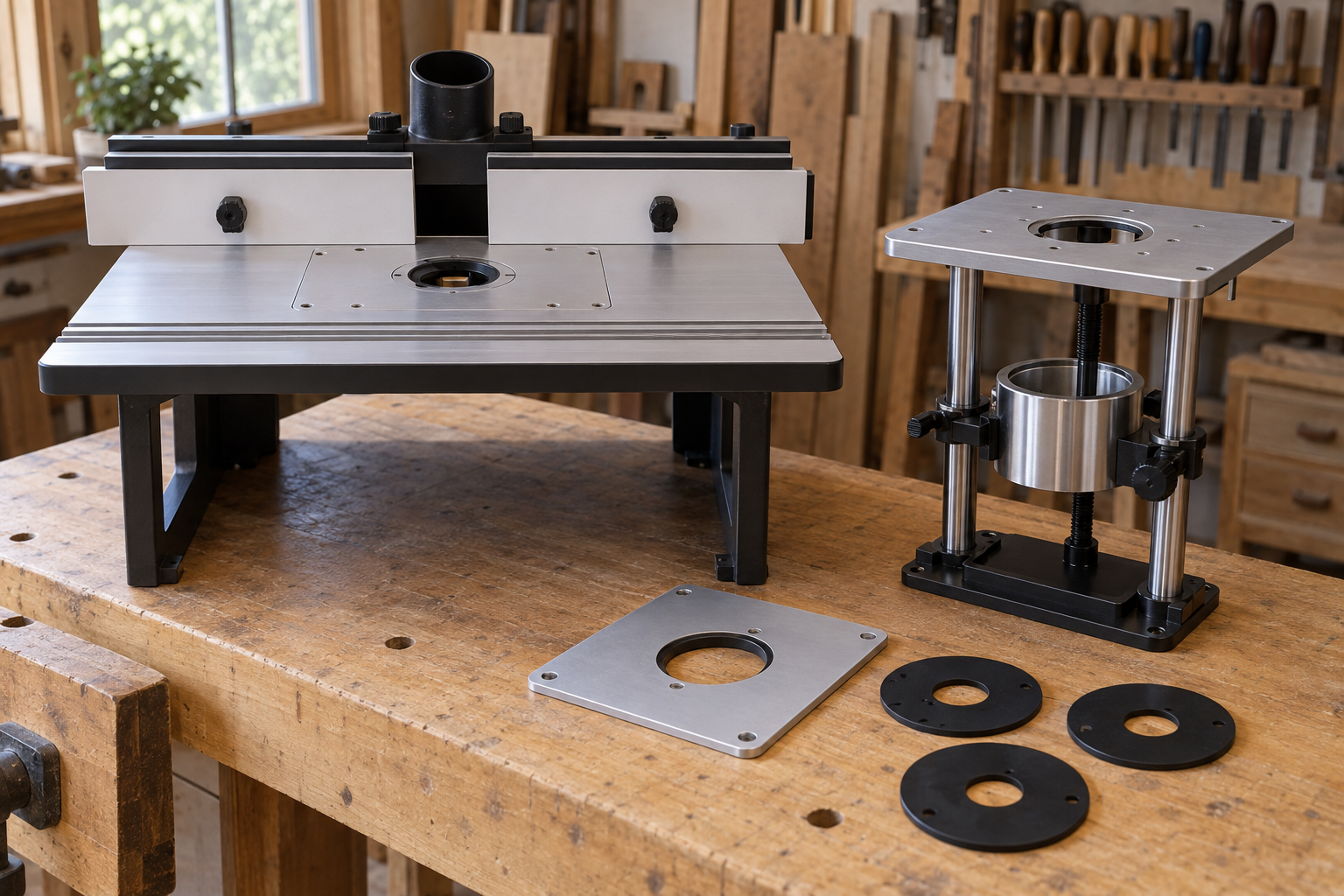
Start with the router, not the lift. Lifts are built around particular motor diameters or router models, and a motor that is slightly too large or small may not clamp securely. Check the lift maker’s compatibility list and measure the motor housing if needed. Also check the table opening and plate dimensions; common plate sizes are around 9¼ by 11¾ inches, but tables vary. Do not assume a lift fits because its plate looks close.
Adjustment pitch affects how finely you can set height. A lift that moves 1/16 inch per crank revolution is quicker to adjust than one that moves 1/32 inch, but the finer mechanism is easier to sneak up on. Actual repeatability depends on backlash and locking, not pitch alone. For a cabinet door set, you may make test cuts, adjust in small increments, and use a straightedge or caliper to verify the shoulder rather than trust the dial by itself.
Router lift options compared
| Option | Best fit | Advantages | Trade-offs |
|---|---|---|---|
| Dedicated, full-featured lift | Frequent profile work and multiple setups | Convenient above-table adjustment, good locking, often fine adjustment | Costs more; motor and plate compatibility must be confirmed |
| Basic lift or compact lift | Regular use on a tighter budget | Better access than under-table adjustment; fewer extras to pay for | May have coarser adjustment or less convenient bit access |
| Router mounted directly in a plate | Occasional routing and simple profiles | Lowest-cost route if the router already has a suitable plate | Height changes may require reaching below; repeat settings take longer |
For a dedicated cabinet-door setup, compare router table lifts for cabinet-door profiles by motor fit, adjustment mechanism, plate size, and included locking features. A well-made basic lift is usually enough if you run one profile at a time and do not change height often. Paying extra makes more sense when you switch between cutters, batches, or shallow and deep passes throughout a project.
How to get repeatable door profiles
Install the lift and check that its plate is level with the table. Use a straightedge across the plate and tabletop; even a small lip can catch a narrow rail or stile. Adjust the leveling screws, then recheck after tightening. A plate that sits low can also trap dust and affect how a workpiece slides.
Unplug the router before changing bits or making adjustments near the cutter. Install the bit with the shank seated securely in the collet, following the router and bit makers’ instructions; avoid bottoming the shank out. Make a test cut in scrap of the same species and thickness as the doors. Check the shoulder and joint fit, then change height in small increments. A change of 1/64 inch can be visible on a tight cope-and-stick joint.
Use a marking reference for your starting height, but verify the result on the work. Some lift scales show movement rather than the final cutting diameter, and different bits may have different reference points. Once the profile is right, lock the lift and make another test cut. If locking shifts the setting, compensate before cutting the door parts. Keep the same face against the fence and use consistent feed pressure; changing the reference face can make two matching pieces appear mismatched.
Bit access, dust, and safety
Above-table adjustment is not the same as above-table bit changing. Some lifts let you raise the collet far enough to reach it from above; others require access below the table or a separate access opening. If your work includes frequent cutter changes, check this detail before purchase. A lift can be mechanically precise and still be frustrating if the router’s collet sits too low for your wrenches.
Large panel-raising bits need adequate table opening, fence clearance, and router power. Follow the bit maker’s maximum speed and use several shallow passes when the cut is heavy. Forcing a deep pass risks burning, chatter, or loss of control. A router lift improves adjustment; it does not increase the router’s capacity or make an undersized table safer.
Dust collection matters because chips can collect around the lift mechanism and interfere with adjustment or locking. Clean the screw and moving parts as the manufacturer directs, and do not grease components unless the instructions allow it. If the lift begins to feel gritty or develops more play, stop and inspect it rather than compensating with the scale.
Which option should you buy?
Choose a dedicated lift if you make cabinet doors regularly, need to repeat several bit heights, and can confirm a precise fit for your router and table. Look for a positive lock, a plate that can be leveled, and an adjustment you can make without excessive effort. If you are comparing a router lift with fine adjustment and a lock, treat those features as useful only when the motor fit and plate dimensions check out.
Choose a basic lift if you want convenient height changes but do not need elaborate scales or frequent above-table bit changes. If you build only a few doors a year, a suitable router plate—or even under-table adjustment—can be fine. Spend the difference on a sharp, properly matched bit, stable fence, and good test stock. Those affect the finished profile just as directly as the lift, and a lift cannot rescue a dull cutter or inconsistent feed.