What's inside
As an Amazon Associate I earn from qualifying purchases. This post may contain affiliate links at no extra cost to you.
Our Top Picks


Which Bit Belongs on an Electrical Terminal Screw?
For electrical terminal screws, the correct bit is the one that fully fits the drive recess and lets you apply controlled torque without slipping. That sounds obvious, but terminal screws are often small, tightly tightened, and positioned where a dropped screw or damaged conductor creates a real problem.
Slotted and Phillips bits are not interchangeable in practice. A slotted bit can work well on the broad, simple screws found in switches, receptacles, breakers, and terminal blocks. A Phillips bit is usually faster and more stable when the screw has a cross-shaped recess. The cheapest suitable bit is often fine, but the wrong size causes more trouble than a modest upgrade in bit quality solves.
As an Amazon Associate we earn from qualifying purchases at no extra cost to you.


When slotted bits make sense
Slotted, or flat-blade, terminal screws are common on electrical devices. The screw head has one straight slot, so the bit must match the slot width and fit its depth without excessive side-to-side movement.
For a typical device screw, a bit around 1/8 inch wide is often appropriate, but terminal screws vary. A blade that is too narrow concentrates force on the slot edges and can twist out. A blade that is too wide may not seat fully or can damage the plastic body around the screw. Check the fit before applying pressure.
Slotted bits have one important advantage: they are easy to place into a terminal screw while working at an angle. They are also inexpensive and useful for more than electrical work. A set of insulated slotted screwdrivers gives you several blade widths instead of forcing one oversized driver to do every job.
The main weakness is cam-out. Because the bit is held in one straight slot, it can slide out if the driver is tilted, the screw is corroded, or the bit is too small. Cam-out can damage the screw head, scrape nearby insulation, or make the screwdriver jump toward your hand.
When Phillips bits are better
Phillips terminal screws are less common on traditional residential devices than slotted screws, but they appear on many terminal blocks, control equipment, appliances, and combination-head screws. A Phillips bit centers itself better than a slotted blade when the size is correct.
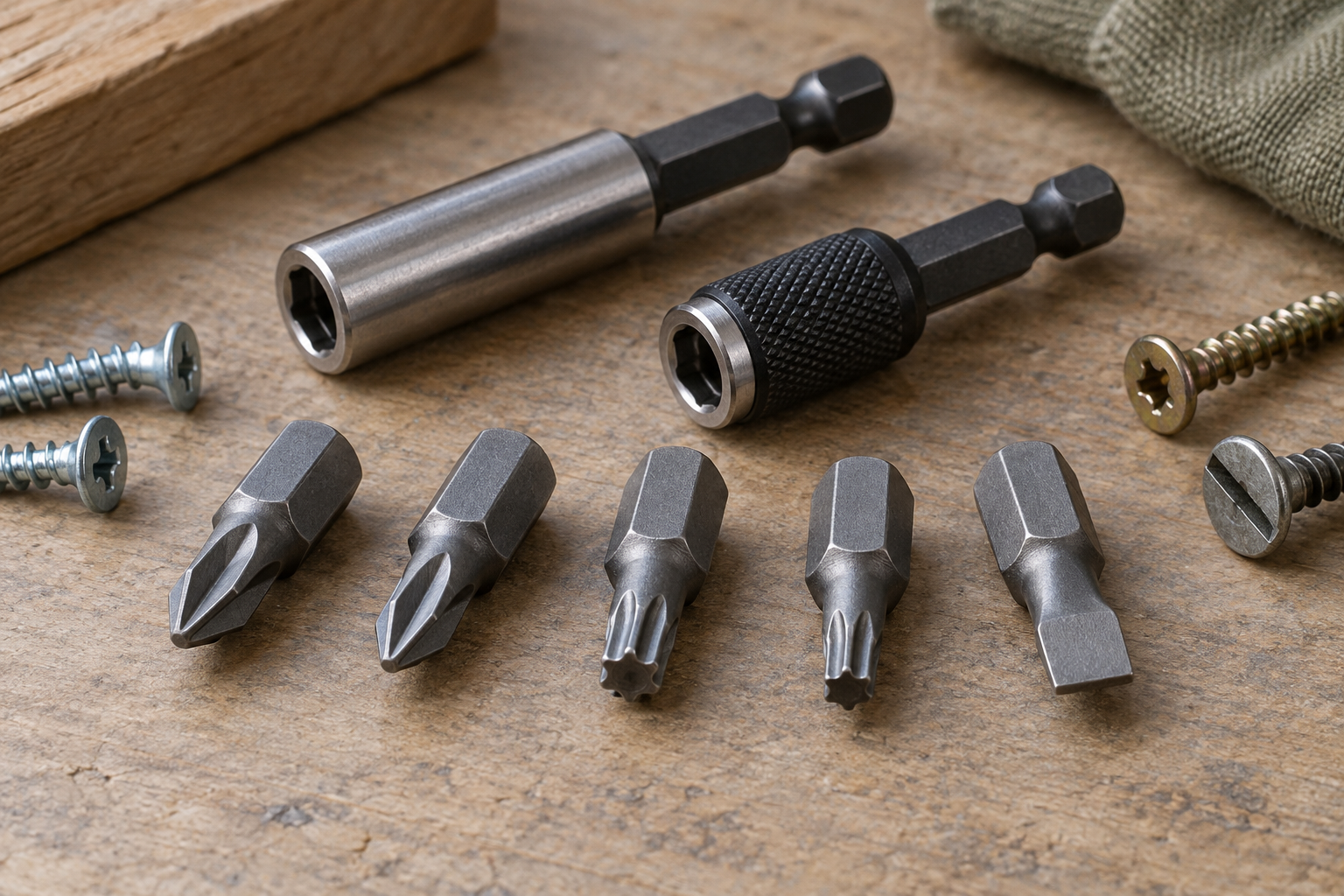
For small electrical hardware, #1 and #2 Phillips are the sizes you will encounter most often. #2 is common on larger device and equipment screws; #1 fits smaller terminal screws. Do not assume that every cross-shaped recess is a Phillips drive. Pozidriv and similar designs need a matching bit, and a Phillips bit may fit poorly even when it seems to turn the screw.
A Phillips bit can apply torque quickly with a manual driver or drill, but it is not automatically safer for terminal work. If the bit is undersized, it will damage the four wings of the recess. If you use an impact driver, the repeated hammering can strip the screw or over-tighten the terminal. For routine wiring, a hand driver or a torque-controlled screwdriver is easier to control.
Slotted vs. Phillips for terminal screws
| Factor | Slotted | Phillips |
|---|---|---|
| Best use | Common receptacle, switch, and breaker terminals | Terminal blocks, controls, appliances, and cross-head screws |
| Centering | Low; requires a steady hand | Better when the size matches |
| Typical failure | Bit slips sideways or rounds the slot | Bit cams out and strips the recess |
| Speed | Moderate, especially with manual driving | Generally faster to start and drive |
| Cost | Usually the cheaper option | Usually inexpensive, with more sizes needed |
| Torque control | Good with a properly sized manual driver | Good, but easy to overdrive with a drill |
What to buy for general electrical work
If most of your work involves residential switches and receptacles, start with a quality slotted driver in the common terminal-screw size, plus a medium Phillips driver for mounting screws and combination-head hardware. A basic electrician screwdriver set is usually a better buy than a large bit assortment.
For equipment repair or control panels, choose a broader set with #1 and #2 Phillips, several slotted widths, and possibly Pozidriv and Torx bits. A precision torque screwdriver set becomes worthwhile when the manufacturer specifies terminal torque or when you are working on expensive equipment.
Insulated handles and shafts can provide an additional layer of protection, but they do not make live electrical work safe. De-energize the circuit, lock out the disconnect when appropriate, and verify absence of voltage with a properly working tester before touching conductors. Use tools marked for the electrical work you are performing, and inspect insulation for cuts or cracks.
How to avoid stripped terminal screws
First, identify the drive type and clean dirt or paint from the recess. Push the bit firmly into the screw before turning. Keep the driver aligned with the screw axis; even a 10-degree tilt can make a slotted blade slip, while a Phillips bit can lose contact with the recess.
Use the lowest hand force that keeps the bit seated. Tighten the terminal only to the device maker’s specification. Many common device terminals are specified in inch-pounds rather than “as tight as possible”; values around 12 to 18 inch-pounds are common, but the exact number varies by device. A torque screwdriver prevents both loose connections and crushed terminals.
For a screw that will not move, stop using a drill. Apply penetrating technique only when appropriate for the equipment, use the correct replacement screw, and avoid damaging the terminal clamp. If the recess is already rounded, replacement of the device or terminal hardware is often safer than forcing it with locking pliers.
Which one should you choose?
Choose slotted bits when the terminal screw has a straight slot, especially on standard residential wiring devices. They are cheap, easy to replace, and perfectly adequate when the blade fits snugly. Choose Phillips when the screw is cross-headed or when the equipment specifies that drive type; the better centering can save time.
If you do varied electrical work, buying both is the practical answer. Spend less on a large collection of exotic bits and more on correct sizing, sound tips, insulation in good condition, and a torque-controlled driver for terminals with published torque requirements.