Key takeaways
- An 8Ah pack is not just a bigger 5Ah pack: it changes balance, charge time and cost per amp-hour, so the right size depends on your heaviest tool.
What's inside
As an Amazon Associate I earn from qualifying purchases. This post may contain affiliate links at no extra cost to you.
The 5Ah vs 8Ah battery question gets sold on runtime and decided on everything else. Both packs slide onto the same tools, charge on the same chargers, and carry the same warranty terms. What separates them is how the pack changes the tool it is bolted to: balance, heat, how hard it sags when the trigger is buried, how long you stand at the charger, and how much of your budget ends up in cells instead of tools.
Short version: the 5Ah pack is the compromise most people actually want, and the 8Ah is a specialist that earns its keep on tools that pull hard. Choosing wrong is rarely a disaster, just a slow and expensive kind of wrong, usually a heavy pack bolted to a drill or a dead pack halfway through a deck.
As an Amazon Associate we earn from qualifying purchases at no extra cost to you. Product prices and availability are accurate as of the date shown and are subject to change.


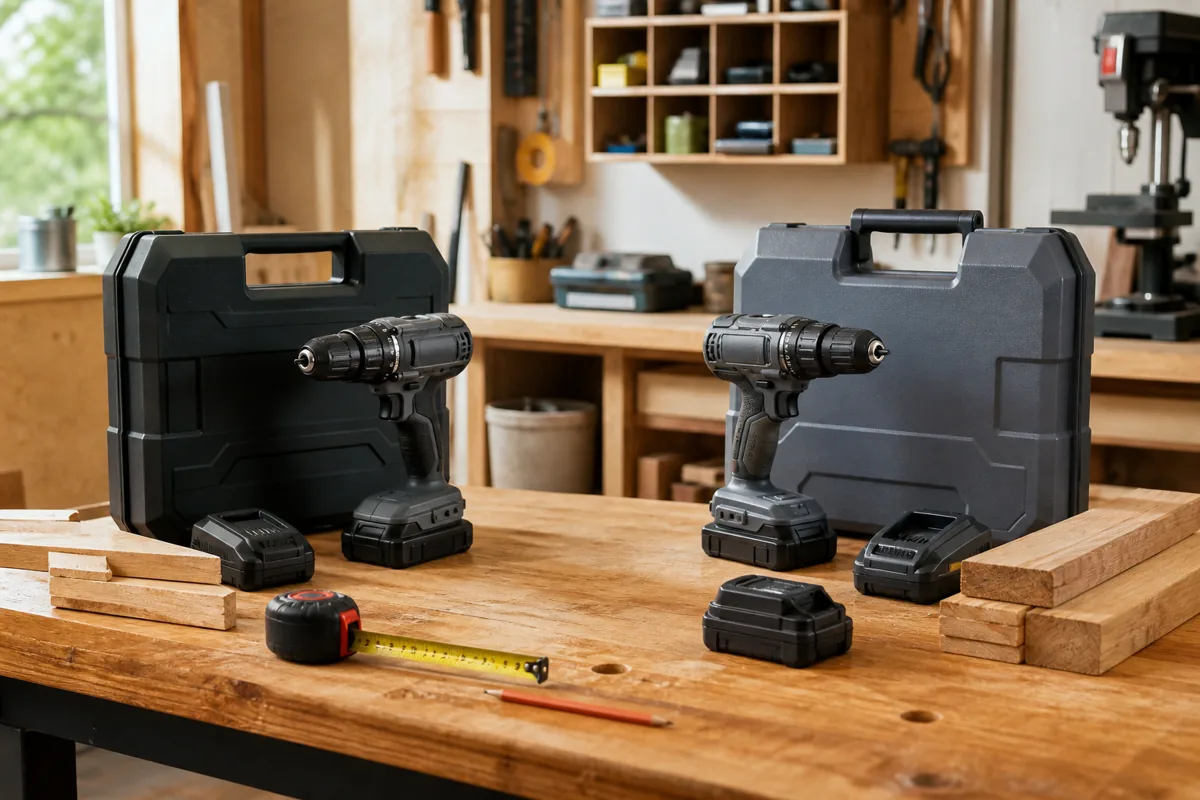
5Ah vs 8Ah battery: side by side
| Factor | 5Ah pack | 8Ah pack |
|---|---|---|
| Design intent | All-round pack for drills, drivers and mid-size saws | High-draw and long-run work |
| Weight on the tool | Around a pound and a half | Commonly past two pounds |
| Under heavy load | Good, but sags sooner | Holds speed and runs cooler |
| Charge time | Reasonable on any charger | Slow unless you own a rapid charger |
| Warranty | Platform terms, usually 2 to 3 years | Identical platform terms |
| Availability | Everywhere, in kits and two-packs | Thinner stock, often sold bare |
| Price behavior | Heavily promoted and bundled | Premium listing, rarely discounted |
| Air travel | Under the 100Wh carry-on limit | Over 100Wh, needs airline approval |
| Best for | Most DIY and general trade work | Framing, grinding, breaking, yard tools |
What actually changes between the two
Capacity is the least interesting difference. An 8Ah pack holds about 1.6 times the amp-hours, so on a low-draw tool like a drill you get roughly 1.6 times the work. On high-draw tools the gap widens, because high-capacity packs are usually built from higher-current cells with more headroom, so voltage sags less and the tool holds speed. That shows up as faster cuts and fewer thermal cutouts, not just more cuts per charge.
Weight is the price you pay. Mid-size packs generally land around a pound and a half while high-capacity packs commonly run past two pounds, the difference between a drill that stands on the bench and one that tips over. Height matters too, since a tall pack changes what you can reach into inside a joist bay. A bigger pack also takes longer to fill, so on the slow charger from your kit, a battery upgrade quietly becomes a charger problem.
When a 5Ah pack is still the right default
If your heaviest cordless tool is a drill, an impact driver, an oscillating multi-tool or a compact recip saw, the mid-size pack is the answer and the savings belong in a second one. Two packs mean you are always working while something charges, which beats one large pack on most real jobs. This is also the platform’s volume seller, so it turns up in kits, two-packs and free-battery promotions, which makes its street price behave very differently from its list price.
Mid-size 5Ah battery two-pack
Buy these in pairs rather than one at a time, since swapping beats waiting. Two-packs are also the listing most likely to be discounted. Confirm it is a first-party pack for your brand before checkout.
When 8Ah earns the extra weight
High-draw tools are the whole argument. Circular saws, angle grinders, rotary hammers, cut-off tools, chainsaws, blowers and mowers all punish small packs, and most of them are two-handed tools where the extra weight is carried by the tool rather than your wrist. The same logic covers any job where swapping is expensive: on a roof, in a lift, up a ladder, or on a site with no power at all.
- ✔ Holds voltage under heavy load
- ✔ Fewer swaps and less downtime mid-job
- ✔ Runs cooler, so fewer thermal cutouts
- ✔ Better cost per amp-hour at list price
- ✘ Noticeably heavier and taller on the tool
- ✘ Long charge times on stock chargers
- ✘ Rarely discounted or bundled
- ✘ Over the 100Wh limit for easy air travel
High-output 8Ah battery for demanding tools
Worth the money if you own a cordless circular saw, grinder, rotary hammer or a yard tool you run hard. Skip it if your heaviest tool is a drill, because you will pay for weight you never cash in.
Design philosophy differs more than capacity does
Brands disagree about what a big pack is for. DeWalt splits it three ways: compact pouch-cell packs for balance, mid-capacity XR packs for general work, and high-capacity or FlexVolt packs for the tools that demand them. Milwaukee’s FUEL and High Output tiering is about current delivery and heat as much as raw capacity, which is why the big packs are aimed at grinders and breakers rather than drills. Makita kept mid-size LXT packs central and answered heavy tools with twin-18V designs and the 40V XGT line. On value platforms the large pack is often the cheapest route to real power. Compare within your own platform, because that tiering tells you which size the brand expects you to buy.
Warranty, availability and price behavior
Warranty is not a tiebreaker. Battery coverage typically runs two to three years depending on the brand, it is often shorter than the tool warranty, and the terms are identical whether you buy the small pack or the big one. Availability is the real difference: mid-size packs are stocked deep and bundled constantly, while high-capacity packs are thinner on the shelf, usually sold as a single bare pack, and sometimes only sensible to buy inside a kit. Cost per amp-hour favors the big pack at list price and loses once you count how often the mid-size pack is discounted or given away with a tool.
One warning applies to both sizes: skip the no-name replacement packs. Cell quality and battery management are exactly where a cheap pack cuts corners, tool warranties generally exclude damage caused by third-party batteries, and the failure mode is fire.
Rapid or dual-port charger for your platform
This is the upgrade most people should buy before a bigger battery. Shortening the gap between packs is what actually keeps work moving, and it matters more the larger your packs get.
5Ah vs 8Ah battery FAQ
Does an 8Ah battery make my tool more powerful? Not in the sense of changing the motor, but on high-draw tools it can feel that way, because larger packs sag less under load and reach their thermal limits later. On a drill or impact driver you will notice little beyond the added weight.
Will an 8Ah pack fit my existing tools and charger? Electrically yes, on the same platform and voltage. Check physically, because tall packs can foul tool boots, tight framing bays and molded cases, and an older charger will fill a large pack far more slowly.
Can I fly with either pack? A 5Ah 18V or 20V max pack sits under the 100 watt-hour carry-on threshold and travels like a laptop battery, in your carry-on with the terminals protected. An 8Ah pack in the same voltage class lands in the 101 to 160 watt-hour band, which needs airline approval first. Check current TSA and airline guidance before you pack.
The verdict
Decide by your heaviest tool, not by the spec sheet. If your work is drilling, driving and light cutting, two mid-size packs beat one large pack nearly every time. If a saw, grinder, breaker or yard tool sets the pace, add one high-capacity pack and keep the mid-size packs for everything else. Then check what your platform stocks, because bundles move the value here more than capacity numbers do.
Check prices on Amazon →