What's inside
As an Amazon Associate I earn from qualifying purchases. This post may contain affiliate links at no extra cost to you.
What Restart Control Actually Means
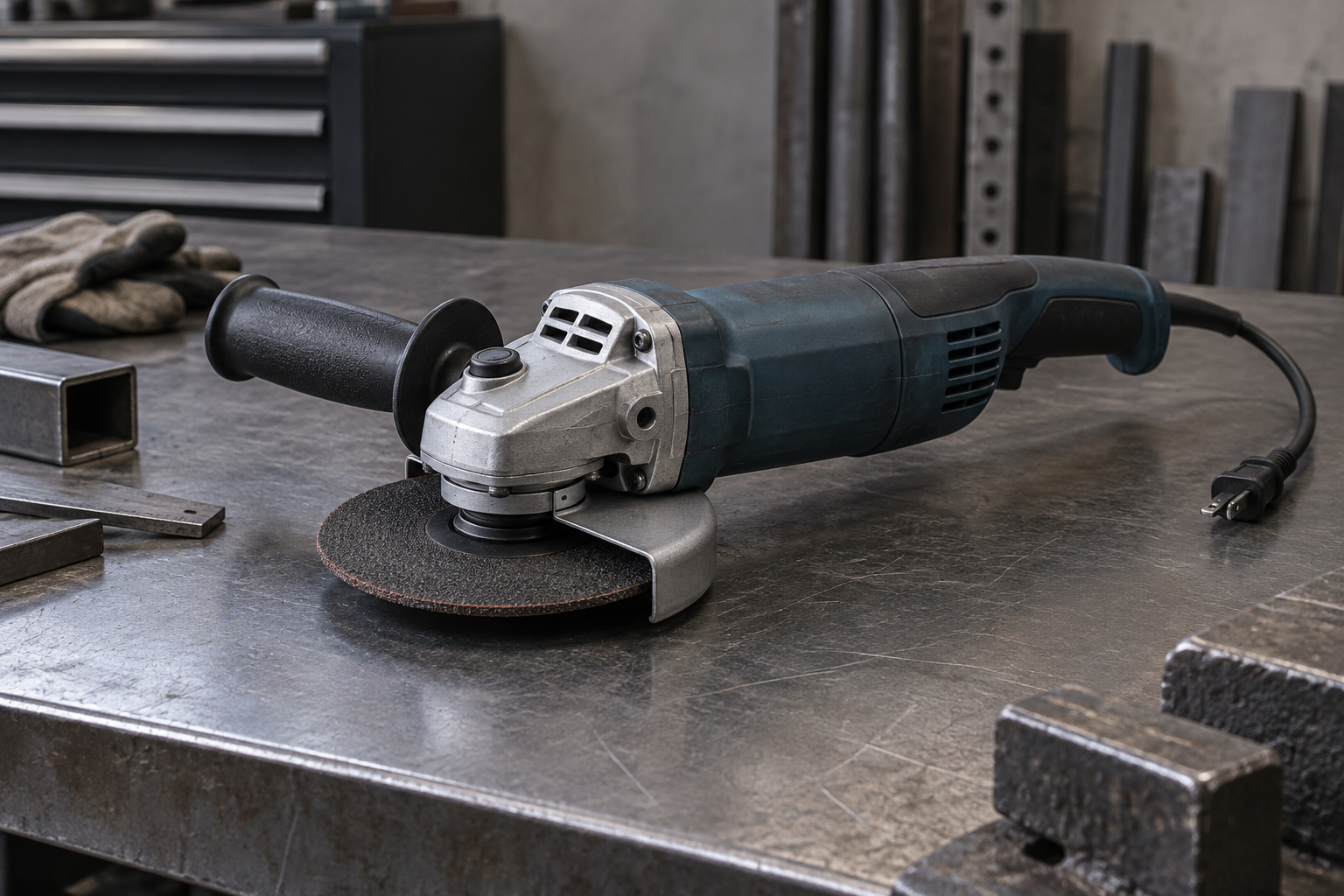
Restart control on an angle grinder is not about comfort. It is about what happens after a power interruption. If you are cutting rebar and someone trips a breaker, or your extension cord pulls loose, or the power flickers for half a second, a grinder without restart protection will spin back up at full speed the instant power returns. If it is sitting on the floor or still against the workpiece, that is a serious hazard.
Manufacturers use a few different terms for the same core feature: no-volt release, anti-restart, restart protection, or zero-volt switch. Under UL and IEC standards, a grinder with this protection must not restart after a power loss until the user manually cycles the switch off and then on again. A grinder without it will restart automatically if the switch was left in the ON position.
As an Amazon Associate we earn from qualifying purchases at no extra cost to you.


Both paddle and trigger grinders can have this protection, but they implement it differently, and the switch type changes how likely you are to defeat it or get caught out by it in real work.
How a Paddle Switch Works
A paddle switch (also called a dead-man paddle) runs along the underside of the grinder body. You grip the tool and press the long lever in with your palm to run it. Release pressure and a spring pushes the paddle out, cutting power. Most paddle grinders also have a small slide or button lock-on for extended grinding, but you have to deliberately engage it.
From a restart-control standpoint, the paddle is inherently a momentary switch. Its default state is OFF. This is why OSHA and many job sites prefer it. If you drop the grinder, get startled, or lose power, you instinctively release your grip and the tool stops. It cannot restart until you intentionally squeeze again.
The trade-off is that paddle switches are more exposed to dust and grit. The long lever rides in a slot that can pack with metal dust, concrete slurry, or wood dust. When that slot gums up, two failure modes appear: the paddle sticks ON, or it becomes stiff and fails to make consistent contact, which can cause intermittent power. A quick blast with compressed air and a wipe-down of the pivot usually fixes it, but it is a maintenance item you do not get with a sealed trigger. The spring itself is also a wear point. After 2-3 years of daily site use, the return spring weakens, so the dead-man action feels mushy and may not snap off crisply.
How a Trigger Switch Works
A trigger switch sits where you would expect on a drill: a finger-operated trigger near the head of the grinder, often with a separate lock-on button on the side and a lock-off lever you must depress first. To start, you press the lock-off, then pull the trigger. Some models require you to hold the lock-off continuously. Others use a two-stage trigger where you slide forward then pull.
Trigger grinders rely on electronic restart protection rather than pure mechanics. Inside, a small circuit board monitors voltage. If voltage drops to zero and then returns while the trigger is still held, the board blocks power to the motor until you fully release and re-pull the trigger. This works well when it works, but it adds an electronic failure point. If that board fails due to moisture, vibration, or a voltage spike from a generator, you can lose restart protection without any visible warning. The grinder will still run, it just will not protect you.
The trigger’s advantage is ergonomics and sealing. It is easier to feather for short tack welds or cutoff bursts, and the housing is generally better sealed against dust than a paddle slot. For overhead work or tight spaces where you cannot get a full palm grip, a trigger gives you more control with one or two fingers. The downside is that a trigger with a lock-on button can be left locked ON. If a worker tapes the lock-off down or holds the trigger with a zip tie for continuous grinding — a common shortcut on long weld cleanup — you have completely defeated both the ergonomics and the restart protection.
Head-to-Head: Restart and Safety Comparison
| Feature | Paddle Switch | Trigger Switch |
|---|---|---|
| Default Power State | Momentary OFF, spring-return | Momentary OFF, spring-return + electronic latch |
| Method of Restart Protection | Mechanical – must re-squeeze paddle | Electronic – board blocks restart until trigger is cycled |
| Protection If Switch Is Locked On | Only protected if lock-on is not engaged; most paddles auto-release lock when power is lost | Protected only if electronics are functional; lock-on must be cycled after power loss on good models |
| Behavior After Power Interruption | Stays off even without electronics | Stays off only if anti-restart circuit is intact |
| Common Defeat / Failure Mode | Grit-packed paddle sticks, weak return spring | Board failure from dust/moisture, user locking trigger on |
| Best For | Site work, crews, anyone prioritizing drop safety | Controlled shop work, overhead or one-handed cuts |
In testing and field reports, a mechanical paddle fails safer. Even if the electronics die completely, the paddle still requires a deliberate human action to restart. A trigger is dependent on that small anti-restart board. In budget grinders under $60, that board is often the first thing to go, particularly when run on a generator with dirty power or after the tool has sucked in a lot of steel dust.
That does not mean all paddle grinders are automatically compliant. Older or ultra-cheap paddle grinders may use a simple sliding ON/OFF switch disguised as a paddle, with no true dead-man action. If the paddle clicks and stays in, it is not a dead-man switch. Look for language like “no-volt release switch” or “anti-restart protection” on the spec sheet, not just “paddle switch.”
Lock-On, Lock-Off, and Real-World Hazards
This is where most injuries happen, regardless of switch type. Both styles offer a lock-on for long grinding sessions to reduce hand fatigue. On a quality paddle grinder, the lock-on is designed to trip off if power is interrupted. You still need to re-engage the paddle. On many trigger grinders, especially older designs, the mechanical lock-on stays physically engaged through a power outage, and only the electronic circuit prevents a restart. If that circuit is compromised, the grinder restarts locked on.
Another difference is accidental starting. A paddle requires a full-hand squeeze, so bumping it in a toolbox rarely starts it. A trigger can be snagged by a cord, glove, or tool bag strap. That is why most trigger grinders now add a lock-off lever. It helps, but it also adds a step that workers get annoyed by and often modify.
If you work alone, on a ladder, or with the grinder above shoulder height, the dead-man release of a paddle is a clear advantage. If the disc binds and kicks, your hand opens reflexively and the tool stops. With a trigger, especially with a lock-on engaged, the tool can keep running during a kickback.
Which Should You Buy?
For general contracting, site work, or any situation where multiple people share tools or power is unreliable, buy a paddle switch grinder with stated anti-restart protection. The mechanical dead-man gives you a second layer that does not depend on a circuit board. If you do a lot of concrete cutting or metal grinding where dust is heavy, you will need to clean the paddle slot regularly, but that is a better trade than relying solely on electronics. A mid-range paddle switch angle grinder with restart protection from a major brand will have both the spring-return and the electronic no-volt release working together.
A trigger switch makes sense if you do short, precise work in a shop with stable power — spot welds, auto body, tile notching — and you value trigger feathering over drop safety. Choose a model that explicitly lists a two-stage trigger with lock-off and anti-restart, not just a simple lock-on trigger. If you have to choose a budget option for occasional home use and you will never use the lock-on, a basic trigger switch angle grinder with anti-restart is fine and often $15 to $30 cheaper than a comparable paddle model.
Do not pay extra for “restart protection” on a grinder that will be run on a generator without checking the fine print. Some budget grinders list “overload protection” but not “restart protection” — they are not the same. Overload protects the motor from overheating. Restart protects you from an unexpected spin-up. If the spec sheet does not clearly say anti-restart, no-volt, or zero-volt, assume it does not have it.
Whichever style you choose, test the protection the day you buy it. With the disc removed, start the grinder, then unplug it while holding the switch on, then plug it back in. If it spins back up without you releasing and re-engaging the switch, return it. That test takes 30 seconds and tells you more than any marketing claim.