What's inside
As an Amazon Associate I earn from qualifying purchases. This post may contain affiliate links at no extra cost to you.
The Ridgid HD0318 has the stronger published suction figure: 80 inches of water lift, compared with 65 inches for the DeWalt DCV581H. That gives the Ridgid an advantage for pulling water through a hose or lifting heavier debris. But suction is only one part of a portable vac’s performance. The DeWalt can run on a battery or AC power, while the Ridgid is a corded 3-gallon vac. Which one is better depends on whether you need more pull or more freedom from an outlet.
As an Amazon Associate we earn from qualifying purchases at no extra cost to you.

Our Top Picks


Key specifications compared
| Feature | DeWalt DCV581H | Ridgid HD0318 |
|---|---|---|
| Published suction | 65 inches of water lift | 80 inches of water lift |
| Capacity | 2 gallons | 3 gallons |
| Power | 20V battery or AC adapter | Corded AC |
| Hose | About 5 feet | About 4 feet |
| Wet pickup | Yes | Yes |
Published specifications can vary slightly by listing or revision, so check the manual for the exact configuration you’re buying. Water lift measures how much resistance a vac can overcome; it is not the same as airflow, usually listed in cubic feet per minute. A higher water-lift number is useful for demanding pickup, but does not guarantee faster cleanup across every surface.
Which has better suction?
On the numbers, the Ridgid HD0318 wins. Its 80-inch water-lift rating is about 23 percent higher than the DeWalt’s 65 inches. That extra margin can help when extracting water from a low spot, lifting heavier grit, or working through a hose and nozzle that add resistance.
In practice, hose length, filter condition, nozzle shape and leaks all affect what reaches the floor. A clogged filter can erase the advantage of a higher rating. So can a loose hose connection. For fine dust, use the appropriate filter and keep it clean; for wet pickup, remove or change the filter as directed by the manual. A wet filter left in place after liquid pickup can restrict airflow and make the vac seem weak.
The DeWalt’s lower rating is still adequate for routine portable cleanup: sawdust, small spills, vehicle interiors and workbench debris. If you mostly need a compact vac for occasional jobs, the difference may not justify choosing around suction alone.
Battery convenience versus continuous power
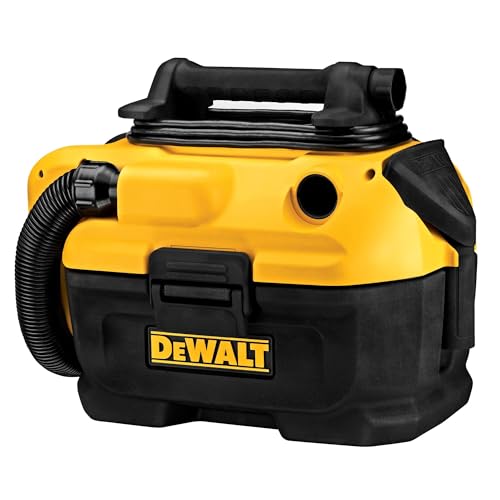
The DCV581H is the more flexible machine. It can run from a compatible 20V battery or from its AC adapter, so it works in a vehicle, on a jobsite without convenient outlets, or in a garage. Battery operation is handy for short cleanups, but runtime depends on battery capacity, the material being picked up and how often the vac is running. A small pack can run down quickly during an extended cleanup, and a battery is an added cost if you do not already own compatible DeWalt batteries.
The HD0318 has no battery-runtime limit. Plug it in and it can keep working as long as the job and outlet allow. The trade-off is an extension cord or a nearby receptacle, which can be awkward around vehicles and outdoor work. Its 3-gallon tank also means less frequent emptying than the DeWalt’s 2-gallon tank, though neither is intended to replace a full-size shop vac for large volumes of water or long cleanup sessions.
Hose, capacity and everyday handling
Both are small wet-dry vacs, not high-capacity extractors. The Ridgid’s extra gallon matters when collecting damp debris or several small spills before emptying. A full tank gets heavier and harder to carry, so empty it before moving it far. The DeWalt’s smaller tank is easier to manage when portability matters, but it fills sooner.
The DeWalt’s roughly 5-foot hose gives it a reach advantage over the Ridgid’s roughly 4-foot hose. That extra foot can reduce how often you reposition the vac when cleaning a car or a work area. Neither hose is especially long, and a short hose can be frustrating when the machine has to stay outside a vehicle or below a workbench. Check the included attachments and hose compatibility if you already own accessories; fitting sizes are not universal.
Which one should you buy?
| Need | Better fit | Reason |
|---|---|---|
| Higher published suction and larger tank | Ridgid HD0318 | 80-inch water lift and 3-gallon capacity |
| Use away from outlets | DeWalt DCV581H | Can operate on a compatible battery |
| Long cleanup without swapping batteries | Ridgid HD0318 | Corded operation has no battery runtime limit |
| Short, occasional cleanup on a tight budget | Either, depending on price | The DeWalt’s lower suction may be enough; the Ridgid’s cord may be acceptable |
Choose the Ridgid HD0318 if suction is your priority and you can work near an outlet. It is the stronger pick for repeated wet pickup and heavier debris, provided you keep the filter and hose clear.
Choose the DeWalt DCV581H if cordless operation will save time or let you reach places a cord cannot. It is also a sensible buy if you already have compatible batteries and expect short cleanup jobs rather than sustained water removal.
Before you put either to work
For a wet mess, follow the manual’s instructions on filter setup and maximum liquid level; overfilling can send liquid toward the motor. For fine drywall or other very fine dust, use a suitable filter and consider whether a small vac is the right tool at all, since filters can clog rapidly and performance drops. If you routinely clean large spills, long runs of debris or a whole workshop, step up to a larger shop vac rather than expecting either portable unit to do that job comfortably.