What's inside
As an Amazon Associate I earn from qualifying purchases. This post may contain affiliate links at no extra cost to you.
The best GPS dog fences in 2026 for most properties are the SpotOn GPS Fence for large and wooded acreage, the Halo Collar 4 for customizable boundaries with training guidance, and the PetSafe Guardian GPS for smaller suburban lots on a mid-range budget, because boundary precision, battery life, and collar fit matter more than maximum advertised acreage.
GPS containment does not create a physical barrier. It uses satellite positioning and correction feedback (tone, vibration, static) to keep a dog inside a virtual boundary you draw in an app. Performance depends entirely on GPS accuracy, collar fit, and how consistently the dog is trained to understand the boundary. Choosing by property type prevents the two most common failures: false corrections from GPS drift on small lots, and dead batteries on large properties.
As an Amazon Associate we earn from qualifying purchases at no extra cost to you.


Our Top Picks
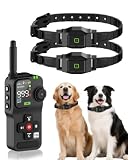
 PetSafe Guardian GPS 2.0 Dog Fence + TrackingOne Size4.2 x 3.4 x 1.4 Inches0.29 PoundsCheck on Amazon


How GPS Dog Fences Compare on What Actually Matters
Marketing often highlights maximum acres, but containment reliability comes from how tight the boundary precision is, how the system handles tree cover and terrain, and how long the collar actually lasts between charges under real use.
| System / Type | Max Boundary Size | Stated GPS Precision | Terrain Handling | Collar Weight & Fit | Battery Life (Active Containment) | Subscription Required |
|---|---|---|---|---|---|---|
| SpotOn GPS Fence | Up to 1,000+ acres per fence, unlimited saved fences | ~3-10 feet with True Location GPS | Best for dense tree cover and rolling terrain; patented forest mode | Approx. 282g (10 oz), neck sizes 10-26 inches | 14-22 hours containment, 30+ hours tracking only | Optional for enhanced tracking, not required for containment |
| Halo Collar 4 | Up to 1,000+ acres, 20+ fences stored | ~5-10 feet with GNSS + proprietary feedback | Good in open to moderately wooded terrain; struggles under heavy canopy or in steep ravines | Approx. 95g (3.35 oz) collar module, fits 8-25 inch necks | 10-20 hours with full use, varies with feedback frequency | Required for GPS fences and training content |
| PetSafe Guardian GPS + Tracking | Up to ~600 acres per boundary | ~8-10 feet, AccuGuard technology | Best in open, flat to gently sloped terrain; limited in dense forest or deep valleys | Approx. 113g (4 oz), fits necks 8-26 inches | 24-72 hours depending on containment vs. tracking mode | Required |
| Wagz Freedom Smart Fence | Up to 1,000+ acres | ~7-10 feet | Geared for open properties and subdivisions; needs strong cellular and GPS line-of-sight | Approx. 170g (6 oz), fits necks 11-25 inches | 12-24 hours containment, charging pad required | Required |
All four use GPS/GNSS plus cellular or Bluetooth to draw boundaries in an app. No consumer GPS fence is accurate to inches. Expect 3 to 10 feet of drift even in good conditions, which is why manufacturers recommend a minimum property size of 0.5 acre and a boundary buffer of at least 10-15 feet from roads or hazards.
Best Picks by Property Type
1. Best for Large Acreage and Wooded Properties: SpotOn GPS Fence
SpotOn is the most property-agnostic system because it does not rely on cellular to maintain the fence. Once you walk or draw the boundary, it is stored on the collar itself. That makes it the most reliable option for 5 to 1,000+ acre farms, heavily wooded lots, and properties with spotty cell service.
- Why it works for this terrain: Its dual-antenna and forest-optimized GPS is designed to hold position under tree canopy where single-antenna collars tend to wander. It also allows overlapping fences and exclusion zones to block ponds, barns, or gardens.
- Trade-offs: It is the heaviest and most expensive type, typically in the premium market range, and fit can be bulky on dogs under 20 pounds. Battery must be charged daily if containment is left on continuously.
- Best for: Owners with 2+ acres, mixed woods and pasture, or multiple non-rectangular boundaries.
2. Best for Custom Boundaries and Training Support: Halo Collar 4
Halo focuses on precision boundary creation and built-in training. You can draw fences with your finger, set warning and encouragement feedback zones, and access video training from Cesar Millan-based programs. It combines GPS with activity and health tracking.
- Why it works for varied properties: The ability to set 3 types of feedback zones (sound, vibration, static) and adjust their width is useful for irregularly shaped suburban-to-rural lots where you need to shape the dog’s approach to the boundary.
- Trade-offs: Requires a subscription to use fences, needs regular charging, and is sensitive to fit. The lightweight module must sit high and snug on the neck with consistent contact, which can be difficult on very thick-coated breeds without proper sizing.
- Best for: First-time GPS fence users who want guided training and have 0.5 to 50 acres with moderate tree cover.
3. Best for Suburban and Small Properties: PetSafe Guardian GPS
PetSafe is designed for smaller, open properties where simplicity and battery life matter more than forest performance. Its minimum lot recommendation is more forgiving than most, and its battery lasts longest when used intermittently.
- Why it works for this terrain: On open, flat half-acre to 5-acre lots with clear sky view, its accuracy is sufficient and setup takes minutes. Longer battery life in tracking-only mode means you can use it for walks and then activate containment at home.
- Trade-offs: Not ideal for dense woods, steep hillsides, or properties with narrow corridors between boundary and street. You need a 10-15 foot setback from any hazard because drift is more pronounced near houses and fences.
- Best for: Suburban homes, HOA lots, and open parcels where cellular coverage is strong and boundaries are simple rectangles or ovals.
4. Alternative for Open Lots With Smart Home Integration: Wagz Freedom
Wagz operates more like a smart collar ecosystem with geofence containment plus doorbell and wellness integrations. It is suitable if your property is open, you want app-based boundary adjustments without walking the line, and you prefer a charging pad over a plug-in cable.
- Consider before buying: It requires good GPS and LTE-M coverage to hold boundaries. Review return policies carefully, as performance is highly location dependent.
Decision Matrix: Match Your Situation to the Right Type
| Your Situation | Recommended Approach | Why |
|---|---|---|
| Under 0.5 acre, or boundary within 15 feet of a road | Avoid GPS-only; consider wired underground fence or physical fence | GPS drift of 5-10 feet risks corrections on the wrong side of the line or inconsistent containment |
| 0.5 – 2 acres, open and flat, strong cell signal | PetSafe Guardian GPS or Wagz Freedom type | Sufficient accuracy, longest effective battery, lower cost of ownership |
| 2 – 20 acres, mix of open and wooded | Halo Collar 4 or SpotOn GPS Fence | Better precision under partial canopy and more flexible fence shapes and exclusion zones |
| 20+ acres, dense woods, hills, or off-grid | SpotOn GPS Fence | Stores fence on collar without needing cell service to stay active |
| Dog under 25 pounds or thick double coat | Lightest module with correct contact points (Halo or PetSafe) | Heavy collars cause neck fatigue and poor contact leads to inconsistent feedback |
| Need to move fences seasonally (pasture rotation, lake home) | Any GPS system with multiple saved fences | Portability is the core advantage over wired systems |
Coverage and Battery: A Worked Calculation
Maximum acreage is misleading because you must keep a buffer. For a square 1-acre lot (208 x 208 feet), if you pull the boundary 15 feet in from every property line to account for GPS drift, your usable containment area becomes 178 x 178 feet, or 0.73 acres. That is a 27% reduction before you add house and driveway setbacks.
Battery life is also property dependent. Manufacturers list battery life in hours of containment, but active GPS fixes drain faster when the dog moves or when the collar is searching for satellites under trees.
- Example: A collar rated for 20 hours in open terrain may deliver 10-12 hours in dense woods with the dog patrolling the boundary frequently. For daily use, plan to charge every night regardless of the advertised range.
- Cost of operation: Most GPS fences require a cellular/data plan typically in the general market range of $5 to $30 per month after the first year. Factor this into total ownership cost alongside replacement contact points and straps.
Collar Fit, Training, and Durability Realities
Collar Fit Is Containment
An improperly fitted GPS collar will fail no matter how accurate the satellites are. The contact points must touch skin, not just fur, and the module should sit high on the neck, just behind the ears, not hanging like a loose necklace. You should be able to slide one finger snugly under the strap, no more. For long-haired breeds, longer contact points are required, and the fit should be checked as the coat changes seasonally. Rotate the collar position every few hours and inspect for pressure sores, especially in the first two weeks.
Training Required for Reliable Containment
No GPS fence is plug-and-play. Dogs do not instinctively understand tones or vibrations as boundaries. Reliable containment requires 2 to 4 weeks of structured training, typically 10 to 15 minutes twice daily:
- Phase 1 (Days 1-7): Leash walks to the warning tone zone, then retreat and reward inside the safe area. No corrections beyond tone/vibration.
- Phase 2 (Days 8-14): Introduce higher-level feedback at the boundary only if the dog pushes past the warning zone, immediately guiding back and rewarding.
- Phase 3 (Days 15-28): Off-leash supervised sessions with distractions. Gradually increase duration before trusting unsupervised time.
If the dog is fearful, highly prey-driven, or has a history of barrier frustration, consult a professional trainer or veterinary behaviorist before using static correction. Some dogs do better with tone and vibration only.
What Wears First and Common Mistakes
GPS collars are electronics worn outdoors. The first failure points are charging ports and contact points corroded by moisture and skin oils, followed by strap fraying at the buckle. Rinse the collar with fresh water after swimming, dry the contact points daily, and clean them with mild soap weekly. Do not leave the collar on 24 hours a day, and never attach a leash to the GPS collar itself.
Three common mistakes that cause escapes: setting the boundary too close to the road without a buffer, leaving the collar loose so the dog feels inconsistent feedback, and skipping training and relying on correction alone. In winter, battery capacity drops 10-20% in freezing temperatures, so shorten containment sessions or charge mid-day.
Buying Checklist Before You Commit
- Map your property in the app first with satellite view. If you cannot achieve a 15-foot buffer from all hazards, GPS may not be suitable.
- Verify cellular coverage at your home with the carrier the collar uses, not just your phone carrier.
- Weigh your dog and measure neck circumference. If the collar is more than 5% of body weight, it will affect comfort and compliance.
- Confirm subscription cost and what happens to fences if you cancel. SpotOn type systems retain fences on-collar, others disable GPS boundaries without an active plan.
- Budget for replacement straps, contact points, and a second charger for daily charging.
FAQ
Will a GPS fence work under heavy trees or next to a metal building?
Accuracy degrades under dense canopy, inside metal barns, and next to tall buildings that reflect GPS signals. Systems with dual antennas and forest modes hold better, but if your dog spends time under heavy cover near the boundary edge, expect wider drift and occasional false alerts. Test boundary tones on foot with the collar in your hand before training the dog.
Can I use a GPS fence for a puppy?
Most manufacturers recommend waiting until at least 6 months of age and after basic recall training is started. The collar must fit properly, which is difficult on very small, growing necks. Ask your veterinarian about timing for your breed and size.
Does a GPS fence keep other animals out?
No. It only contains the dog wearing the collar. It will not prevent wildlife, stray dogs, or people from entering your property. For properties with predator pressure or frequent visitors, a physical fence is still needed.