As an Amazon Associate I earn from qualifying purchases. This post may contain affiliate links at no extra cost to you.
A garden tiller solves a deceptively narrow problem: turning compacted, weed-choked soil into something you can actually plant in. The good machines do this without stalling on rocks, without leaving your wrists numb after ten minutes, and without costing more than a season’s worth of vegetables. The bad ones are either so underpowered they churn topsoil into mud without reaching the hardpan beneath, or so overbuilt they make a raised bed feel like tilling a football field.
We compared the eight best-selling options on published specs, street prices, and recurring themes in owner feedback. What separates a worthwhile tiller from a disappointment usually comes down to three things: how deep and wide its tines actually cut relative to stated numbers, how much torque survives a stretch of clay or root-tangled ground, and whether the power source matches the job size. This roundup treats corded electrics, battery models, gas walk-behinds, and manual cultivators as distinct categories and picks winners within each, so you can match the tool to your plot without overspending or underbuying.
As an Amazon Associate we earn from qualifying purchases at no extra cost to you. Product prices and availability are accurate as of the date shown and are subject to change.


Quick Picks
| Product | Best for | Price |
|---|---|---|
| LawnMaster TE1216M | Mid-size beds on a tight budget | $103.99 |
| Sun Joe TJ604E | Reliable corded tilling with steel durability | $149.99 |
| 4 Stroke Gas Tiller (1.5KW) | Small plots with no outlet nearby | $215.99 |
| Sun Joe TJ603E | Light annual cultivation in smaller beds | $139.99 |
| SOARFLY Cordless Tiller | Raised beds and spot work without cord anxiety | $69.98 |
| LawnMaster TE1318M | Widest corded coverage under $150 | $132.98 |
| EARTHQUAKE Victory | Breaking new ground and large areas fast | $799.99 |
| Jardineer Hand Tiller | Flower boxes, pots, and tiny patches | $28.99 |
How We Picked
We weighted four factors: tine width and depth relative to motor or engine displacement (does the power match the cut?), build quality of the tine steel and frame (will it survive a season of stones?), operator comfort and weight (how long before fatigue sets in?), and value within its power class. We also flagged recurring owner complaints about stalling, overheating, and premature tine wear because those patterns predict real-world durability better than any spec sheet alone.
The 8 Best Garden Tiller in 2026
LawnMaster TE1216M Electric Tiller 12-Amp, 16-Inch
Owners with established beds that get compacted each winter call this the sweet spot between price and coverage. The twelve-amp motor drives a sixteen-inch cutting path, which is wide enough to work a standard four-by-eight bed in two passes.
- Sixteen-inch width is generous for a corded electric at this price tier.
- Sturdy folding handle eases storage in a garage corner.
- Corded power means you need an extension cord that can handle twelve amps without voltage sag.
Skip this if your soil has never been tilled before; the motor is adequate for annual loosening, not virgin ground.
Sun Joe Corded Electric Garden Tiller & Cultivator, TJ604E
The TJ604E has built a reputation as the dependable mid-range corded pick. Steel tines hold their edge longer than the softer alternatives on some competitors, and Sun Joe’s parts availability means a broken shear pin is a ten-dollar fix rather than a death sentence for the machine.
- Hardened steel tines resist bending around buried debris.
- Well-supported aftermarket with widely available replacement parts.
- Heavier than the TJ603E, which matters if you work sloped ground.
Pass on this if your plot is under two hundred square feet; you are paying for width and depth you will never use.
4 Stroke Gas Tiller Cultivator, 1.5KW Heavy Duty
For small suburban yards without convenient outlets, this four-stroke gas unit delivers cordless freedom at a fraction of the price of larger machines. The 1.5-kilowatt rating puts it in a middle weight class—more grunt than any corded electric here, far less than a rear-tine tiller.
- Four-stroke engine means no oil-and-gas mixing and easier cold starts.
- Good torque for breaking compacted topsoil in areas under one thousand square feet.
- Assembly out of the box requires basic mechanical comfort; instructions assume prior familiarity.
Not ideal if you need to store the machine for months between uses; four-stroke engines can gum up without regular exercise.
Sun Joe Corded Electric Garden Tiller & Cultivator, TJ603E
The TJ603E is the lighter, narrower sibling of the TJ604E, and owners consistently recommend it for annual spring refresh of already-worked beds. It costs less, weighs less, and handles the job most hobby gardeners actually need—loosening a few inches of soil before setting transplants.
- Lower weight reduces arm fatigue during extended sessions.
- Folds compactly for shelf storage in tight spaces.
- Cutting width and depth are the smallest in Sun Joe’s electric lineup; too modest for new ground.
Skip this if you have clay-heavy soil that resists penetration; you will want the extra power of the TJ604E or better.
SOARFLY Cordless Tiller Cultivator 9-Inch Width, 6.6-Inch Depth
This is the best garden tiller for people who genuinely dread dragging an extension cord. Two four-amp-hour batteries and a nine-inch cutting width make it a natural fit for raised beds, narrow pathways, and patch repairs. Owners report solid runtimes for the size.
- Truly cordless; no outlet or extension cord logistics.
- Light enough to maneuver between closely spaced rows.
- Nine-inch width means more passes over larger areas; runtime drops noticeably in dense or wet soil.
Not the right call if your working area exceeds a few hundred square feet of open ground; the small footprint becomes tedious.
LawnMaster 13.5 Amp 18-Inch Electric Tiller, TE1318M
Eighteen inches of cutting width from a thirteen-and-a-half-amp motor puts this at the top of what corded electric tillers can physically deliver. Owners upgrading from twelve-amp units notice the difference on the first pass—fewer overlapping strips, faster coverage.
- Widest corded option under $150, meaning fewer passes per bed.
- Thirteen-and-a-half-amp motor provides noticeably more torque than twelve-amp peers.
- Requires a heavier-gauge extension cord; thin cords will stall it under load.
Skip if your beds are narrow or your storage space is limited; the eighteen-inch body is physically larger and harder to stash.
EARTHQUAKE Victory Rear Tine Tiller, 209cc 4-Cycle Viper Engine
This is the serious option for breaking new ground, turning in cover crops, or working several thousand square feet in a single weekend. Counter-rotating tines and a bronze gear transmission give it the mechanical grip that electric machines simply cannot match. Instant reverse and pneumatic wheels make maneuvering a ninety-pound machine manageable.
- Two-hundred-nine-cc engine with counter-rotating tines handles untouched, root-heavy soil.
- Bronze gear transmission outlasts the aluminum alternatives common at lower prices.
- At roughly eight hundred dollars, it is an order of magnitude more expensive than the electric choices here.
Overkill for raised beds, annual bed refresh, or any area under two thousand square feet where an electric cultivator already does the job.
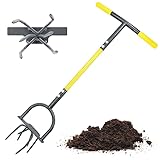
Jardineer Hand Tiller, Manual Twist Cultivator
No engine, no battery, no noise—just a heavy-duty claw you twist into the soil by hand. For flower boxes, window troughs, pots, and small raised beds, owners say this outperforms every motorized option at ten times the price because you can feel exactly what the tines are doing.
- Under thirty dollars and virtually indestructible.
- Perfect control for delicate transplant areas where a power tiller risks root damage.
- Physical effort scales with area; tilling even a modest forty-square-foot bed this way is back-breaking.
Do not buy this expecting to prepare open ground; it is a precision tool for confined spaces, not a tiller replacement.
Buying Guide
Match Power Source to Plot Size
Corded electric tillers like the LawnMaster TE1318M and Sun Joe TJ604E suit plots up to roughly fifteen hundred square feet if an outlet is reachable. Battery models such as the SOARFLY are best confined to raised beds and spot work under a few hundred square feet. Gas units—whether a compact 1.5KW four-stroke or a full-size rear-tine machine like the EARTHQUAKE Victory—make sense when you need power far from an outlet or you are breaking new ground that has never been cultivated.
Read Tine Width and Depth Together, Not Separately
A sixteen-inch cutting width is impressive only if the tines bite deep enough to break the compaction layer. Cross-check the stated width against the engine or motor rating: a twelve-amp unit driving sixteen inches of tines through wet clay will stall or underperform. The EARTHQUAKE Victory pairs its wide counter-rotating tines with a two-hundred-nine-cc engine for a reason. Look for owner reports about whether the machine maintains cutting depth in your soil type, not just on loose garden soil.
Weight and Ergonomics Determine How Long You Actually Garden
A light corded tiller you can steer comfortably is more useful than a powerful one you abandon after fifteen minutes. The Sun Joe TJ603E is noticeably easier on the wrists than the TJ604E. Rear-tine machines demand the most physical engagement despite helpful features like pneumatic wheels and instant reverse. If you have shoulder or back limitations, a cordless model like the SOARFLY or the Jardineer hand tool may be the practical choice regardless of raw power.
Our Verdict
The LawnMaster TE1318M is our top overall pick for most gardeners: eighteen-inch coverage, thirteen-and-a-half-amp power, and a price under $150 make it the best garden tiller for anyone tilling established beds season after season. The Jardineer Hand Tiller is the clear budget pick at $28.99, unbeatable for containers, flower boxes, and anyone who values control over speed. If your project is breaking new ground or turning in heavy cover crop, the EARTHQUAKE Victory wins on mechanical capability alone; no corded or battery model in this list can match its torque in compacted soil.
FAQ
Can an electric tiller handle clay soil?
Yes, but only if the clay is already broken and you are loosening it for planting. Clay that has not been worked before or that contains buried roots will stall most electric motors regardless of amp rating. For initial soil breakdown, a gas-powered unit like the 1.5KW four-stroke or the EARTHQUAKE Victory provides the necessary torque.
How long do batteries last on the SOARFLY cordless tiller?
Owners report completing a standard raised bed session on a single four-amp-hour charge, with the second battery extending workable runtime to roughly double. Run time drops in damp or dense soil because the motor draws more current under resistance.
Is a rear-tine tiller worth the price difference over a front-tine model?
For plots under two thousand square feet with soil that has been tilled before, a front-tine or electric cultivator is sufficient and saves significant money. Rear-tine machines like the EARTHQUAKE Victory justify their cost when you need counter-rotating bite on virgin, root-laced, or repeatedly compacted ground where smaller tines deflect rather than dig.
Do I need a special extension cord for a 13.5-amp tiller?
Yes. A thirteen-and-a-half-amp load on a long, thin cord causes voltage drop that reduces torque and can overheat the motor. Use a twelve-gauge or ten-gauge cord rated for outdoor use, and keep runs as short as practical to maintain full power delivery.