Key takeaways
- A neutral breakdown of palm sander vs orbital sander, covering sanding motion, finish quality, dust control, cost and which tool suits which job.
What's inside
As an Amazon Associate I earn from qualifying purchases. This post may contain affiliate links at no extra cost to you.
The confusion around palm sander vs orbital sander starts with the labels themselves. Retail listings, packaging and even manufacturer copy use the two terms loosely, and shoppers end up comparing a shape to a motion. A palm sander describes the form factor: a compact body you grip with one hand. Orbital describes how the pad moves. Plenty of tools are both at once, which is exactly why the aisle feels muddy.
In practical US retail terms, the comparison almost always comes down to two specific tools: the quarter-sheet finishing sander, commonly called a palm sander, and the random orbit sander that takes round hook-and-loop discs. Those two behave very differently on wood, cost different amounts, and suit different stages of a project. Below is how they line up before we get into the detail.
As an Amazon Associate we earn from qualifying purchases at no extra cost to you. Product prices and availability are accurate as of the date shown and are subject to change.



| Factor | Quarter-Sheet Palm Sander | Random Orbit Sander |
|---|---|---|
| Pad shape | Square or rectangular | Round, typically 5 inch |
| Motion | Small orbits in a fixed pattern | Orbit plus free pad rotation |
| Corner access | Reaches into inside corners | Cannot reach square corners |
| Swirl marks | Possible if you rush | Rarely visible when used correctly |
| Material removal | Light to moderate | Moderate to aggressive |
| Abrasive supply | Sheets, often cut to size | Pre-punched discs, widely stocked |
| Typical price band | Budget to mid | Budget to premium, wider spread |
| Best for | Trim, cabinet faces, tight spots | Tabletops, doors, panels, decks |
Palm Sander vs Orbital Sander: What the Motion Actually Changes
A quarter-sheet palm sander moves its pad in tiny circles, but the pad itself stays oriented the same way relative to the housing. Every abrasive grain follows a repeating path. That predictability is useful when you want gentle, controlled work, and it is also why careless use leaves faint circular scratches that show up the moment stain hits the wood.
A random orbit sander adds a second layer of movement. The pad orbits, and it also spins on a bearing that is not driven at a fixed ratio, so the abrasive path never repeats in a tidy pattern. The scratch marks cross each other at constantly changing angles, and the eye reads that as smooth. This is the single biggest functional difference between the two categories and the reason random orbit sanders have taken over most general-purpose sanding.
The tradeoff is geometry. A round pad cannot get into the inside corner of a face frame, a window sash, or a built-in bookcase. A square pad can push right up to the corner on two sides. No amount of technique closes that gap, which is why many workshops keep both tools rather than choosing.
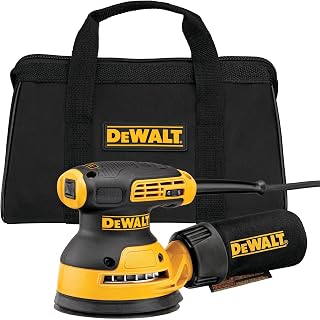
Random Orbit Sander, 5-Inch Cordless
If you are buying one sander and one only, this is the category to shop. Cordless models from the major platforms have closed most of the gap on corded power, and the freedom to move around a workbench or job site without a cord is genuinely useful. Buy into the battery system you already own if you have one, since the tool-only price is usually a fraction of the kit price.
Design Philosophy and Product Range
The two categories are built with different intentions. Quarter-sheet sanders are finishing tools. Manufacturers design them light, low-vibration and unaggressive, because their job is the last pass before finish and the awkward areas a bigger tool cannot reach. The range is narrow. Most brands offer one or two corded models, occasionally a cordless version, and the designs change rarely because there is not much left to solve.
Random orbit sanders are treated as core products, so the range is deep. You will find bare-bones corded units at the bottom, mid-tier models with variable speed and better dust ports, and premium cordless tools in the DeWalt XR, Milwaukee FUEL and Makita LXT families with brushless motors, electronic speed control and pad braking that stops the disc from gouging on contact. Above those sit the finish-focused European tools with tighter orbit tolerances and dust extraction designed around a vacuum rather than a bag.
That range difference matters when you shop. With palm sanders, spending more buys you a bit less vibration and a better switch. With random orbit sanders, spending more genuinely changes what the tool can do: pad braking, smoother startup, real dust capture, and less hand fatigue over a long session.
Dust, Noise and How They Feel Over an Hour
Dust handling is where budget tools of both types disappoint. Small onboard bags fill fast and leak at the seams. If you sand indoors or care about your lungs, plan on hooking the tool to a shop vacuum. Random orbit sanders are more likely to come with a port that fits standard hose adapters, and the pre-punched disc holes line up with pad extraction holes, so the system actually works. Quarter-sheet sanders vary more, and sheets you cut yourself have no holes at all unless you punch them.
Comfort diverges too. Quarter-sheet sanders are quieter and buzz at a higher frequency you feel in your fingertips. Random orbit sanders push more air, make a deeper noise, and transmit a lower-frequency vibration through the palm. Neither is pleasant for hours on end. Cordless brushless models generally run smoother than cheap corded ones, and a soft-grip top plate makes a bigger difference to fatigue than any spec on the box.
- ✔ Random orbit: near-invisible scratch pattern on bare wood
- ✔ Random orbit: discs are stocked everywhere in every common grit
- ✔ Random orbit: removes old finish and levels glue-up seams quickly
- ✔ Random orbit: strong cordless options across all major battery platforms
- ✘ Random orbit: cannot reach inside corners or tight rabbets
- ✘ Random orbit: easy to dish thin veneer or round over a crisp edge
- ✘ Palm sander: fixed orbit can leave swirl marks under stain
- ✘ Palm sander: narrow model selection and less premium refinement
Price Behavior, Availability and Warranty
Entry-level corded tools in both categories sit in the same low band, and quarter-sheet models often land a little cheaper because the mechanism is simpler. Move up and the two diverge sharply. Random orbit sanders scale into premium territory, and cordless kits with a battery and charger carry a large premium over tool-only listings. If you already own batteries, always check the bare-tool price first.
Discounting follows a familiar US pattern. Power tool prices soften around spring project season, Prime Day, Black Friday and the pre-holiday window, and cordless combo kits get cut harder than individual tools. Because sanders are frequently bundled into multi-tool kits, the effective price of a sander can drop close to nothing inside a good kit deal. That is worth watching if you are also shopping for a drill or impact driver.
Warranty is a real differentiator, not marketing filler. Mainstream US pro brands typically cover cordless tools for three years, with separate and shorter coverage on batteries. Value corded lines often carry shorter terms. Service network matters as much as the term: brands with wide authorized service coverage and easy pad and brush replacement stay usable for years, while cheap unbranded tools become disposable the moment a pad wears out and no replacement exists. Check that replacement pads and backing plates are actually listed for sale before you commit.
Quarter-Sheet Palm Sander, Corded
Worth owning as a second sander rather than a first. If your projects involve face frames, window trim, cabinet interiors or painted furniture with square profiles, the flat corner is something a round pad simply cannot replicate. A basic corded model is fine here since you will use it in shorter bursts.
Which One Should You Buy
Buy a random orbit sander first if you are working on flat panels, tabletops, doors, decks, plywood cabinet parts, or anything you plan to stain or clear-coat. It is the more capable tool across more of the job, and the finish quality is more forgiving of imperfect technique.
Buy a quarter-sheet palm sander first only if your work is dominated by trim, molding, built-ins, small painted pieces and repairs where corners and edges are the whole task. It is also the safer choice on thin veneer and delicate antique surfaces, since it removes material slowly and is harder to gouge with.
If your budget allows one good tool and one basic one, the usual answer is a mid-tier or cordless random orbit sander plus an inexpensive corded quarter-sheet. That pairing covers close to everything a home shop encounters, and it costs less than a single premium finishing sander. Add a detail or triangular sander later only if you keep running into inside angles neither tool can enter.
Frequently Asked Questions
Is a palm sander the same thing as an orbital sander? Not necessarily. Palm sander describes a one-handed body shape, and orbital describes the pad motion. Most quarter-sheet palm sanders use a fixed orbital motion, and most round-pad sanders are random orbit. When a listing just says orbital sander, check the pad shape and whether the description mentions random orbit before you assume.
Can one sander handle a whole project? A random orbit sander handles the large majority of flat and gently curved work, from stripping old finish through final smoothing, as long as you step through grits in order. Where it falls short is inside corners and tight profiles, which usually get finished by hand with a sanding block or with a smaller detail sander.
Do I need a variable speed sander? It helps more than most buyers expect. Lower speeds reduce heat and clogging on paint, filler and softwoods, while full speed suits hardwood stock removal. If two comparable models are close in price, the variable speed one is the better long-term purchase.
Check prices on Amazon →