What's inside
As an Amazon Associate I earn from qualifying purchases. This post may contain affiliate links at no extra cost to you.
For most indoor remodeling jobs, a cross-line laser is the practical choice: it projects visible horizontal and vertical lines, sets up quickly, and costs less. A rotary laser earns its keep when you need a level reference around a large room, across several rooms, or over a long distance. The difference is less about precision on a box and more about how much area you need to cover without moving the tool.
As an Amazon Associate we earn from qualifying purchases at no extra cost to you.


Our Top Picks
 DEWALT USB Rechargeable Green 2 Spot and CrossCross Line Laser Base Kit9.5 x 8.1 x 0.1 inchesCheck on Amazon


What the tools project
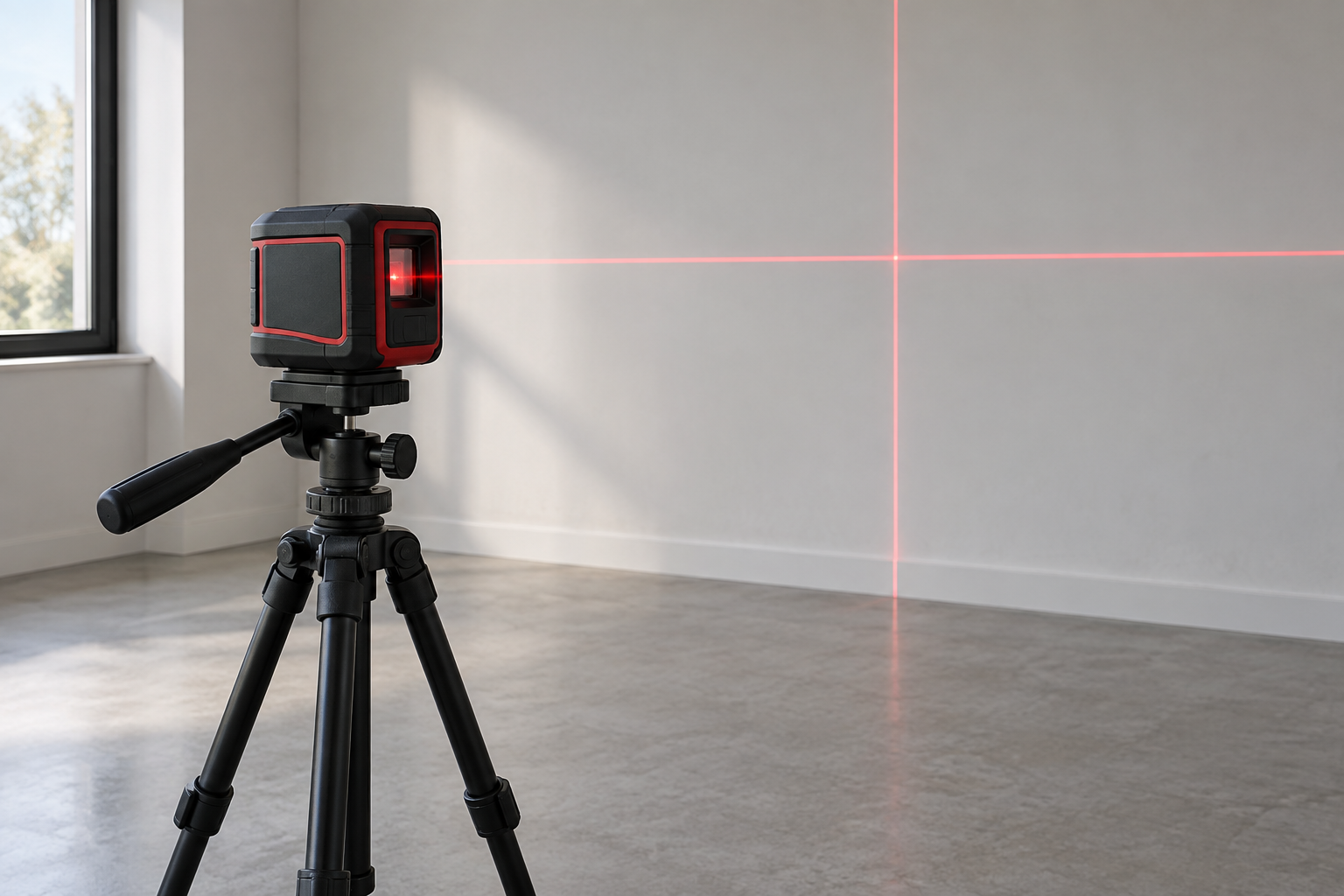
A cross-line laser casts one or more stationary lines onto nearby surfaces, usually a horizontal line, a vertical line, or both. It is useful for aligning cabinets, laying tile, setting door frames, hanging a ceiling grid, and marking a backsplash. Many models self-level within a limited range, commonly a few degrees; if the tool is outside that range, it should warn you rather than project a false level line.
A rotary laser spins a beam rapidly to create a level reference around the room. You generally see the rotating beam as a point, not a bright line, unless you use a detector. A detector can locate the beam where it is hard to see, including in bright conditions or farther away. Some rotary lasers also project a visible stationary line, but that is not their main advantage.
Cross-line vs. rotary at a glance
| Factor | Cross-line laser | Rotary laser |
|---|---|---|
| Best coverage | One room or a nearby work area | Large rooms, connected areas, long runs |
| Typical indoor visibility | Bright lines on nearby surfaces | Often needs a detector for reliable locating |
| Setup | Fast on a tripod, pole, or stable surface | More setup; detector may need calibration or careful positioning |
| Useful layout marks | Horizontal and vertical lines at once | A level plane around the work area |
| Cost and complexity | Usually lower | Usually higher, especially with detector and receiver rod |
| Common limitation | Line runs out of view around corners | Does not give the same convenient crosshair for plumb layout |
Choose a cross-line laser for room-scale work
When you can see the walls you need to mark from one setup, a cross-line laser is usually easier. For example, one horizontal line can help set a consistent cabinet height across a kitchen wall, while the vertical line helps locate a cabinet edge or align tile courses. A 360-degree horizontal model can extend the line around the room, but check whether it projects a full plane or only a line in one direction. “360-degree” does not necessarily mean it solves every layout task.
Line brightness matters more than a long advertised range for many remodels. Green beams are generally easier to see than red beams in bright rooms, but visibility still depends on wall color, ambient light, distance, and the laser’s output. In a sunny room, close curtains or use a laser target; do not assume a bare beam will remain visible across the full room. A self-leveling cross-line laser is a sensible starting point for typical indoor layout.
Its main failure mode is assuming the line is level without checking the setup. A bumped tripod, a tool sitting outside its leveling range, or a unit that has been dropped can produce a bad reference. Let it settle, confirm its out-of-level alarm is clear, and check the line against a second reference before making a long run of cuts or fasteners.
Choose a rotary laser when the reference must travel
A rotary laser makes more sense when the work spans several walls or spaces, or when you need to transfer one elevation over a long distance. It is useful for leveling a dropped ceiling across a large open area, checking floor elevations, or keeping framing and finish heights consistent through connected rooms. With a detector, it can locate the same level plane where the beam is not visible to the eye.
The trade-off is added cost and setup. You may need the laser, detector, receiver rod, and tripod, and you must keep the detector oriented and positioned correctly. A detector helps find the beam; it does not correct a tilted tripod, a unit that has not leveled, or a measurement taken from the wrong rod mark. For remodelers who only need a line on one wall, this gear is needless complexity. For broad coverage, compare rotary laser kits with a detector rather than judging the laser alone.
Accuracy depends on setup as well as the tool
Check the accuracy specification before buying. It is often stated as a tolerance over a distance, such as millimeters per 10 meters; a smaller number indicates less allowed error. On a short cabinet run, a modest error may be manageable. Across a long ceiling or floor layout, small errors accumulate, so a verified reference matters more than a feature list.
Before relying on either tool, set it on a stable surface, allow it to self-level, and mark a test line. Rotate the tool or move it to another position and compare the new mark with the first. If the marks disagree beyond the manufacturer’s stated tolerance, stop and check the tool or have it calibrated. Avoid using a laser line as a substitute for measuring from the actual finished floor: floors may slope, and trim or cabinets may need to follow a different reference.
What to buy for your project
For one room, cabinet installation, tile, or general interior trim, buy a cross-line laser and spend the difference on a stable mount, a target, or a compatible tripod. A laser-level tripod and mount can make repeatable height changes much easier than balancing a tool on a ladder or a stack of materials.
For a large open plan, multiple connected rooms, or repeated elevation checks, a rotary laser with a detector is worth considering. If the job is occasional and short-range, borrowing or renting one may cost less than buying the full kit. Either way, do not pay for outdoor range you will not use, and do not assume a high price guarantees accuracy: check the published tolerance, leveling range, visibility claims, and included accessories.