
What's inside
As an Amazon Associate I earn from qualifying purchases. This post may contain affiliate links at no extra cost to you.
The Bosch 1617EVSPK and DeWalt DW618PK are two-motor router kits built around the same basic cabinet-shop idea: use a fixed base for table or edge work and a plunge base for mortises, stopped grooves, and other cuts that start inside a panel. Both have 2.25-horsepower motors and variable speed. Neither is automatically the better buy. The practical differences are in adjustment, handling, and how easily each kit fits the work you do most.
As an Amazon Associate we earn from qualifying purchases at no extra cost to you.


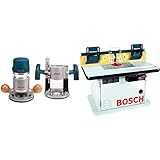

Our Top Picks
 Bosch 1617EVSPK 2.25 HP Combination Plunge- and Fixed-Base6 in6 x 11.5 x 11.6 inches18.2 PoundsCheck on Amazon


Quick comparison
| Feature | Bosch 1617EVSPK | DeWalt DW618PK |
|---|---|---|
| Motor | 2.25 hp, 12 amps | 2.25 hp, 12 amps |
| Speed range | 8,000–25,000 rpm | 8,000–24,000 rpm |
| Base types | Fixed and plunge | Fixed and plunge |
| Collets | 1/4 and 1/2 inch | 1/4 and 1/2 inch |
| Best fit | General shop use and router-table setups | Frequent handheld base changes and plunge work |
Specifications can vary by kit revision and included accessories, so check the listing before ordering. Both use standard 1/2-inch-shank bits, a sensible choice for larger cabinet profiles because the thicker shank is generally stiffer than a 1/4-inch one.
Motor power and cut quality
On paper, there is little between them. Each has enough power for common cabinet jobs such as cutting hinge mortises, routing shelf-pin templates, trimming laminate, and making cabinet-door profiles with an appropriate bit. The speed controls matter more than the one-thousand-rpm difference at the top of their ranges: larger-diameter bits should run slower, and small bits can run faster. Follow the bit maker’s speed limits rather than treating maximum rpm as the default.
Neither router turns a heavy profile cut into a one-pass job. A large raised-panel bit, for example, puts substantial load on the motor and workpiece. Take several shallow passes, keep the stock secured, and use a router table and featherboards where the cut calls for them. Forcing a deep cut can burn the wood, chatter, or pull the router off line. A sharp bit and a controlled feed rate will usually make a bigger difference to the edge than choosing between these two motors.
Base adjustment and handling
The Bosch is a strong choice when the fixed base will live in a router table. Its motor can be adjusted from above the table with the appropriate access arrangement, which is handy for bit-height changes without removing the router. Confirm that your table plate and lift or adjustment setup are compatible; “above-table adjustment” does not mean every table accessory fits without checking. The Bosch plunge base also has a useful turret stop for repeating a stepped depth in several passes.
The DeWalt’s main appeal is its base-change arrangement. It is designed to make moving the motor between fixed and plunge bases straightforward, which helps if you alternate between edge routing and plunge cuts in the same session. The plunge base has a depth rod and adjustable stops for repeat work. In either kit, a base change is only useful if you take time to reseat and lock the motor correctly. A motor that is not fully secured can shift under load, ruining the cut and creating a safety risk.
For handheld cabinet work, balance and grip are personal. The DeWalt’s handles and base controls may suit users who want frequent plunge-to-fixed changes; the Bosch is often an easier fit for a shop where the fixed base is dedicated to a table. If possible, hold both before buying. A router that feels awkward when you guide it along a cabinet side can be harder to control, even if its specifications look right.
Which kit suits your cabinet work?
Choose the Bosch 1617EVSPK if the fixed base is likely to spend most of its time under a table, or if repeatable stepped plunge cuts are a regular task. It is also a practical all-rounder for a home shop that needs one motor and two useful bases. Budget for the table plate or mounting hardware your setup requires; those parts are not necessarily included with the router kit.
Choose the DeWalt DW618PK if you expect to swap bases often and value a kit organized around that workflow. For cabinet installation and small-shop jobs involving a mix of mortises, grooves, and edge profiles, that convenience can save setup time. It does not make the router inherently more accurate: accuracy still depends on a rigid guide, a properly set depth, and a test cut in scrap.
If most of your work is trimming edges or routing small grooves, either kit may be more router than you need. A lighter compact router kit can be easier to steer and less tiring for repeated edge work. For occasional hinge mortises, a guide template and a plunge-capable router are more important than extra motor power.
Cost, bits, and setup costs
Compare the price of complete kits, not just the motor. Check whether the package includes both bases, collets, a case, guide hardware, and the wrenches you need. Included accessories and packaging can differ between sellers. Also account for a quality set of 1/2-inch-shank cabinet router bits; the router kit alone will not cover door profiles, flush trimming, and joinery.
For table work, check the router’s mounting pattern against your table plate before buying. For handheld work, a straightedge or edge guide, clamps, and a dust-collection fitting may matter more than a bundled accessory you will never use. Both routers can create fine dust, especially in MDF and plywood. Connect extraction where possible, wear suitable respiratory protection, and keep the workpiece clamped rather than trying to hold it by hand.
The practical choice
There is no meaningful power advantage here: both kits have enough capacity for most cabinet-shop routing. Bosch gets the nod for a fixed-base router-table setup and a versatile plunge stop. DeWalt makes a persuasive case when frequent base swaps are central to the work. Buy whichever complete kit is cheaper if your use is occasional and the features are not decisive; both can do the job when paired with sharp bits, secure setup, and sensible passes.