What's inside
As an Amazon Associate I earn from qualifying purchases. This post may contain affiliate links at no extra cost to you.
Our Top Picks


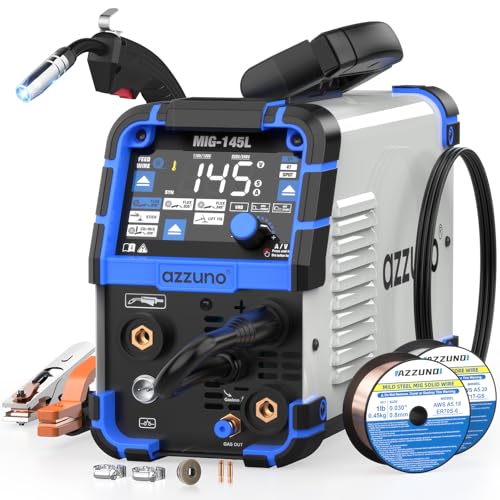
Best MIG Welders for Welding Without Gas
For MIG welding without gas, choose a welder that explicitly supports self-shielded flux-core wire and lets you reverse polarity; among widely available options, the Lincoln Electric POWER MIG 211i suits frequent shop use, while the Hobart Handler 140 and Forney Easy Weld 140 FC-i fit simpler, lower-cost jobs.
“Gasless MIG” is common shorthand, but the process is technically flux-cored arc welding (FCAW-S). The wire contains flux that generates shielding as it burns, so you can weld outdoors without a cylinder. The trade-offs are more smoke, slag to remove, and usually a rougher bead than gas-shielded MIG. The right machine depends less on its advertised maximum amperage than on whether it feeds the wire reliably, supports the right polarity, and can run the thickness you actually need.
As an Amazon Associate we earn from qualifying purchases at no extra cost to you.


At a glance: gasless-capable welders
Specifications below are manufacturer-published or typical model ratings; output and wire capacity vary by exact version and power supply. Check the manual for your machine before buying wire or changing polarity.
| Welder | Input and rated output | Flux-core wire / polarity | Practical fit |
|---|---|---|---|
| Lincoln Electric POWER MIG 211i | 120/230 V; up to 211 A | Supports self-shielded flux-core; polarity is configurable for FCAW | Shop, repair, and mixed-material work; higher capacity than compact 120 V units |
| Hobart Handler 140 | 115 V; 25–140 A | Supports flux-core; reversible output leads | Home garage and light repair, especially when 120 V is the available supply |
| Forney Easy Weld 140 FC-i | 120 V; 30–140 A | Self-shielded flux-core only; fixed polarity for flux-core operation | Occasional, straightforward mild-steel jobs on a limited budget |
These are not identical machines or a universal ranking: the Forney is flux-core-only, while the Lincoln and Hobart offer more process flexibility. Verify current package contents, spool size limits, and included accessories with the manufacturer or seller, since bundles can differ.
Choose by the job, not the headline amperage
- Occasional outdoor repairs on mild steel: The Forney Easy Weld 140 FC-i is a simple choice if its fixed flux-core setup matches your needs. Its 120 V input is convenient, but expect to work within the limits of a small machine: short welds, sensible joint preparation, and modest material thickness.
- One welder for household repairs and future gas welding: The Hobart Handler 140 gives you flux-core capability now and gas-shielded MIG flexibility later. Its reversible leads make changing between processes possible, but it remains a 115 V machine, so it is not a substitute for a higher-output 230 V welder.
- Frequent work or thicker steel: The dual-voltage Lincoln POWER MIG 211i offers more headroom and can use a 230 V supply where available. That does not mean every thick plate can be welded in one pass; joint design, preparation, wire, settings, and duty cycle still control the result.
Material thickness claims need context. A machine may advertise a maximum thickness, but that figure often assumes a particular joint, multiple passes, or ideal conditions. A 120 V welder is generally most comfortable on thin-to-moderate mild steel. For structural work or repeated welding on thick sections, use the manufacturer’s capacity chart and a qualified welding procedure rather than relying on a product-page maximum.
Flux-core wire, polarity, and outdoor performance
For gasless work, buy self-shielded flux-core wire, not solid MIG wire. Common mild-steel wire diameters include 0.030 and 0.035 inch, but the machine’s drive rolls, liner, contact tip, and manual determine what it can feed. Use the wire type and diameter specified for the welder, and match the spool to its hub and feed system.
Most self-shielded flux-core wire runs with electrode-negative polarity (DCEN), while solid wire with shielding gas commonly runs electrode-positive (DCEP). Some welders require moving the output leads; some flux-core-only models are already configured for the process. Follow the specific wire and welder instructions. Incorrect polarity can cause unstable arc behavior, excessive spatter, poor penetration, or a bead that is difficult to control.
Gasless does not mean wind-proof. Flux provides shielding without an external gas cloud, which makes self-shielded wire more tolerant of a breeze than gas-shielded MIG. Strong gusts, rain, damp steel, and contamination can still compromise a weld or make the work unsafe. Keep the area dry, protect the weld zone from wind where practical, and never weld near flammable materials. Outdoors, flux-core is often more convenient than hauling a cylinder and regulator, but it produces more smoke; use effective ventilation and appropriate protective equipment.
MIG welding with gas or without?
For outdoor repairs, portability, or jobs where cylinder handling is inconvenient, gasless flux-core is often the practical choice. For cleaner indoor work on thin sheet, less spatter, and a neater finish, solid-wire MIG with shielding gas is usually easier. Gas-shielded MIG also avoids the slag layer associated with flux-core, though the cylinder adds cost, space, and setup.
| Factor | Gasless flux-core | Gas-shielded MIG |
|---|---|---|
| Wire | Self-shielded flux-core | Usually solid wire, such as ER70S-6 for mild steel |
| External cylinder | Not needed | Required, with compatible regulator and hose |
| Wind sensitivity | More tolerant, not immune | Shielding gas can be blown away readily |
| Cleanup | Slag removal and typically more spatter | Usually no slag with solid wire; often a cleaner finish |
| Typical advantage | Convenience outdoors and simple transport | Cleaner control on indoor and thinner-material jobs |
A MIG welding gas regulator is needed when using a shielding-gas cylinder, not for self-shielded flux-core wire. If switching a dual-process machine to gas, use the correct regulator for the gas and cylinder connection, check the machine’s gas-hose routing, and set flow according to the manual and working conditions. Do not try to “improve” flux-core welding by adding shielding gas unless the wire maker specifies a gas-shielded process.
Setup details that prevent wasted wire
- Confirm the process and polarity. Check the welder manual and wire label; set the output leads as instructed before striking an arc.
- Fit the feed system to the wire. Install the correct drive-roll groove and contact tip. Too much roll pressure can flatten tubular wire; too little can cause feed slip.
- Set voltage and wire speed from the chart. Start with the machine’s settings for the wire diameter and steel thickness, then make small adjustments on scrap of the same material.
- Prepare clean, dry metal. Remove paint, rust, oil, and heavy scale around the joint. Contamination can cause porosity and unreliable fusion.
- Use the recommended travel direction and technique. Flux-core instructions may call for a different angle or travel direction than solid-wire MIG. Follow the wire maker’s guidance, and chip or brush off slag between passes.
Check the duty cycle before planning long welds. It states how long a machine can weld within a ten-minute period at a specified output before needing to cool. Compact welders may handle short repair beads well but require pauses at higher settings. Keep the cooling vents clear, inspect the torch liner and contact tip as they wear, and replace damaged tips or clogged liners rather than compensating with excessive drive-roll tension.
Bottom line
For the simplest occasional gasless work, choose a flux-core-only machine such as the Forney Easy Weld 140 FC-i if its capacity and fixed setup suit your projects. Pick the Hobart Handler 140 if you want 120 V flux-core now with the option to use shielding gas later. For more frequent work and access to 230 V power, the Lincoln Electric POWER MIG 211i provides greater operating headroom. In every case, match wire, polarity, and material thickness to the manual; those choices matter more to the finished weld than the “gasless” label alone.