What's inside
As an Amazon Associate I earn from qualifying purchases. This post may contain affiliate links at no extra cost to you.
Our Top Picks


Why a Track Saw Makes Sense in a Small Shop
In a one-car garage or basement shop, a full sheet of plywood is the biggest thing you will ever have to handle. A 4×8 sheet is 32 square feet, weighs 60 to 95 pounds depending on material, and needs about 10 feet of clearance in every direction to crosscut safely on a table saw. Most small shops simply do not have that.
A track saw solves the space problem by bringing the tool to the material instead of the other way around. You lay the sheet on foam board on the floor or on a pair of sawhorses, lay the rail down, and make the cut. You need about 5×9 feet of floor space for the cut itself, and zero permanent floor space when you are done because the rail hangs on the wall. The trade-off is speed on repeated narrow rips. If you are ripping 40 pieces of 3-inch strips, a table saw is still faster. For breaking down sheet goods into cabinet-sized parts, a track saw is faster, safer, and more accurate for most small-shop owners.
As an Amazon Associate we earn from qualifying purchases at no extra cost to you.



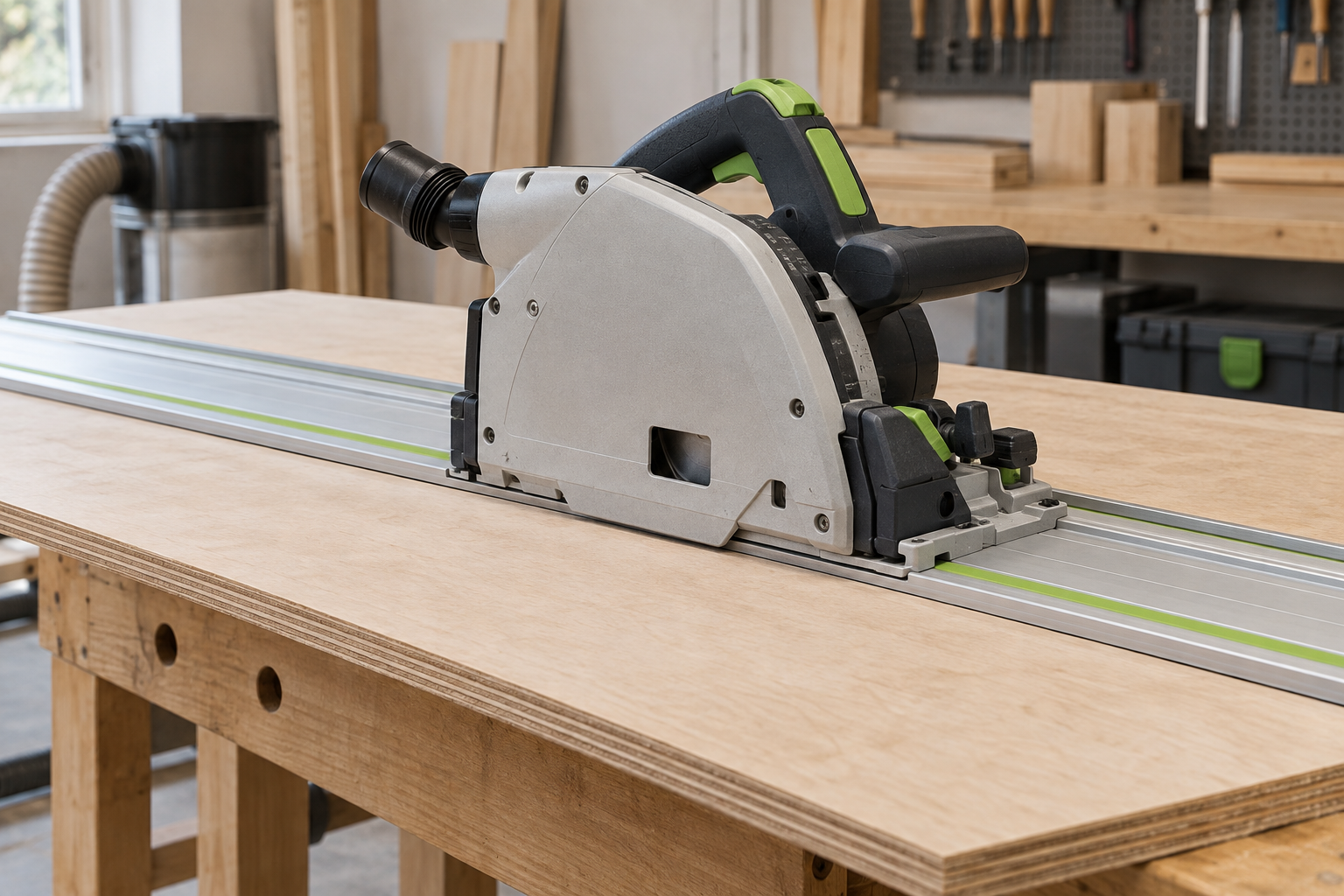
Track Saw vs. Circular Saw and Straightedge
A good circular saw with a clamped straightedge can make a straight cut, but it fails in three predictable ways when you do it often.
First, the saw base wanders. Even 1/32 inch of play between the saw plate and your guide turns into a visible gap on a plywood edge that should glue up tight. A track saw rides in a grooved rail with anti-slip strips and gibs that remove that play. Once the rail is set, the blade path is fixed.
Second, tearout. Track saws use a narrow-kerf blade with a scoring-like action and a splinter guard on the rail that holds wood fibers down right at the cut line. On prefinished maple plywood or melamine, the difference is not subtle. A standard circular saw will chip the top veneer even with a fine-tooth blade; a track saw with a 48-tooth blade and a fresh splinter strip leaves a nearly ready-to-finish edge.
Third, plunge and dust control. You can plunge a track saw anywhere on the sheet for cutouts or stopped cuts, and the enclosed shroud actually collects dust if you hook up a vacuum. A circular saw throws dust everywhere and cannot plunge cleanly without tipping.
If you break down a sheet once or twice a year, a circular saw and a circular saw straight edge guide is fine. If you build a kitchen, a closet system, or a lot of shop cabinets, the track system pays for itself in saved plywood.
What Actually Matters in a Track System
Do not get distracted by horsepower. All the major systems cut 3/4-inch plywood without bogging. What matters for sheet goods in a small space is the rail, the cut quality, and how the system lives in your shop.
Rail length and joining. A single 55-inch rail only gives you about 48 inches of usable cut after you account for the saw overrun. To crosscut a 48-inch wide sheet you need a 55-inch rail. To rip an 8-foot sheet you need 106 inches. That means either a 118-inch one-piece rail or two 55-inch rails joined with connectors. One-piece rails stay straighter and are faster to set, but they are awkward to store and ship. Joined rails store easily but can develop a bump at the joint if you do not check them with a straightedge after assembly. If your shop ceiling is under 9 feet, two 55s are more practical.
Blade and depth. Most 6-1/2 inch track saws cut 2-1/8 inch deep off the track, which is enough for double-stacked 3/4 inch or a solid-core door. Cordless 18V and 36V models cut about 1/4 inch less due to motor housing. That still handles sheet goods, but check if you plan to cut 8/4 hardwood on the rail.
Splinter guard and anti-slip. The rubber splinter guard on the rail is a consumable. You trim it on the first cut to match your exact blade, and it is what gives you zero-clearance support. When it gets chewed up, tearout returns until you replace it for about $15. The foam-like strips on the bottom of the rail are what keep it from sliding when you do not clamp. They work on smooth plywood but slip on sawdusty MDF. In that case, clamp the rail.
Dust collection. Connected to a shop vacuum, a track saw captures 80 to 90 percent of dust. In a small basement shop where your furnace shares air, that matters more than it does in a big garage. Festool and Makita have the best shrouds; DeWalt and Kreg are decent but leak more at the front.
Track compatibility. This is the hidden cost. Festool, Makita, and several aftermarket rails share the same profile and are cross-compatible. DeWalt uses a different double-groove profile. Kreg uses its own wide ACS rail. If you buy into a system, you are buying future rails, squares, and accessories that only fit that profile.
Head-to-Head: The Main Systems Compared
For breaking down sheet goods specifically, these four cover 95 percent of what you will find in stores. Prices are for a kit with one 55-inch rail, as of late 2024.
| System | Power | Street Price (Kit) | Rail Profile | Weight | Best For |
|---|---|---|---|---|---|
| Festool TS 55 F | Corded 120V | $650 – $700 | Festool / Makita compatible | 9.9 lb | Cleanest cut, best dust collection, most accessories |
| Makita SP6000J1 | Corded 120V | $380 – $430 | Festool / Makita compatible | 10.1 lb | Best value for accuracy, huge aftermarket rail support |
| DeWalt DWS520 / DCS520 (cordless) | Corded or 60V cordless | $400 – $550 | DeWalt only | 9.5 lb (corded) | People already in DeWalt batteries, very good anti-slip |
| Kreg ACS2000 | Corded, adaptor for circular saw | $280 – $350 | Kreg ACS only | Uses your own saw | Lowest entry cost if you already own a good circular saw |
The Festool cuts the cleanest out of the box and has the most refined plunge action and depth stop, but you pay for it. The Makita is within a hair of the Festool on cut quality for $250 less, and it runs on the same rails, which means you can buy cheaper Powertec or Makita rails later and they fit. That compatibility is a big deal in a small shop where you might want a short 39-inch rail for quick crosscuts and a long rail for rips.
DeWalt’s cordless DCS520 is the most convenient if you work outside or hate cords on the floor. It has the best stock blade of the group for plywood and the rail has extra grip. The downside is you are locked into DeWalt rails, which are less common and have fewer third-party accessories like rail squares.
Kreg is different. It is not a track saw at all but a rail and sled that your existing circular saw rides in. It works, and it is the cheapest way to get a guided cut over 8 feet, but the sled adds slop, dust collection is poor, and you still have the tearout of your circular saw blade. It is better than a straightedge clamp, not as good as a true track saw.
How to Break Down Sheets Without a Big Table
You do not need a fancy cutting table. Two rigid foam boards (1-1/2 inch insulation) on the floor or on sawhorses are the standard. Set your depth to cut 1/8 inch into the foam. The foam supports the whole sheet so both sides of the cut do not fall and pinch the blade.
Sequence matters. First, crosscut the sheet to rough length about 1/4 inch long. Then rip to width. This reduces the weight you handle and lets you use the factory edge as your reference for the first rip. Use the track saw’s measurement scale or, better, make your first rip and then use that clean edge against your track saw guide rail with a rail square for repeatable crosscuts.
Failure modes to watch for: letting the rail overhang the sheet without support causes the rail to tip down at the end and the blade to exit with a chip. Clamp the far end or extend your foam. Not checking for screws or staples in reclaimed plywood will nick the splinter guard and dull the blade fast. And forcing the saw faster than the blade wants to cut in 3/4-inch Baltic birch will leave swirl marks and overheat the motor; let the saw feed at its own pace, about 2 to 3 inches per second.
What to Buy for Your Shop and Budget
For most small workshops building cabinets and built-ins, a corded Makita kit with two 55-inch rails and connectors is the sweet spot. It is accurate enough for glue-ready edges, it shares the most common rail standard, and replacement blades and splinter strips are cheap and available. Pair it with a 48-tooth blade for plywood and keep a 28-tooth for ripping solid wood faster.
If you can spend more and want the best dust control because you work indoors, the Festool TS 55 is measurably better sealed and a little smoother to plunge. It is not more accurate in wood, but it is more pleasant to use for hours.
If you are already invested in DeWalt FlexVolt batteries and want cordless freedom, the DCS520 cordless kit is worth the premium. Just budget for an extra long rail instead of trying to save money by joining two shorts every time.
If you only have three sheets to cut for a single project, do not buy a system at all. Buy foam board and a good straightedge, save your money, and rent time on a friend’s track saw. Or look at a budget track saw kit with rail from Wen or Kreg to see if you like the workflow; you can resell it for little loss if you decide to upgrade.
Whichever you choose, add three cheap accessories right away: rail connectors if you have two short rails, a rail square for 90-degree crosscuts without measuring, and a second splinter guard. Those three items fix 90 percent of beginner complaints about track saws drifting or not being square.