What's inside
As an Amazon Associate I earn from qualifying purchases. This post may contain affiliate links at no extra cost to you.
Our Top Picks
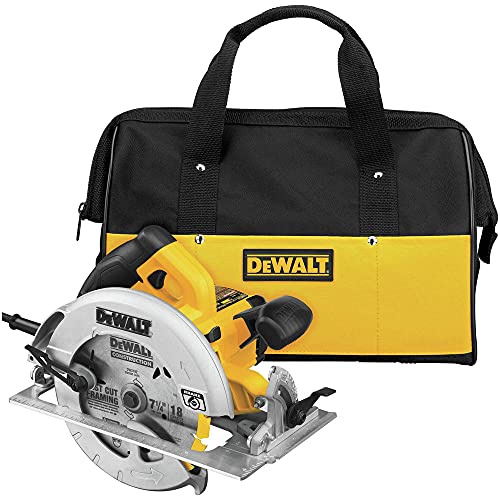
 DEWALT 20V MAX XR Brushless Cordless 7-1/4 in.STANDARD15.35 x 9.4 x 9.6 inches9.88 poundsCheck on Amazon

At a glance
The DeWalt DWE575SB and Skilsaw SPT67WM are both 15-amp, 7-1/4-inch corded circular saws built to reduce fatigue without giving up full-size cutting capacity. That makes them useful for overhead work such as cutting roof sheathing, trimming fascia, installing subfloor from below, or making repeated cuts while holding the saw above shoulder height.
The DeWalt is the lighter-feeling, more compact choice and has a few features that help when the saw is awkward to control. The Skilsaw is slightly more substantial, with a strong magnesium build and a motor that feels particularly well suited to long rip cuts. Neither turns overhead cutting into an easy job: a 15-amp saw still weighs roughly 9 pounds with the cord, and the workpiece must be supported so it cannot pinch the blade.
As an Amazon Associate we earn from qualifying purchases at no extra cost to you.


| Feature | DeWalt DWE575SB | Skilsaw SPT67WM |
|---|---|---|
| Blade size | 7-1/4 inches | 7-1/4 inches |
| Motor | 15 amps | 15 amps |
| Weight | About 8.8 pounds | About 8.6 pounds |
| Maximum bevel | 57 degrees | 56 degrees |
| Cut depth at 90 degrees | 2-9/16 inches | 2-7/16 inches |
| No-load speed | 5,200 rpm | 5,300 rpm |
| Brake | Electric brake | Electric brake |
| Best fit | Overhead control and general remodeling | Long cuts and rugged framing use |
Which saw is easier overhead?
The DWE575SB has the edge for overhead work, even though the listed weight difference is small. Its handle arrangement and relatively narrow body make it easier to keep the blade aligned when your arms are extended. The lower guard also has an anti-snag design that is helpful when starting a cut from the edge of plywood or dimensional lumber. A built-in rafter hook provides a practical place to hang it between cuts.
The SPT67WM is also light for a 15-amp saw, but its layout feels more like a traditional framing saw. That is an advantage when you are standing on a floor and pushing through long boards, but it can feel less nimble when reaching overhead. The difference is not dramatic; technique, cord drag, and blade choice often matter more than the extra few ounces.
For repeated overhead cuts, a circular saw shoulder strap can reduce the effort of lowering and repositioning the tool, but do not use a strap as fall protection. Secure the material first and keep both hands on the saw during the cut.
Cutting performance and capacity
Both saws have enough power for 2x lumber, plywood, OSB, and typical framing stock. The SPT67WM has a slightly higher no-load speed and a rigid magnesium construction that feels confident during long rips. It tends to track well when the shoe is fully supported, and its direct-drive motor has the familiar fast, high-pitched character of a powerful sidewinder.
The DeWalt’s small advantage in depth is real but rarely decisive. At 90 degrees it cuts up to 2-9/16 inches, while the Skilsaw cuts 2-7/16 inches. Both handle a 2×4 in one pass, but neither has enough depth for a 4×4 without turning the workpiece. The DeWalt also bevels to 57 degrees versus 56 degrees on the Skilsaw, a difference that matters only for unusual compound or steep bevel work.
Use a sharp, appropriate blade rather than judging either saw by the included general-purpose blade. A 24-tooth framing blade is faster in lumber and less likely to load up with wet wood. For clean plywood edges, choose a 7-1/4-inch fine-tooth circular saw blade. More teeth improve the edge but increase feed resistance, which is noticeable when cutting overhead.
Safety details that matter above shoulder height
The DeWalt includes an electric brake, a dust blower, and a blade guard designed to reduce catching at the start of a cut. Those features improve control, but they do not prevent kickback. Kickback is most likely when the kerf closes behind the blade, when the blade is twisted, or when the offcut drops and pulls the saw sideways.
Support long sheets at several points, keeping the cut line open. When cutting roof or floor sheathing, place supports close enough that the sheet does not sag into the blade. Do not cut between two tightly supported sections if the material can compress and pinch the blade. Let the shoe stay flat; lifting the rear of the saw to finish a cut exposes more blade and makes binding more likely.
The SPT67WM’s solid shoe and balanced framing-saw layout also provide good control, particularly for workers accustomed to Skilsaw’s design. Its guard should retract smoothly before use. If either guard sticks because of dust, pitch, or damage, stop and clean or repair it rather than forcing the saw through the cut.
Which one should you buy?
Choose the DeWalt DWE575SB if overhead work is a regular part of the job, if you value a compact-feeling saw, or if the built-in rafter hook and anti-snag guard will save time. It is also the better general remodeling pick for someone moving between plywood, framing lumber, trim backing, and occasional bevel cuts.
Choose the Skilsaw SPT67WM if most of your work is floor-level framing, long rips, and production-style cuts where its sturdy feel matters more than the last bit of overhead maneuverability. If it is substantially cheaper in your area, it is a sensible buy. The small differences in depth, bevel range, and weight do not justify paying a large premium for the DeWalt unless you specifically need its handling.
If your work consists mainly of short overhead cuts in thinner material, a lightweight corded circular saw in this class is appropriate. For occasional repairs where extension cords are the main nuisance, consider a 20V cordless circular saw, accepting shorter runtime and potentially lower sustained cutting speed. For either choice, buy the saw that leaves you with enough control to keep the shoe flat and the blade moving straight.