What's inside
As an Amazon Associate I earn from qualifying purchases. This post may contain affiliate links at no extra cost to you.
A detail sander and an oscillating multi-tool can both reach places a random-orbit sander cannot, but they are not interchangeable. A detail sander is built to smooth wood with a small triangular pad. A multi-tool can sand with a triangular attachment, yet its main advantage is access: the narrow head can fit into spaces the sander’s pad cannot. For ordinary inside corners in trim, cabinets, or furniture, a detail sander is usually easier to control. For a tight corner or a mixed repair that also needs cutting or scraping, a multi-tool may be the better buy.
As an Amazon Associate we earn from qualifying purchases at no extra cost to you.


Our Top Picks
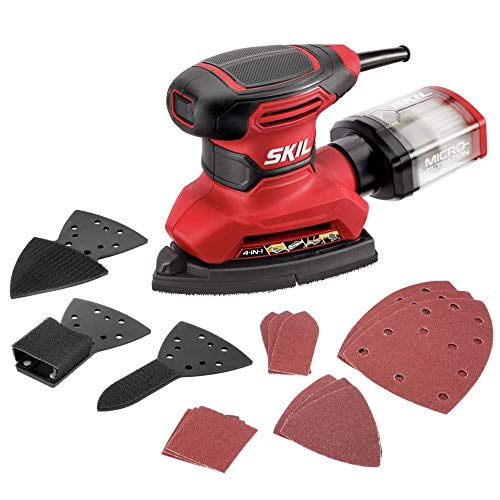 SKIL Corded Multi-Function Detail Sander with Micro-Filter DustOne Size9.84 x 5.7 x 6.69 inches2.6 poundsCheck on Amazon

What counts as an inside corner?
There are two common jobs people mean by “inside corner.” One is sanding a flat surface right up to the meeting point of two boards, such as the inside angle of a cabinet. The other is sanding the vertical corner itself, where two faces meet. A triangular detail-sander pad can work on the adjoining flat faces, but its tip may not reach all the way into a sharp, narrow corner. A multi-tool’s smaller sanding finger or narrow triangular attachment may reach farther, depending on the attachment and clearance.
Neither powered tool can make an inaccessible corner easy. If the angle is too tight for the pad, or the surfaces are delicate, a folded piece of sandpaper or a small sanding block gives better control. Don’t force a pad into a gap: pressure can round the corner, tear the abrasive, or burnish the wood instead of sanding it.
How the tools sand
A detail sander moves its pad in a small orbital pattern. It is intended for sanding, so it is generally more predictable across a flat area than a multi-tool. Its larger triangular pad covers more ground, and hook-and-loop abrasives are quick to change. It is a sensible choice for sanding cabinet frames, window trim, and small pieces of furniture, especially when the work includes several square inches of surface rather than just a thin corner seam.
A multi-tool oscillates its attachment through a short arc. With a sanding plate attached, it can remove material and smooth a small area, but the short, fast motion makes it easier to create uneven spots if you hold it still or press hard. The attachment is usually smaller than a detail sander’s pad, so it takes more passes over a broad surface. A sanding finger can get into a narrow recess that a triangular pad cannot, but it covers very little area and is easy to tilt into the adjacent face.
Head-to-head
| Factor | Detail sander | Oscillating multi-tool with sanding attachment |
|---|---|---|
| Best fit | Flat surfaces near corners; routine fine sanding | Tight or obstructed corners; small spot repairs |
| Coverage | More area per pass with a triangular pad | Less area; narrow attachments need patience |
| Control | Usually steadier for broad, flat sanding | Useful in cramped spots, but easier to gouge if tilted |
| Other jobs | Primarily sanding | Can also cut, scrape, and remove grout with suitable attachments |
| Common drawback | Pad tip may not reach a sharp corner | Slow on larger surfaces; attachment can leave uneven marks |
Which one should you buy?
Choose a detail sander if sanding is the main task and you want to finish several flat faces next to inside corners. It is also the less fussy option for a beginner: keep the pad flat, use light pressure, and move steadily. A corded model is fine for work at a bench or near an outlet; cordless convenience matters more when moving around installed trim or a room. Compare pad size, dust collection, and the cost and availability of replacement abrasives before choosing a detail sander.
Choose a multi-tool if you already own one, need to sand only a few cramped spots, or also expect to cut flush, scrape adhesive, or trim material. Buying a multi-tool solely to sand a large project is usually poor value in time: the small sanding attachment makes repeated passes tedious. If access is the deciding factor, check that the tool accepts a compatible sanding plate and finger attachment before buying a multi-tool with sanding attachments.
If you only have one or two corners to finish, the cheaper option may be sandpaper wrapped around a small block. It costs little, fits a sharp angle, and gives you direct control over how much material comes off. A detail sander is a poor purchase for a single tiny touch-up if a hand sanding block will do it. A multi-tool is likewise unnecessary unless its other functions justify the cost.
A sanding method that avoids gouges
Start with the least aggressive grit that will remove the marks. For bare wood with scratches or small uneven spots, 120 grit is a practical starting point; use 150 or 180 grit for light smoothing, then follow the finish manufacturer’s instructions. If the corner only needs a minor touch-up, begin at 180 grit rather than stripping away good material. Sand with the grain where possible, and test on a hidden area if the wood is stained or veneered.
Keep the pad moving and use just enough pressure to maintain contact. On a detail sander, let the flat pad do the work; pressing on the pointed tip can round over the corner or wear the abrasive quickly. On a multi-tool, use short, controlled passes and check the surface often. A few seconds stationary can leave a divot or a visibly different texture. Stop when the scratch pattern is even rather than chasing every mark into a low spot.
Dust is another practical difference, not a reason to skip protection. A detail sander with a dust bag or extractor port generally manages sanding dust better than a small multi-tool attachment, though neither captures everything. Wear eye protection and a suitable dust mask, particularly when sanding old paint or unknown coatings. For old paint, check local guidance before sanding because it may contain lead.
The practical choice
For most inside-corner sanding on wood, buy a detail sander if you need to cover adjoining flat surfaces cleanly. Use a multi-tool when the corner is genuinely too tight for its pad or when the tool’s cutting and scraping ability will also earn its place. For a single sharp corner, hand sanding can be cheaper and more precise than either. The right choice depends less on which tool is more powerful than on how much surface you need to sand and whether the attachment can actually reach the spot.