What's inside
As an Amazon Associate I earn from qualifying purchases. This post may contain affiliate links at no extra cost to you.
For a deep hole in a timber, the right bit depends on what “straight” and “deep” mean in the job. A brad-point bit is easier to control and leaves a clean entry, but its ordinary length limits how far it can reach. An auger bit is built to pull itself through thicker stock and carry shavings out, but that pulling action can make it harder to steer—especially in a handheld drill.
For shallow, accurate holes in furniture parts, a brad-point bit is usually the better choice. For a hole several inches deep in a beam or post, an auger is generally more practical. Neither bit guarantees a straight hole; setup and drilling technique matter as much as the bit.
As an Amazon Associate we earn from qualifying purchases at no extra cost to you.


Our Top Picks


How the two bits cut
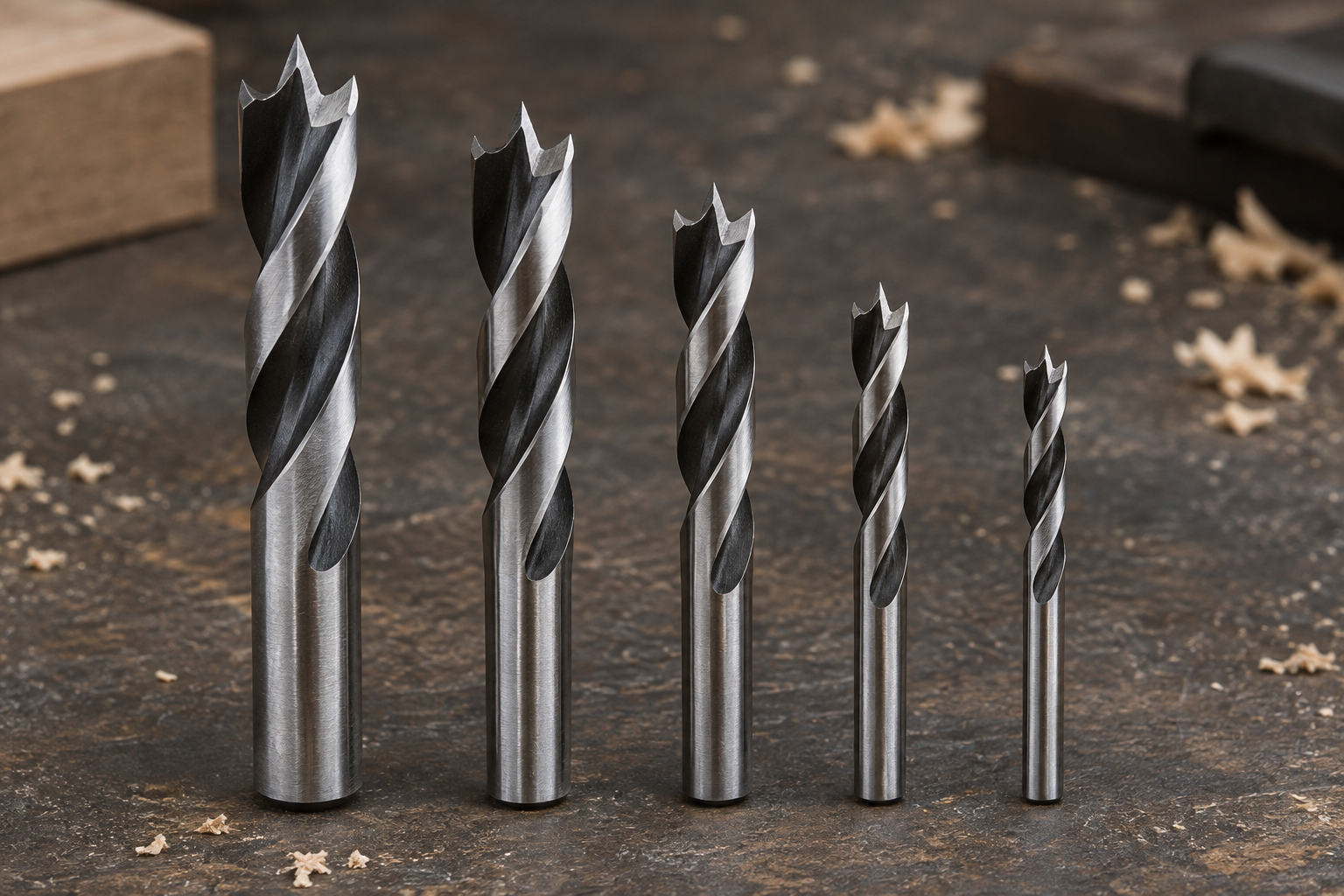
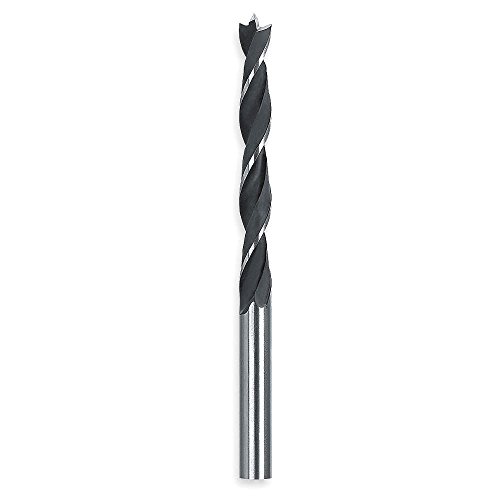
A brad-point bit has a sharp center spur that locates the hole, two outer spurs that score the rim, and cutting edges that remove the waste. Those spurs help it start accurately and reduce splintering at the entry and exit. Its flutes carry chips, but they are not designed to clear long, deep holes as aggressively as an auger’s.
An auger bit has a threaded screw tip that bites into the wood and draws the bit forward. Its deep, open flute transports shavings back toward the entry. That makes it useful in thick timber, but the screw can feed quickly. If the drill is awkwardly positioned or the bit catches, the tool can twist suddenly.
Brad-point vs auger at a glance
| Factor | Brad-point bit | Auger bit |
|---|---|---|
| Best use | Accurate holes in boards, joinery, and furniture parts | Deep holes in beams, posts, and framing timber |
| Typical advantage | Easy starting and clean hole edges | Efficient chip removal and strong progress in thick wood |
| Depth limitation | Common lengths may be too short for deep timber | Long versions are readily suited to deep boring |
| Control | Usually easier to guide by hand | Can self-feed hard and torque the drill |
| Common failure | Burning or clogging if pushed too hard in a deep hole | Snatching, wandering, or binding when the bit is misaligned |
| Exit quality | Clean when backed up or stopped before breakthrough | Can tear out badly as the screw point exits |
Choose a brad-point for accuracy and clean edges
Use a brad-point bit when the hole is relatively shallow, the location must be precise, or the finish matters. Its center spur is especially useful for repeated holes laid out with a ruler or marking gauge. For cabinet work, dowel holes, and hardware pilot holes, the clean entry can save sanding and reduce the chance of a drill bit skating off a mark.
Depth is the trade-off. A standard brad-point bit may not reach through a thick post, and forcing it deeper than its flute can clear is a recipe for packed chips, heat, and a stalled bit. For a 1-inch-diameter hole 3 inches deep, for example, a short brad-point may struggle even if the cutting portion technically reaches the target. Withdraw the bit regularly to clear chips, and do not keep leaning harder when cutting slows.
If this is the right style for the job, compare a brad-point bit set for wood. Buy for the diameters and usable lengths you need; a large assortment is not useful if its bits are too short.
Choose an auger for deep timber
For a hole 4 inches or more into a beam, an auger’s length and chip-clearing flute are real advantages. The screw point helps it advance without constant pushing, while the flute carries shavings out of the bore. This is why augers are common for larger holes in framing and rough construction, where speed and reach matter more than a furniture-quality finish.
That self-feeding action is also the main risk. A sharp auger can pull a drill forward fast enough to surprise an inexperienced user. Use a drill with a side handle if available, hold it with both hands, and select low speed with strong torque rather than high speed. If the bit binds, release the trigger; do not try to muscle a spinning drill back into line. A corded drill or suitable low-speed cordless drill is a better match than a small, high-speed driver.
Augers can wander if the tip starts on a sloped face, follows a knot, or meets grain that changes direction. They can also splinter badly at breakthrough. Clamp the work, start square, and stop when the screw point is nearly through; finish from the opposite side if both faces are accessible. For rough framing holes, a little tear-out may be acceptable. For visible work, it often is not.
For deep boring, compare wood auger bits by diameter, overall length, and shank type. Check that the bit fits your drill’s chuck and that the drill can handle the torque.
How to keep a deep hole straight
Neither bit corrects a crooked start. Mark the center clearly, make a small starter indentation, and align the drill before the cutting edges engage. Sight the bit from two directions, or use a drill guide or drill press where the stock will fit. A level attached to the drill can help, but it only checks one plane at a time.
Clamp the timber so it cannot shift. Drill at a steady, controlled speed and back the bit out periodically to clear chips—more often with a brad-point in a deep bore. If the hole is too deep for the bit’s cutting length, do not assume a longer shank means the cutting flutes will clear waste equally well. Match the bit’s usable flute length to the depth.
For a long through-hole, drill from both sides when possible. Measure and mark the target center on each face, then bore toward the middle. This reduces exit tear-out and limits how far a small alignment error can accumulate. The holes may still meet slightly off-center, so use a guide when the passage must be especially straight.
The practical buying decision
Choose a brad-point bit when precision, clean edges, and easy control matter more than reach. It is also the cheaper and safer option for occasional shallow holes in ordinary boards. Choose an auger when the hole is genuinely deep, the timber is thick, and your drill is built to manage the torque.
If you need both kinds of work, there is little reason to force one bit to cover every job. A modest brad-point set for common sizes plus an auger in the specific diameter and length required is often more useful than a large mixed set. For an infrequent rough hole, a suitable existing bit may be good enough; buying an auger makes sense when the reach and chip removal solve a recurring problem.