Our Top Picks

What's inside
As an Amazon Associate I earn from qualifying purchases. This post may contain affiliate links at no extra cost to you.
The HARDELL 6-inch rechargeable digital caliper with a backlit screen is the best digital caliper for most woodworkers: an all-metal body, USB-C charging, a lit display that helps in a dim shop, four measuring modes and a stated 0.001-inch accuracy. A digital caliper reads thickness, width, depth and inside openings from a sliding jaw and shows the result on an LCD in inches, millimeters or fractions, which is why woodworkers use it to set router bits, check tenons and dial in joinery. For wide boards and larger stock, the 12-inch HARDELL is the one to buy.
Quick List
- Stainless Digital Caliper (Easy Unit Switch) – best for a no-frills first caliper with a large screen
- HARDELL 6-Inch Rechargeable Backlit Caliper – best for a dim garage shop and no battery swaps
- HARDELL 12-Inch Digital Caliper – best for wide stock, large tenons and longer parts
- Stainless Digital Caliper with Auto-Off – best for an affordable stainless caliper for basic measuring
- Kynup 6-Inch Digital Caliper – best for a simple 6-inch tool with inch, metric and fraction readout
- HARDELL 6-Inch Digital Caliper with Large LCD – best for a standard 6-inch caliper with four modes and auto-off
Which One Is Right for You?
| If you… | Choose |
|---|---|
| Measure stock wider than 6 inches or check long parts | HARDELL 12-Inch Digital Caliper |
| Work in a dim shop and hate swapping coin cells | HARDELL 6-Inch Rechargeable Backlit Caliper |
| Want a plain, inexpensive caliper to throw in the apron pocket | Stainless Digital Caliper (Easy Unit Switch) |
| Prefer a standard battery caliper with four modes and auto-off | HARDELL 6-Inch Digital Caliper with Large LCD |
| Like a simple 6-inch design and a fraction readout for imperial plans | Kynup 6-Inch Digital Caliper |
| Want another stainless option with auto-off and a large screen | Stainless Digital Caliper with Auto-Off |
Most woodworking does not need machinist-grade precision. A typical hobby caliper that reads to 0.0005 inch with a stated accuracy near 0.001 inch is more than enough, since wood moves with humidity by far more than that. What matters more is that the jaws close cleanly to zero, the thumb wheel is smooth, the display is easy to read and the battery lasts.
All 6 Picks in Detail
1. Stainless Digital Caliper with Unit Switch – Best Simple First Caliper
As an Amazon Associate we earn from qualifying purchases at no extra cost to you.
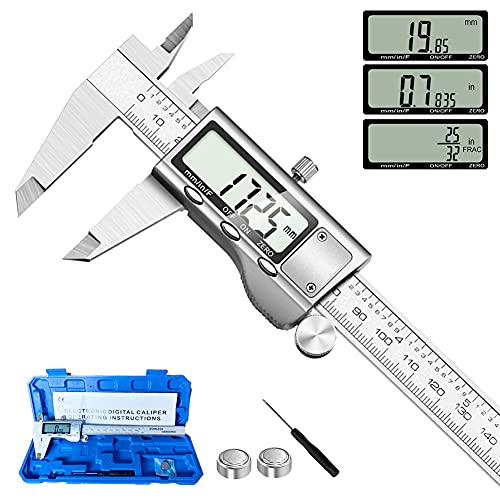
This listing describes a stainless steel vernier-style digital caliper with a large LCD and an easy switch between inch, metric and fraction. The brand is not named in the title, and the length is not stated in the part we have, so treat it as a typical 6-inch class tool and confirm the range on the product page.
It is a sensible choice for someone who wants to try a caliper before buying a better one. The large display and one-button unit switch are the features that matter most in daily use, whether you are reading a drill bit shank, a piece of veneer or a dowel diameter.
- Body: stainless steel
- Display: large LCD
- Units: inch, metric, fraction via a button
- Range: confirm on listing (6-inch class typical)
- Resolution and accuracy: confirm on listing
- Power: confirm battery type on listing
Pros
- Basic and easy to use
- Stainless body resists shop humidity
- Instant fraction reading for imperial plans
Cons
- Brand and some specs are unclear from the listing
- No backlight or rechargeable battery named
Step up to the rechargeable HARDELL if you want a lit screen and no coin cells.
2. HARDELL 6-Inch Rechargeable Caliper with Backlight – Best Overall for Woodworking

The listing highlights an all-metal build, a backlit screen, USB-C charging, four measurement modes (outside, inside, depth and step) and a stated 0.001-inch accuracy with inch, millimeter and fraction readouts. The backlight is the practical highlight: shops are often dim, and a lit display saves squinting under a bench light.
HARDELL’s pages for similar rechargeable models describe a quick charge and months of use per charge, but those figures vary by listing, so check the one for this exact model. A rechargeable cell means you do not have to hunt for coin batteries in the middle of a project, though you do need to remember to plug it in occasionally.
- Range: 6 inch (150 mm)
- Accuracy: 0.001 inch per listing
- Modes: outside, inside, depth and step
- Units: inch, mm and fraction
- Display: backlit LCD
- Power: rechargeable via USB-C
Pros
- Backlit display helps in a dim shop
- No disposable coin cells
- All-metal construction and four modes
Cons
- Needs a charging habit
- 6 inches will not span wide boards
It is the best fit if you will use the caliper weekly; the 12-inch HARDELL is for bigger parts.
3. HARDELL 12-Inch Digital Caliper – Best for Wide Stock
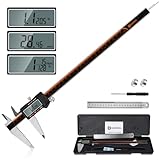
A 12-inch caliper opens up measurements a 6-inch tool cannot make: the width of a glued-up panel strip, the length of a table leg blank, the outside diameter of a larger turning or the thickness of thick stock. The listing describes a large LCD, a stainless body, inch, millimeter and fraction readouts and auto-off.
The jaws on a long caliper are bigger and heavier, so it feels less nimble for tiny work like drill bits and small dowels. Many woodworkers keep a 6-inch caliper for detail and a 12-inch for big stock. Check how the slide feels, and keep the rail clean of sawdust, since a long beam picks up debris more easily.
- Range: 12 inch (300 mm)
- Body: stainless steel per listing
- Display: large LCD
- Units: inch, mm and fraction
- Power saver: auto-off per listing
- Accuracy: confirm on listing
Pros
- Measures wide boards and long parts
- Same readout options as shorter calipers
- Auto-off saves the battery
Cons
- Bulkier for small precise work
- Long beam can flex if pressed hard
Pair it with a 6-inch caliper if you do both fine joinery and large stock.
4. Stainless Digital Caliper with Auto-Off – Best Basic Stainless Option

This listing describes a stainless steel electronic caliper with a large LCD, an auto-off feature and inch and metric readings. Like the first unbranded entry, the title does not state the length, brand or resolution, so confirm those on the product page before ordering.
It will do the everyday woodworking measurements: stock thickness, tenon width, bit shank diameter and groove depth. Its main selling point is that it offers the key features of more expensive models, with the caveat that unbranded tools have a wider range of quality and less support.
- Body: stainless steel
- Display: large LCD
- Units: inch and metric per title; confirm fraction mode
- Auto-off: yes
- Range: confirm on listing
- Battery: confirm type on listing
Pros
- Stainless body and auto-off
- Large, easy-to-read screen
- Simple to use
Cons
- Brand and key specs are not stated
- Fraction mode not confirmed in the title
The HARDELL 6-inch with large LCD gives you a named brand and a stated four-mode design for a similar outlay.
5. Kynup 6-Inch Digital Caliper – Best for Simple Imperial Work

The Kynup caliper is a stainless steel 6-inch tool with inch, metric and fraction conversion. The listing calls it a micrometer-style vernier caliper, but the word “dial” in the title is confusing; it is a digital model with a display, so confirm the readout style on the product page.
Fraction conversion is especially useful in woodworking, where plans and lumber dimensions are usually in fractions of an inch. Reading 3/4 or 5/16 straight from the screen avoids converting decimals in your head, which cuts mistakes when you cut to a line.
- Range: 6 inch
- Body: stainless steel
- Units: inch, metric, fraction
- Display: digital LCD; confirm on listing
- Resolution and accuracy: confirm on listing
- Battery: confirm type on listing
Pros
- Fraction readout is convenient for plans
- Stainless body for shop use
- Standard 6-inch size
Cons
- Listing wording on “dial” is confusing
- No backlight or rechargeable power named
Choose it over the plain unbranded models if you want a named 6-inch caliper, or over the rechargeable HARDELL if you prefer replaceable batteries.
6. HARDELL 6-Inch Digital Caliper with Large LCD – Best Standard 6-Inch

This HARDELL model is a 6-inch caliper with a large LCD, stainless body, inch and millimeter conversion, four measuring modes and auto-off. It uses standard replaceable batteries rather than a rechargeable cell, which many woodworkers prefer for reliability, as a spare coin cell in the drawer solves any dead-battery problem in seconds.
The four modes let you take outside, inside, depth and step measurements, which covers everything from stock thickness to mortise width to dado depth. Because the listing mentions inch and mm conversion but not fraction, confirm the fraction mode if you need it.
- Range: 6 inch (150 mm)
- Body: stainless steel
- Display: large LCD
- Modes: four (outside, inside, depth, step)
- Units: inch and mm; confirm fraction on listing
- Auto-off: yes
Pros
- Named brand and a clear four-mode design
- Replaceable battery, so there is no charging
- Large, clear display
Cons
- No backlight named in the listing
- Fraction readout needs confirming
It is the straightforward alternative to the rechargeable backlit HARDELL.
Specs Compared
| Caliper | Range | Body | Units | Display / power | Extras |
|---|---|---|---|---|---|
| Stainless Digital Caliper (Unit Switch) | Confirm on listing | Stainless steel | Inch, metric, fraction | Large LCD; battery type confirm on listing | One-button unit switch |
| HARDELL 6-Inch Rechargeable | 6 inch | All metal | Inch, mm, fraction | Backlit; USB-C rechargeable | Four modes, 0.001 inch accuracy |
| HARDELL 12-Inch | 12 inch | Stainless steel | Inch, mm, fraction | Large LCD; battery type confirm on listing | Auto-off |
| Stainless Digital Caliper (Auto-Off) | Confirm on listing | Stainless steel | Inch and metric | Large LCD; battery type confirm on listing | Auto-off |
| Kynup 6-Inch | 6 inch | Stainless steel | Inch, metric, fraction | Digital; battery type confirm on listing | Conversion button |
| HARDELL 6-Inch (Large LCD) | 6 inch | Stainless steel | Inch and mm; confirm fraction | Large LCD; replaceable battery | Four modes, auto-off |
How We Chose These
We began with the calipers shown in current catalog listings and compared them using the listing titles, manufacturer pages where available and published descriptions of similar models. The criteria were length, body material, units and fraction support, display and backlight, power source, measuring modes, auto-off and how clearly the listing states its specifications. Where a title did not state range, accuracy or battery type, we marked the value as something to confirm on the product page. We did not check any caliper against gauge blocks, so statements about accuracy are the listed figures rather than our own measurements, and entry-level calipers can vary from unit to unit.
What to Look For
Range: 6 Inch or 12 Inch
A 6-inch caliper (150 mm) handles most woodworking measurements: stock thickness, tenon cheeks, router bit diameters, hardware, drilled depths and dowels. A 12-inch caliper measures wider boards, longer parts and bigger turnings, but it is heavier and less nimble. If you can own only one, a 6-inch is the more versatile choice; if you build furniture with wide panels, add the 12-inch later.
Resolution, Accuracy and What Woodworking Needs
Resolution is the smallest increment on the display; accuracy is how close the reading is to the true size. Most budget calipers show 0.0005 inch (0.01 mm) resolution with a stated accuracy of about 0.001 inch (0.02 mm). Woodworking joinery generally tolerates thousandths of an inch easily, since a good fit is often judged to a few thousandths and wood itself swells or shrinks more than that with humidity. A caliper that reads consistently and zeroes properly is more valuable than one with an extra decimal place.
Body Material and Build
Stainless steel and all-metal bodies resist rust in humid shops and hold their shape better than plastic ones. Check that the jaws meet without light gaps, the thumb wheel moves smoothly and the beam does not flex. A depth rod that sits flush with the end when closed is a good sign of alignment. Jaws with sharp, clean edges help you measure inside slots and grooves.
Power: Coin Cell or Rechargeable
Many calipers use an LR44 or SR44 button cell, and silver-oxide cells tend to hold a steadier voltage than alkaline ones. Auto-off helps conserve power, and some models let you switch off the display manually. Rechargeable models such as the backlit HARDELL remove disposable cells and add a backlight, which is useful in dim shops. Whichever you choose, keep a spare battery or a charging cable on the shelf where you keep the caliper.
Technique: Getting Repeatable Readings
Close the jaws, wipe them clean and press zero before each session. Measure with light, consistent pressure; squeezing soft pine or poplar compresses the fibers and gives a smaller reading. Use the thumb wheel to bring the jaws to the work, take the reading while the jaws are square to the surface, and lock the slide with the thumb screw if you need to carry the measurement to a marking gauge. As a worked example, to set a router bit to cut a 1/4-inch-deep rabbet, open the depth rod to 0.250 inch, lock the caliper, and set the bit against the rod’s end on the bench before making the cut on a scrap piece. Wipe sawdust off the beam regularly so the slide stays smooth.
Care and Storage
Store the caliper in its case or a drawer lined with soft fabric, away from chisels and saw blades. Keep it dry, wipe it after use, and avoid dropping it on a concrete floor, since the jaws and scale are precision parts. Remove the battery if you will not use the caliper for months, and recharge a rechargeable model every few months so the cell does not sit empty. If the display flickers or numbers drift, replace the battery first, then clean the contacts and the rail before assuming the tool is damaged.
Woodworking Jobs a Caliper Does Well
A caliper earns its place on the bench through a handful of recurring jobs. Checking the thickness of planed stock against a target, for example 0.750 inch for three-quarter-inch panels, tells you whether the planer is still set correctly. Measuring a tenon with the outside jaws and a mortise with the inside jaws lets you aim for a snug fit before glue. The depth rod reads the depth of dados, rabbets and drilled holes, and the step mode compares a shoulder against a reference face. Many woodworkers also keep the caliper beside the drill press to confirm bit diameters, since bit sizes marked on shanks wear away and fractional bits are easy to mix up with letter or number sizes.
Common Mistakes and Troubleshooting
The most common error is measuring with the jaws tilted, which adds a tiny amount to every reading. Hold the beam parallel to the part and the jaws square to the surface. A second mistake is measuring a rough or glued surface, where dried glue or fuzz inflates the reading, so scrape and wipe before measuring. If the display jumps or shows an error, check the battery first, then clean the scale and slide with a dry lint-free cloth. If the caliper will not return to zero when closed, inspect the jaws for dust, a nick or a bent tip and wipe them with a clean sheet of paper pulled between the closed jaws. Never use the tips as a scribe or screwdriver, which damages the measuring faces.
Worked Example: Fitting a Drawer Slip
Suppose a drawer bottom must slide into a 1/4-inch groove that you plowed in the sides. Zero the caliper, close the inside jaws into the groove and read the width, which might show 0.253 inch. Measure the plywood panel with the outside jaws; if it reads 0.236 inch the fit is loose but workable, while 0.250 inch will bind once finish is added. Sand or plane the panel until it reads about 0.245 inch, which leaves a few thousandths of clearance for finish and seasonal movement. Because the numbers are on the screen, you can repeat the same fit on every drawer in the project without relying on trial and error, which is the real value of owning a caliper in a woodshop.
Questions
Do woodworkers need a digital caliper?
They are not required, but they make repeated measurements faster and easier to read than a ruler or tape. They are especially helpful for setting router bits, fitting joints and checking stock thickness.
What accuracy is enough for woodworking?
A stated accuracy around 0.001 inch is more than most woodworking needs. Wood moves with humidity, so consistent technique matters more than the last decimal place.
Is a 12-inch caliper better than a 6-inch?
It is better for wide stock but not for small details. Many woodworkers start with a 6-inch and add a 12-inch only if they regularly measure wide parts.
How do I keep readings consistent?
Zero the caliper with the jaws closed, use light even pressure, and measure at the same point each time. Keep the jaws and beam free of dust and glue.
Which battery should I choose?
Standard calipers use LR44 or SR44 button cells, with silver oxide cells holding steadier voltage. A rechargeable model avoids cells and often adds a backlight, but you must remember to charge it.
Can a digital caliper replace a combination square?
No. A caliper measures size, while a square checks angles and marks lines. Use the caliper for dimensions and a square for checking and marking right angles.
Update History
- October 20, 2026 – Initial publication; product set drawn from current catalog listings.
- Check the product page for current specifications and availability before buying.
Sources
- Retailer listing titles and specification fields for each caliper
- Manufacturer and brand product pages for HARDELL calipers
- Published buying guides and spec summaries for budget digital calipers