What's inside
- Quick Picks
- How We Chose
- What Actually Matters in a Hacksaw
- Comparison Table
- Best Overall
- Best for Heavy Trade Work
- Best Compact
- Best Value Solid Frame
- Best for Comfort and Precision
- Best Trade-Brand Heavy Duty and Multi-Function
- Worked Example: Choosing TPI by Wall Thickness
- Blade Selection by Material
- How to Cut Cleanly and Safely
- Blade Breakage and Troubleshooting
- Frequently Asked Questions
As an Amazon Associate I earn from qualifying purchases. This post may contain affiliate links at no extra cost to you.
The best hacksaw for most people is the Lenox 12132HT50 high-tension frame, with the Milwaukee 48-22-0050 12-inch high-tension saw as the stronger choice for heavy daily trade work and the Milwaukee 48-22-0012 10-inch compact saw as the pick for tight spaces. Every one of them accepts a standard 12-inch (or 10-inch) blade, so the frame decides rigidity, comfort and blade access, while the blade decides how cleanly steel, conduit, copper or PVC cuts.
This guide is research-based. It compares published specifications, manufacturer descriptions and recurring points in 2026 buyer guides, and applies standard cutting rules for tooth count and blade tension. Where a number could not be verified, the entry describes the saw by class instead of quoting a figure.
As an Amazon Associate we earn from qualifying purchases at no extra cost to you.
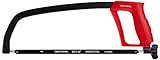

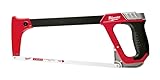

Our Top Picks
 KATA 10 Inch Mini Hacksaw for Metal Cutting10 Inch (3 Blades)11.4 x 2.75 x 1.18 Inches0.3 PoundsCheck on Amazon
Quick Picks
- Best overall: Lenox 12132HT50 (12-inch, high tension, 24 TPI blade, blade storage in the handle).
- Best for heavy trade work: Milwaukee 48-22-0050 (12-inch, high tension, three bi-metal blades, internal storage).
- Best compact: Milwaukee 48-22-0012 (10-inch, tool-free blade change, adjustable blade length with flush-cut mode).
- Best solid-frame value: Stanley STHT20138 high-tension solid frame.
- Best all-day comfort: Bahco 319.
- Best for speed and precision: Bahco 325 Pro.
- Best heavy-duty frame from a trade brand: Klein 702-12.
- Best multi-function option: Stanley FatMax 5-in-1.
How We Chose
We looked at the saws that repeat across 2026 buyer guides and checked each against the manufacturer’s listing. Criteria were frame style (tubular, I-beam or solid), blade tension method, blade angle options, blade storage, handle shape and grip comfort, ability to cut flush or in confined spaces, and the blade supplied. No saw was physically used for this article; the ranking is a synthesis of published specifications and common buyer-guide conclusions, and a few specifications are marked as class-level where a precise figure was not confirmed.
What Actually Matters in a Hacksaw
Frame Tension Versus Rigidity
A hacksaw blade cuts best when it is stretched tight. A slack blade bows, wanders and snaps. Cheap tubular frames flex under the tension and lose it during the cut. High-tension frames use thicker beams or I-beam sections so the blade stays straight. Lenox describes its HT50 as holding up to 50,000 psi of blade tension, and Milwaukee’s 12-inch high-tension frame is aimed at the same heavy-duty target. A stiffer frame cuts straighter and breaks fewer blades, which matters more than any other spec when you are cutting steel pipe or bolts.
Blade TPI for Metal Versus PVC
TPI stands for teeth per inch. The usual rule is to keep at least three teeth in contact with the material at all times. Thin material needs more teeth, thick material needs fewer. Almost every hacksaw ships with a 24 TPI bi-metal blade, which covers most steel, copper and aluminum work in the 1/8 inch wall-thickness range and above. An 18 TPI blade cuts faster and clears debris in thicker stock or wood. A 32 TPI blade suits thin-wall tubing and sheet. Plastic pipe such as PVC can be cut with the common 24 TPI blade, but coarser teeth (18 TPI or lower) clear the soft chips better and reduce melting.
Adjustable Blade Angle
Some saws let you set the blade at 90 degrees or turn it 45 degrees sideways, and some let you mount the blade so it lies flat against the frame for cutting close to a wall. Flush-cut capability matters for pipes against a stud, a slab or a plate.
Handle Comfort
Closed D-handles are common and let you push hard. Open pistol-grip handles are comfortable but can slip with gloves. Look for a cushioned overmold, a shape that fits your palm and a front handle or knuckle guard if you do long strokes.
Compact and Mini Options
A 10-inch compact frame such as the Milwaukee 48-22-0012 weighs about 227 grams according to listings and fits where a 12-inch frame cannot swing. The compromise is a shorter stroke and slightly lower rigidity.
Comparison Table
| Saw | Blade length | Frame | Included blade | Standout feature |
|---|---|---|---|---|
| Lenox 12132HT50 | 12 in | I-beam, high tension (up to 50,000 psi) | 24 TPI | Stores five blades in handle |
| Milwaukee 48-22-0050 | 12 in | High tension | Two 24 TPI metal and one 18 TPI wood | Stores up to six blades |
| Milwaukee 48-22-0012 | 10 in | Compact | 24 TPI | Tool-free change, flush-cut mode |
| Stanley STHT20138 | 12 in | Solid high-tension frame | Standard bi-metal | Solid frame at a value tier |
| Bahco 319 | 12 in class | Ergonomic frame | Class standard | Comfort-focused handle |
| Bahco 325 Pro | 12 in class | Very high tension | Class standard | Fast, precise cutting |
| Klein 702-12 | 12 in | Heavy-duty | Class standard | Trade-grade build |
| Stanley FatMax 5-in-1 | Multi-use | Multi-blade | 24 TPI plus 6 TPI reciprocating blade | Several cutting modes |
Best Overall
Lenox 12132HT50
Spec line: 12-inch · I-beam high-tension frame · up to 50,000 psi blade tension · 24 TPI blade included · stores five blades in the handle.
Best for: Plumbers, electricians and DIYers who want a dependable frame that cuts steel pipe, threaded rod, conduit and copper without bowing.
Skip if: You work in tight spaces where a 12-inch frame will not swing, or you prefer a lightweight tubular frame.
- Pros: stiff I-beam construction; handle stores spare blades; most 2026 guides rank it first; earlier tension-pin complaints have largely been addressed according to guides.
- Cons: heavier than tubular saws; the blade needs to be seated carefully to hold tension.
Best for Heavy Trade Work
Milwaukee 48-22-0050
Spec line: 12-inch · high-tension frame · includes two 24 TPI bi-metal blades for metal and one 18 TPI blade for wood · stores up to six blades.
Best for: Contractors and mechanics who cut metal, PVC and occasional lumber on the same job and want a kit with several blades.
Skip if: You only need a saw for a single project; the cost of a full trade-grade frame may not be justified.
- Pros: mixed blade set covers metal and wood; generous blade storage; rated by guides as strongest for heavy-duty use.
- Cons: bulkier than compact saws; pricing sits in the premium tier.
Best Compact
Milwaukee 48-22-0012
Spec line: 10-inch · tool-free blade change · adjustable blade length with flush-cut mode · about 227 grams · 24 TPI blade included.
Best for: Cutting pipe behind a sink, inside a wall cavity or beneath a vehicle where a full-size frame cannot reach.
Skip if: You cut thick steel stock all day; the shorter, lighter frame is less rigid than a 12-inch high-tension saw.
- Pros: light; tool-free blade change; flush-cut mode for working against surfaces.
- Cons: shorter stroke slows long cuts; less tension than the full-size frames.
Best Value Solid Frame
Stanley STHT20138
Spec line: 12-inch · solid high-tension frame · standard bi-metal blade.
Best for: Home workshops and toolboxes where you need a sturdy saw at a modest cost.
Skip if: You want built-in blade storage or tool-free blade changes.
- Pros: solid frame resists flex; selected by one guide as its top pick; entry-level to mid-range cost.
- Cons: fewer convenience features; handle is plainer than trade-grade rivals.
Best for Comfort and Precision
Bahco 319
Spec line: 12-inch class · ergonomic handle · tensioned frame · standard blade.
Best for: Long cutting sessions where hand fatigue is the main problem.
Skip if: You need maximum tension for large steel stock; consider the 325 Pro instead.
- Pros: described in guides as the most comfortable for all-day use; well-regarded European build.
- Cons: specific tension figures were not confirmed; premium cost compared with basic frames.
Bahco 325 Pro
Spec line: 12-inch class · very high blade tension · professional frame.
Best for: Tradespeople who prize straight, fast cuts in steel pipe and bar.
Skip if: You cut occasionally; a basic frame is enough.
- Pros: very high tension keeps the blade straight; fast, accurate cuts.
- Cons: premium tier; the exact tension rating is not confirmed here.
Best Trade-Brand Heavy Duty and Multi-Function
Klein 702-12
Spec line: 12-inch · heavy-duty frame · standard blade.
Best for: Electricians cutting conduit, strut and threaded rod.
Skip if: You want a lighter or compact frame.
- Pros: trade-focused build; chosen by Bob Vila’s guide for heavy-duty work.
- Cons: precise tension rating not confirmed; weight is higher than tubular frames.
Stanley FatMax 5-in-1
Spec line: multi-use frame · 24 TPI hacksaw blade plus a 6 TPI reciprocating-style blade.
Best for: A toolbox generalist who wants one tool for metal, wood and small demolition tasks.
Skip if: You cut steel regularly; a dedicated high-tension frame holds the blade straighter.
- Pros: flexible, several blade options; modest cost tier.
- Cons: not as rigid as dedicated high-tension frames; compromises in each mode.
Worked Example: Choosing TPI by Wall Thickness
Use the three-teeth rule: TPI should be at least 3 divided by the wall thickness in inches, so that three teeth are always in contact.
- Schedule 40 PVC, 1/4 inch wall: 3 divided by 0.25 = 12 TPI minimum. Any standard blade works, but 18 TPI clears soft plastic chips with less melting. Choose 18 TPI if available, otherwise the supplied 24 TPI.
- Steel electrical conduit (EMT), roughly 1/16 inch wall: 3 divided by 0.0625 = 48 TPI in theory. In practice no common hacksaw blade goes that high, so choose 32 TPI and use light pressure, or switch to a tubing cutter.
- Black steel pipe, roughly 1/8 inch wall or more: 3 divided by 0.125 = 24 TPI. The standard blade is correct.
- Solid 3/8 inch steel rod: 3 divided by 0.375 = 8 TPI minimum. The 24 TPI blade still works because the circular cross-section means contact length changes through the cut, but expect more strokes.
The pattern is simple: thin wall means more teeth, thick or soft material means fewer teeth. A 24 TPI blade is the sensible default, and the rest is exceptions.
Blade Selection by Material
| Material | Suggested TPI | Notes |
|---|---|---|
| PVC and CPVC pipe | 18-24 | Light pressure; deburr the inside and outside edges |
| Copper tube and brass | 24-32 | Use a tubing cutter on thin wall if available |
| Steel pipe, conduit, rod | 24 | Bi-metal blade; add cutting oil on thick stock |
| Thin sheet and small tubing | 32 | Support the work near the cut |
| Wood and rough lumber | 6-18 | Coarser teeth clear sawdust |
| Aluminum | 18-24 | Wax or light oil limits clogging |
How to Cut Cleanly and Safely
- Clamp the work in a vise or hold it firmly. Cut close to the clamp to reduce vibration.
- Install the blade with the teeth pointing away from the handle so the saw cuts on the push stroke.
- Tighten the tension until the blade rings slightly when you flick it, and recheck after the first few strokes.
- Start with a light notch using a thumbnail guide, then use long, even strokes with pressure only on the forward stroke.
- Lift slightly on the return stroke. Dragging teeth backward dulls the blade fast.
- Deburr the cut end with a file or deburring tool, especially on conduit and PVC.
- Wear safety glasses. Hacksaw blades can snap, and metal chips fly.
- Wear gloves with a good grip but keep fingers away from the blade path.
- Never cut a pipe that is pressurized, energized or connected to a live gas or water line. Shut off and drain it first.
- Cutting galvanized pipe produces zinc dust; ventilate the area and avoid breathing it.
- Replace a blade as soon as teeth chip or the cut starts to wander. A dull blade tempts you to push harder and leads to blade breakage.
Blade Breakage and Troubleshooting
If blades snap often, tension is usually the cause: either too loose, which lets the blade twist, or too tight on a weak tubular frame. A blade that dulls quickly is often cutting too fast or being dragged on the return stroke. If the cut curves, check that the frame is square and the pins seat fully, and use a frame with a stiffer beam. A blade that clogs in plastic or aluminum needs coarser teeth or a drop of oil.
Frequently Asked Questions
What is the best hacksaw overall?
The Lenox 12132HT50 is the most commonly recommended all-round hacksaw in 2026 buyer guides because its I-beam frame holds high blade tension and it stores spare blades.
What TPI should I use for cutting metal pipe?
Use 24 TPI for most steel pipe and conduit. Choose 32 TPI for thin-wall tubing and sheet so at least three teeth stay in contact.
Can a hacksaw cut PVC?
Yes. A standard 24 TPI hacksaw blade cuts PVC cleanly with light pressure. Coarser 18 TPI teeth clear chips better, and you should deburr the pipe edges afterward.
Is a high-tension hacksaw worth it?
For regular metal cutting, yes. A stiffer frame keeps the blade straight, cuts faster and breaks fewer blades. For a single light job, a basic frame is adequate.
What size hacksaw do I need for tight spaces?
A 10-inch compact saw such as the Milwaukee 48-22-0012 fits tight spaces, and its flush-cut mode lets the blade run flat against walls or surfaces.
Which way do hacksaw blade teeth face?
Teeth point away from the handle so the saw cuts on the forward push stroke. Mounting the blade backward makes it cut poorly and dulls the teeth.
How tight should a hacksaw blade be?
Tighten until the blade is taut and produces a short ring when flicked. Too loose lets it twist and snap, while excess force on a weak frame can bend the frame.
Should I use cutting oil with a hacksaw?
Yes on thick steel and stainless. A few drops reduce heat and extend blade life. For PVC and thin copper, cut dry with light pressure.