As an Amazon Associate I earn from qualifying purchases. This post may contain affiliate links at no extra cost to you.
Running out of hard drive space is one of the most common frustrations for photographers, video editors, and anyone who keeps large project files locally. The solution usually involves adding a portable external drive, but the market is crowded with options that look nearly identical on a spec sheet while diverging sharply in real-world usability. Encryption options, interface generation, connector type, and whether the drive is designed for desktop or mobile ecosystems all matter more than the marketing copy suggests.
This roundup compares eight drives that address the problem from different angles. Some prioritize hardware-level password protection for sensitive client work. Others focus on freeing up phone storage with one-click photo backup. A couple target enterprise-level capacity that happens to fit a 2.5-inch form factor. We weighed published specifications, price-per-terabyte math, and aggregated owner feedback to separate drives that deliver value from those that charge a premium for brand alone.
As an Amazon Associate we earn from qualifying purchases at no extra cost to you. Product prices and availability are accurate as of the date shown and are subject to change.




Quick Picks
| Product | Best for | Price |
|---|---|---|
| Seagate One Touch 2TB | General-purpose portability with encryption | $138.31 |
| Seagate One Touch 1TB | Budget portability with encryption | $111.82 |
| Seagate One Touch 5TB | Maximum portable capacity with encryption | $227.50 |
| G-Technology G-DRIVE Mobile 2TB | Mac and creative-pro workflows | $299.99 |
| NEWQ 1TB iPhone Drive | Freeing up iPhone photo and video storage | $109 |
| G-Technology G-DRIVE Mobile 1TB | Entry-level pro-grade portability | $197 |
| G-Technology G-DRIVE Mobile 5TB | High-capacity pro portable storage | $649.99 |
| Seagate Exos X24 16TB | Enterprise internal storage expansion | $639.99 |
How We Picked
We evaluated each drive on four criteria. First, price per terabyte: a drive that costs more than double its capacity-proportional share is charging you for something beyond storage. Second, interface and connector compatibility, because a USB 3.1 Gen 1 drive with USB-C handles modern laptops and phones far more smoothly than a USB 3.0 Micro-B device that requires an adapter. Third, encryption and data-security features, which matter enormously for anyone carrying client work or personal documents. Fourth, use-case specificity: a drive designed for iPhone photo offloading serves a fundamentally different need than a SAS-connected enterprise internal. A product that fails on all four is not in this list.
The 8 Best Hard Drive Space in 2026
Seagate One Touch 2TB
This is the default recommendation for anyone who needs more hard drive space on the go without overthinking the purchase. The 2TB capacity handles a full year of RAW photo backups or several high-definition video projects. Password-activated hardware encryption means the drive is protected even if it leaves a bag on a train. Owner feedback consistently praises the plug-and-play simplicity on both Windows and Mac.
- Hardware-level encryption requires no software install to function
- Space Gray aluminum finish resists fingerprints and looks professional in client settings
Con: USB 3.0 with a Micro-B connector feels dated compared to USB-C alternatives at similar price points.
Skip this if you need USB-C connectivity or want to avoid carrying an extra cable.
Seagate One Touch 1TB
At $111.82, this is the entry point into encrypted portable storage. One terabyte is enough for a working project library or a single client folder, but it fills faster than most buyers expect. Owners who bought it as a secondary backup volume report satisfaction, while those who underestimated their file growth tend to upgrade within a year.
- Same hardware encryption as its siblings at the lowest price in the Seagate line
- Lightest and smallest of the One Touch family, easy to pocket alongside a notebook
Con: The effective price per terabyte is noticeably higher than the 2TB model, making it the worst value in the encryption-focused group.
Skip this if your budget stretches to the 2TB version, which offers double the capacity for only $26 more.
Seagate One Touch 5TB
This is the capacity ceiling for the One Touch line and one of the most affordable high-volume portable drives available. Five terabytes of hard drive space suits a freelance videographer archiving full shoot folders or a designer keeping multiple client brand kits in transit. The hardware encryption scales the same way, so a full drive of sensitive material is still protected by a password at the firmware level.
- Best price-per-terabyte in the entire Seagate portable range at under $46 per terabyte
- Identical encryption and software ecosystem as smaller siblings, so upgrading capacity costs nothing in workflow disruption
Con: At 5TB, the physical form factor is thicker and heavier, making it feel less pocketable than the 1TB or 2TB models.
Skip this if you carry the drive daily in a small bag and weight matters more than capacity.
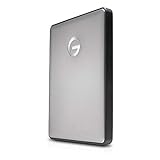
G-Technology G-DRIVE Mobile 2TB
G-Technology positions this drive squarely at Mac-centric creative professionals. The USB 3.1 Gen 1 interface with USB-C means it connects directly to modern MacBook Air and Pro laptops without an adapter. Build quality is the standout: the aluminum housing and rubberized bumper design have earned consistently positive long-term reliability comments from owners who transport the drive frequently.
- Native USB-C eliminates the adapter problem that plagues older portable drives
- G-Technology’s brand reputation in the video and audio production world adds a layer of trust for client-facing work
Con: The $299.99 price is roughly double what the Seagate One Touch 2TB charges for the same capacity, and you do not get hardware encryption included.
Skip this if your budget is tight or if encryption is a non-negotiable security requirement.
NEWQ 1TB iPhone Drive
This product solves a specific and painful problem: running out of storage on an iPhone and needing a quick, reliable way to free up space without relying on cloud subscriptions. One-click backup of photos and videos, combined with both USB-C and Lightning connectors, means it works across older and newer iPhone models. Offline transmission support adds a layer of privacy that cloud-based alternatives cannot match.
- Works directly with iPhone without a computer in the middle, which is rare in this category
- Dual connector (USB-C and Lightning) future-proofs it across Apple device transitions
Con: One terabyte fills fast for 4K video shooters, and the drive lacks hardware-level encryption, so lost-device scenarios expose your photos.
Skip this if you primarily use Android devices or need more than a phone-scale backup solution.
G-Technology G-DRIVE Mobile 1TB
The smallest capacity in the G-DRIVE Mobile line, this is for buyers who want the G-Technology build and USB-C connectivity but do not need a large volume. Owners frequently purchase it as a project-specific drive, dedicating a single terabyte to one client or one production. The design language matches its larger siblings, so it sits neatly beside other G-Technology gear on a studio shelf.
- Same aluminum chassis and bumper design as the 2TB and 5TB models at the lowest entry price
- USB-C to USB-C connection works natively with laptops, tablets, and newer phones
Con: At $197 for a single terabyte, the cost per terabyte is steep, and the drive offers no encryption advantage over cheaper options.
Skip this if you do not specifically need the G-Technology brand or form factor, as other 1TB drives cost well under $120.
G-Technology G-DRIVE Mobile 5TB
This is the premium high-capacity portable option, aimed at production teams and field editors who need to carry multiple projects without a network connection. Five terabytes of hard drive space in a mobile form factor means a full documentary shoot can travel between editing stations on a single drive. The USB 3.1 Gen 1 interface sustains the throughput needed for large video file transfers.
- Among the largest portable capacities available in a pro-grade, ruggedized enclosure
- Consistent G-Technology design language across product lines makes it easy to organize mixed fleets of drives
Con: At $649.99, it costs more than the Seagate One Touch 5TB by a wide margin, and the price-per-terabyte is roughly triple the Seagate equivalent.
Skip this if budget is a constraint; the Seagate line delivers similar capacity for a fraction of the price.
Seagate Exos X24 16TB
This is not a portable drive, and it is not meant to be. The Exos X24 is an enterprise-class 2.5-inch internal hard drive with a 6GB/s SAS interface, 7200RPM spindle speed, and a 2.5-million-hour MTBF rating. It is built for server racks, NAS arrays, and storage enclosures that need sustained throughput and uptime. For a woodworking studio that has outgrown consumer drives and needs to archive decades of project files, this is the appropriate tier.
- 16TB of single-drive capacity is unmatched by any portable option in this list
- Enterprise MTBF rating and SAS connectivity mean it is engineered for continuous operation far beyond consumer expectations
Con: The 2.5-inch SAS interface requires a compatible server, RAID card, or external enclosure; it will not work with a standard laptop out of the box.
Skip this if you need a plug-and-play solution for a personal computer or laptop.
Buying Guide
Interface Generation and Connector Type
USB 3.0 with Micro-B connectors, as found on the Seagate One Touch line, still works but requires a specific cable that most newer devices no longer carry. USB 3.1 Gen 1 with USB-C, used across all three G-DRIVE Mobile models and the NEWQ iPhone drive, connects directly to modern hardware. The practical difference is cable management: one less adapter means fewer things to lose before you can access your data. If you are buying in 2026 and your laptop has only USB-C ports, a Micro-B drive is an immediate workflow friction point.
Hardware Encryption Versus Software Encryption
The Seagate One Touch drives advertise password-activated hardware encryption, meaning the encryption logic runs on a dedicated chip inside the drive. The drive remains locked even if you remove its platters and connect them to another controller. The G-Technology and NEWQ drives in this list do not include hardware encryption. If your work involves client confidentiality agreements, medical records, or anything you would not want exposed in a lost-drive scenario, hardware encryption is not a nice-to-have. It is a baseline requirement.
Price Per Terabyte as a Value Check
Dividing the listed price by the capacity reveals how much each drive costs per terabyte of hard drive space. The Seagate One Touch 5TB comes in at roughly $46 per terabyte, while the G-Technology 5TB charges about $130 per terabyte. The G-Technology premium buys you build quality, brand positioning, and USB-C, but not additional encryption or faster sustained throughput in any meaningful sense. Use this ratio as a sanity check before paying a brand markup that does not translate into performance you can measure.
Our Verdict
Top pick: The Seagate One Touch 5TB is the strongest overall value. It offers hardware encryption, USB 3.0 portability, and the best price per terabyte in the consumer portable category. No other drive in this list delivers encrypted five-terabyte capacity for $227.50.
Budget pick: The NEWQ 1TB iPhone Drive at $109 is the most practical affordable solution for the specific problem of a phone running out of hard drive space. It solves a real daily frustration without requiring a computer.
Condition under which another wins: If you are a Mac-based video editor who needs USB-C on day one and values build quality over encryption features, the G-Technology G-DRIVE Mobile 2TB justifies its higher price through connector compatibility and enclosure durability that G-Technology owners consistently praise.
FAQ
Is 1TB enough hard drive space for a professional workflow?
For a single active project or a small photo archive, 1TB is workable but tight. Most professional photographers and video editors exceed 1TB within a few months of consistent output. If your budget allows, the 2TB tier provides meaningful headroom without a proportional price jump.
Do I need USB-C over USB 3.0 Micro-B?
If your primary device has only USB-C ports, you need a USB-C drive or you will rely on an adapter permanently. For older laptops that still have USB-A ports, a Micro-B cable remains functional. The connector type is less about speed and more about daily convenience and cable compatibility with current hardware.
What is the difference between hardware and software encryption on a portable drive?
Hardware encryption is built into the drive’s controller chip and works independently of your operating system. Software encryption relies on installed applications and can be bypassed if someone extracts the platters. For a portable drive that leaves your desk or studio, hardware encryption provides a stronger physical security layer against unauthorized access.
Can I use the Seagate Exos 16TB as an external drive?
Yes, but only inside a 2.5-inch drive enclosure or a NAS that supports SAS. The Exos is designed for server and enterprise environments with SAS connectivity, so it will not plug into a standard USB port directly. If you want external access, pair it with a compatible SAS-to-USB enclosure, though this adds cost and bulk that a purpose-built portable drive avoids.