What's inside
- Quick comparison: which budget system fits your workshop?
- Best low-cost choice: tempered hardboard with a real mounting frame
- When metal pegboard is worth the extra money
- Where IKEA SKÅDIS fits—and where it does not
- Decision matrix for small workshops
- Calculate the real cost before choosing a panel
- How to install a budget pegboard so it stays useful
- Durability details that affect long-term value
- Bottom line
As an Amazon Associate I earn from qualifying purchases. This post may contain affiliate links at no extra cost to you.
The best budget pegboard wall storage for most small workshops is a 1/4-inch hardboard pegboard mounted on 3/4-inch furring strips, paired with a mixed hook kit and a few tool-specific holders; choose a metal system instead when you regularly hang heavy drills, clamps, or loaded bins.
The cheapest panel is not always the lowest-cost storage solution. A useful comparison has to include the mounting frame, hook quality, hole pattern, accessory availability, and how much wall space is lost behind the panel. The right choice depends on whether you need occasional hand-tool storage, dense everyday organization, or a durable system that can be rearranged repeatedly.
As an Amazon Associate we earn from qualifying purchases at no extra cost to you.


Our Top Picks
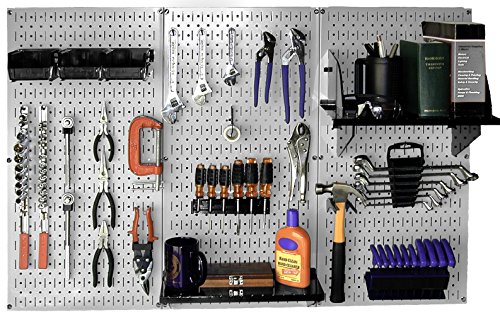 Wall Control 30-WRK-400GB Standard Workbench Metal Pegboard Tool32" x 16"16 x 0.25 x 6 Inches29 poundsCheck on Amazon
 Wall Control 30-P-3232B Black Metal Pegboard Pack32" Tall x 16" Wide x 0.75" Deep32 x 16 x 0.75 Inches14 poundsCheck on Amazon
 Wall Control 30-P-3232GV Galvanized Steel Pegboard Pack0.63 x 32 x 32 Inches13.6 poundsCheck on Amazon

Quick comparison: which budget system fits your workshop?
| System type | Typical panel material | Common panel size | Approximate load guidance | Accessory compatibility | Typical material cost | Best for |
|---|---|---|---|---|---|---|
| Hardboard pegboard | Tempered 1/4-inch fiberboard | 2 x 4 ft or 4 x 4 ft | About 5–10 lb per hook when properly supported | Standard 1/4-inch hooks and baskets | $20–$60 before hooks and framing | Lowest initial cost and general hand tools |
| Metal pegboard | Powder-coated steel | 16 x 32 in to 32 x 48 in | Often 10–25 lb per accessory, depending on mount | Brand-specific hooks plus some compatible 1/4-inch accessories | $60–$180 per panel | Heavy tools, garages, and frequent rearrangement |
| Slotted modular board | Steel or molded plastic rails | Usually 24–48 in wide modules | About 5–20 lb per holder, depending on rail and anchors | Usually proprietary bins and brackets | $50–$160 per starter set | Small parts and a clean, modular layout |
| Retail-style plastic pegboard | High-impact molded plastic | About 16 x 24 in to 24 x 36 in | Often 3–8 lb per hook | Matching plastic hooks and baskets | $25–$80 per panel | Light tools, craft rooms, and humid locations |
These are practical planning ranges rather than universal ratings. The wall anchors, screws, hook design, and the distance between the board and wall can change the safe capacity substantially. A board attached directly to drywall is not equivalent to one screwed into studs or a continuous plywood backer.
Best low-cost choice: tempered hardboard with a real mounting frame
For a small workshop on a strict budget, standard tempered hardboard is difficult to beat. It uses common 1/4-inch round holes, so replacement hooks are inexpensive and widely available. A 2 x 4-foot panel can organize screwdrivers, pliers, squares, chisels, measuring tools, and small clamps without consuming much money.
The important detail is the spacer frame. Use 3/4-inch furring strips around the perimeter and across the back, then fasten the board to the strips with washers. The gap gives hook tabs room to pass through and prevents tools from pressing against the wall. Without that gap, hooks can loosen, tilt, or fail to seat fully.
Hardboard has two ownership weaknesses: moisture and repeated hook movement. Unsealed edges can swell in a damp garage, while thin holes can enlarge if heavy tools are repeatedly lifted sideways. Paint the cut edges, keep the heaviest items low, and use two-point hooks for anything that weighs more than a few pounds.
When metal pegboard is worth the extra money
Powder-coated steel panels, including systems such as Wall Control, cost more but solve several problems at once. They resist humidity, tolerate frequent reconfiguration, and generally hold their shape better around busy tool areas. Metal is especially useful for cordless drills, impact drivers, loaded accessory baskets, and tools that are removed and replaced many times per day.
The trade-off is accessory dependence. Some metal systems use proprietary slots or specially shaped hooks, and an inexpensive universal 1/4-inch hook may not fit. Before buying, confirm whether the panel accepts standard pegboard hooks, the brand’s own accessories, or both. Also check the total depth: a bracket that projects 3 inches from the wall may be awkward above a narrow bench.
Metal is not automatically stronger in every installation. A thin panel attached to weak drywall anchors can still pull away from the wall. Use the manufacturer’s recommended fasteners, locate studs where possible, and avoid concentrating a full bin of metal hardware on one small bracket.
Where IKEA SKÅDIS fits—and where it does not
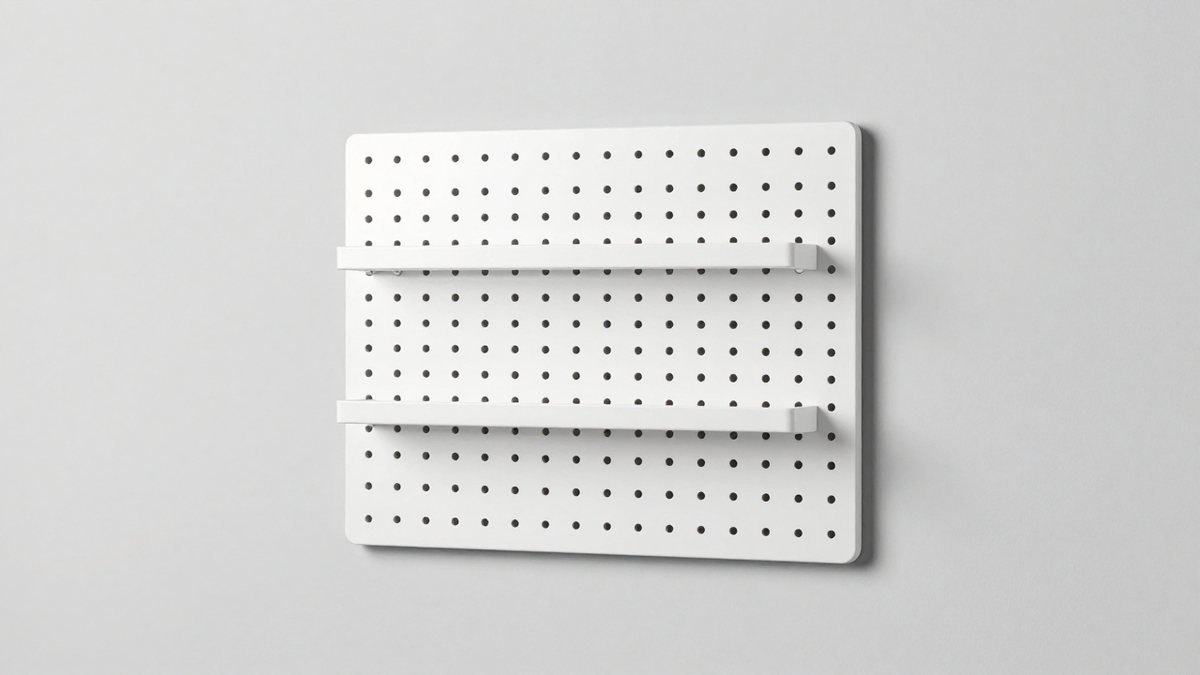
IKEA SKÅDIS is a modular fiberboard pegboard-style system aimed at offices, craft areas, and light-duty storage. Its panels and accessories are neat, space-efficient, and useful when you want cups, shelves, clips, and small containers arranged in a shallow profile. It can be a good choice for sanding supplies, marking tools, electronics parts, or a compact bench above a desk-height work surface.
SKÅDIS is less suitable as a direct replacement for a traditional workshop pegboard. Its accessory ecosystem is more specialized, and many holders are designed for light or medium loads rather than heavy power tools. Choose it for small items and visual organization, not as the main wall for loaded clamps or cast-iron tools.
Decision matrix for small workshops
| Your situation | Most sensible choice | Why | What to avoid |
|---|---|---|---|
| Under $75 and mostly hand tools | 2 x 4 ft hardboard with 3/4-inch spacers | Lowest total cost and broadest hook availability | Buying a large hook assortment before measuring tools |
| Daily use with drills and loaded bins | Powder-coated metal panel | Better resistance to wear and repeated rearrangement | Unrated adhesive mounts or undersized drywall anchors |
| Very little wall width | Shallow modular board with vertical tool holders | Uses height and keeps projection controlled | Deep baskets that block the workbench |
| Humid or unheated garage | Metal or sealed plastic system | Less vulnerable to swelling and edge damage | Unsealed hardboard installed against a damp masonry wall |
| Frequent layout changes | Metal or modular slotted system | Hooks and brackets survive more repositioning | Moving hardboard hooks sideways under load |
| Small parts are the main problem | Modular board with cups and bins | Better containment than individual open hooks | Using open hooks for screws, router bits, or loose fittings |
Calculate the real cost before choosing a panel
Compare complete installations, not just panel prices. For example, a basic 2 x 4-foot hardboard setup might cost approximately $25 for the panel, $15 for furring strips and screws, and $25 for a mixed hook kit: about $65 total. If it organizes 35 regularly used tools, the initial cost is roughly $1.86 per stored tool.
A metal panel system might cost $90 for the panel, $20 for mounting hardware, and $45 for compatible hooks and cups: about $155 total. If it stores 45 tools and bins, the cost is approximately $3.44 per position. The metal option is nearly twice as expensive per position, but that difference may be reasonable if the hardboard would need replacement after a few years of heavy use.
For a narrow wall, calculate coverage as well. A 2 x 4-foot panel provides 8 square feet. Two 16 x 32-inch metal panels provide about 7.1 square feet, but their modular layout may use the wall more effectively if they can be separated around a cabinet or electrical outlet.
How to install a budget pegboard so it stays useful
- Inventory the tools first. Group tools by task and measure the deepest items. Reserve deeper storage for drills, sanders, and bins rather than forcing them onto shallow hooks.
- Mark the work zone. Keep the board close enough to reach without leaning across the bench, but leave clearance for long handles and the swing of cabinet doors.
- Find studs or install a backer. Fastening into studs is preferable. Where stud locations do not match the layout, use a plywood backer secured to several studs, then attach the pegboard to it.
- Create a consistent wall gap. For hardboard, 3/4-inch spacers are a practical starting point. Use washers under screws to spread the load and prevent the board from tearing around the holes.
- Place heavy items low and near supports. Put drills, vises, and dense bins over screws or framing members when possible. Use two-hook brackets for tools that twist as they are removed.
- Reserve 20–30 percent of the board. Empty space is not wasted; it lets the system grow without forcing unrelated tools into unstable positions.
Durability details that affect long-term value
The first parts to wear are usually inexpensive hooks, plastic retaining clips, and the board holes around frequently moved heavy tools. Replace bent hooks rather than straightening them repeatedly, and discard any bracket that no longer sits flat. Keep abrasive metal shavings off painted panels because they can scratch the finish and encourage corrosion in damp conditions.
Clean the board with a dry brush or vacuum first. A lightly damp cloth is suitable for sealed hardboard, plastic, and powder-coated metal, but avoid saturating unsealed fiberboard. Do not hang freshly oiled tools directly against hardboard; use a tray or hook that keeps the oily surface away from the panel.
A common mistake is buying a large assortment of single hooks. Single hooks work for narrow items, but wider tools often rotate or fall forward. Mix single hooks with double hooks, tool clips, small shelves, and bins. Labeling only the bins—not every individual tool—usually gives a better balance between order and flexibility.
Bottom line
Choose tempered hardboard when the priority is the lowest complete cost, standard accessories, and ordinary hand-tool storage. Choose powder-coated metal when the wall will be used heavily, the garage is humid, or you expect frequent rearrangement. Choose a modular system such as IKEA SKÅDIS when shallow storage for small parts matters more than heavy-duty capacity. In every case, spend as much attention on the wall mounting and accessory layout as on the panel itself: that is where budget pegboard systems succeed or fail.