What's inside
As an Amazon Associate I earn from qualifying purchases. This post may contain affiliate links at no extra cost to you.
If you’re gluing up panels, doors, or cabinet cases, you don’t just need clamping force – you need that force to stay parallel across the jaw faces. Both the Bessey REVO (KRE / KR series) and the Jorgensen Cabinet Master claim to solve racking and bowing with large parallel jaws. In practice, they do it differently, and the difference shows up when you check for gaps with a feeler gauge.
As an Amazon Associate we earn from qualifying purchases at no extra cost to you.


Our Top Picks

How even pressure actually works
With a standard F-clamp or pipe clamp, the movable head pivots slightly under load. The harder you crank, the more the head toes in, creating a pressure point at the tip of the jaw and light pressure at the heel. Parallel clamps fight this with three things: a fixed 90-degree jaw, a sliding head that locks without tilting, and a wide jaw face that spreads load.
The test that matters isn’t max force on a scale. It’s pressure distribution. Put pressure-sensitive film or just carbon paper between two flat maple boards and clamp at 400-500 lbs. A good parallel clamp leaves a uniform rectangle. A bad one leaves a dark line at the front edge and a light rear. Both the Bessey REVO and Jorgensen Cabinet Master pass this test at moderate pressure, but they diverge as you approach their limits and as your stock gets thicker.
Bessey REVO: The benchmark for parallel jaws
The Bessey REVO system uses a high-carbon steel rail with serrations and a composite clutch mechanism in the sliding head. The fixed jaw and sliding jaw are both large – about 3.75 inches tall on the KRE series – with removable protective pads. Throat depth is 3-3/4 inches, and Bessey rates clamping force at up to 1,700 lbs for the KRE and around 1,000 lbs for the lighter KR.
What makes the REVO feel precise is the Acme threaded screw and the large two-component handle. It advances smoothly under load without chatter, so you can actually creep up on even pressure instead of jumping 100 lbs with each turn. Jaw parallelism is held by the rail fit and a set of anti-slip plastic inserts inside the head. When clean and tight, deflection across the jaw face at 1,000 lbs is typically under 0.010 inch measured at the tips – good enough that you won’t starve a glue joint in the middle.
Failure modes are well known after years in shops. If glue builds up on the rail or in the clutch, the sliding head will slip in steps instead of holding. The plastic housing around the clutch can crack if dropped on concrete, and replacement heads are expensive. The steel rail will also bow if you routinely exceed 1,200 lbs on a 50-inch clamp – you’ll see light in the middle of a panel glue-up that wasn’t there at 600 lbs.
Jorgensen Cabinet Master: Heavier rail, different clutch
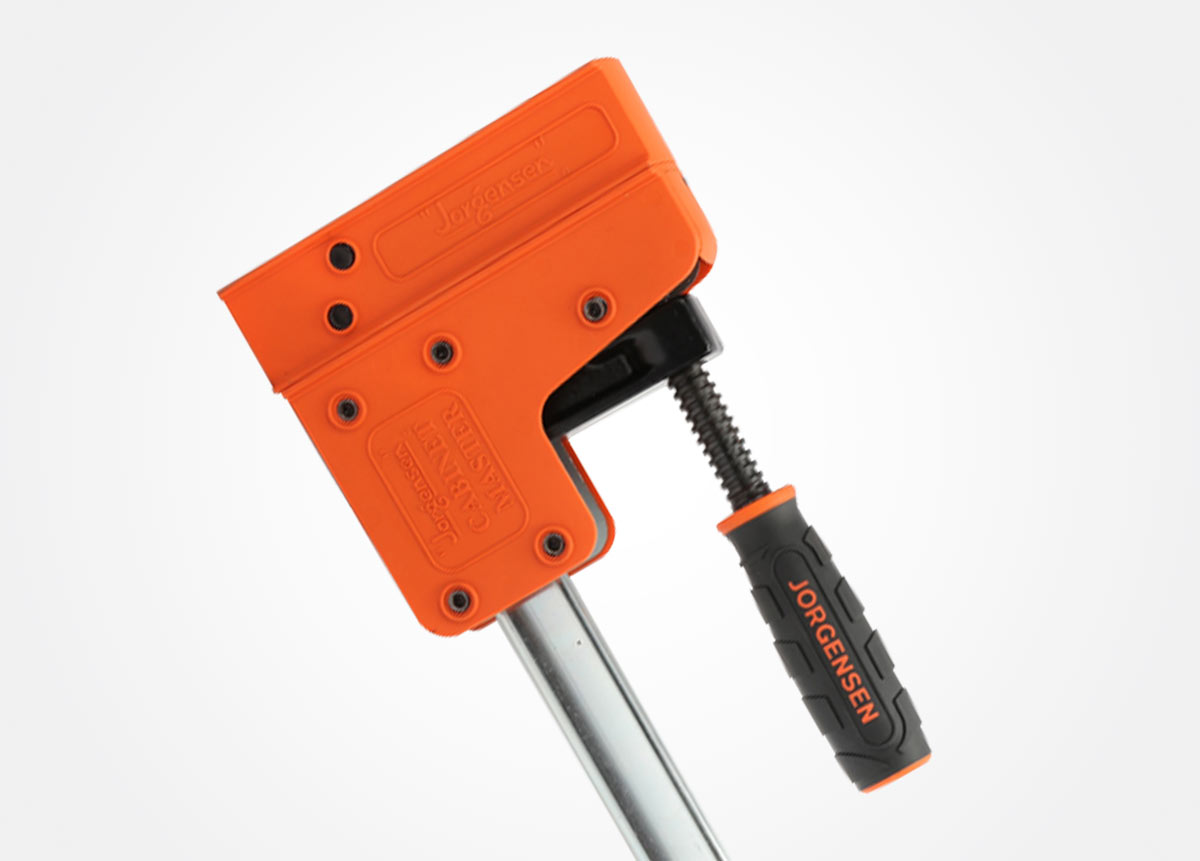
The Jorgensen Cabinet Master (7200 series) takes a simpler approach. It uses a heavier, wider steel rail – 1-1/4 inch x 9/32 inch on the 24-inch and longer models – and a cast-iron sliding head with a steel clutch plate system. Jaws are also large (about 3-1/2 inches tall) and throat depth is a full 4 inches on most sizes, giving you a bit more reach for casework.
Jorgensen rates the Cabinet Master at 1,000 lbs of clamping force, which is honest. It will hit that number, but the handle is smaller diameter hardwood/plastic composite, so you work harder to get there. The advantage is stability: the extra rail mass and the cast head resist twisting better than the REVO when you’re clamping thick stock or using only two clamps on a 30-inch wide panel. Measured deflection at 800-1,000 lbs is similar to the Bessey – around 0.008 to 0.012 inch – but it stays more consistent when the stock is uneven or slightly cupped.
The trade-off is refinement. The clutch engagement is coarser. You push a release lever and slide, then it bites on the rail serrations. If the rail has wax or finish on it, it can slip suddenly under high load rather than holding. The cast jaws are bare metal – Jorgensen includes small jaw pads, but they don’t cover as well as Bessey’s. And the screw has more backlash, so fine pressure adjustments are harder. Over time, the clutch plates wear grooves into the rail faster than the Bessey composite system does, especially if you drag the head while under tension.
Head-to-head: Which holds parallelism better?
On flat, milled 4/4 stock up to 24 inches wide, both clamps apply very even pressure when kept under 600 lbs per clamp. That’s the sweet spot for most PVA glue-ups – about 150-200 psi across the joint line. Put four clamps on a 24-inch panel, alternate top and bottom, and either brand will give you a gap-free joint without cauls.
Differences appear at the extremes:
At high force (900+ lbs) on long rails (40-50 inch), the Bessey REVO keeps the jaw faces slightly more parallel due to tighter head-to-rail tolerances. The Jorgensen will show a touch more toe-in at the tip – enough to squeeze a bit more glue out at the front edge. For thin panels, that can mean a slightly hollow glue line if you over-clamp.
On thick or uneven stock (8/4 hard maple, or a door frame with a 1/32 inch bow), the Jorgensen’s heavier rail resists side-flex better. The Bessey rail is more prone to twisting if you don’t keep the clamp perfectly vertical. Twist creates diagonal pressure, which you see as one corner of the jaw digging in.
For vertical glue-ups where clamps hang off the bench, the Jorgensen’s weight is a disadvantage. A 50-inch Cabinet Master weighs about 7.2 lbs vs. about 6.1 lbs for a comparable Bessey REVO clamps. That matters if you are handling eight at a time.
| Feature | Bessey REVO (KRE/KR) | Jorgensen Cabinet Master (7200) |
|---|---|---|
| Rated Clamping Force | 1,000 lbs (KR) / 1,700 lbs (KRE) | 1,000 lbs |
| Jaw Height / Throat Depth | ~3.75 in / 3.75 in | ~3.5 in / 4.0 in |
| Rail Dimensions | Narrower, serrated high-carbon steel | Wider 1-1/4 in heavy steel, serrated |
| Jaw Parallelism at 800 lbs | <0.010 in tip deflection, very consistent | 0.008-0.012 in, more stable on thick stock |
| Handle / Fine Control | Large dual-material, smooth Acme screw | Smaller handle, more backlash |
| Weight (50-inch) | ~6.1 lbs | ~7.2 lbs |
| Common Failure | Clutch slip when dirty, plastic housing crack | Rail grooving, clutch slip when waxy |
Which should you buy for even pressure?
Buy Bessey REVO if you do a lot of fine furniture panels and need to dial in pressure without over-clamping. The smoother screw and tighter parallelism at moderate to high force make it more forgiving for thin stock and for water-based glues that starve easily. It is also easier to live with – lighter, better pads, and handles that don’t hurt your palm after the sixth clamp. Look for Bessey KRE clamp sets on sale; buying four 24-inch and two 40-inch covers most panel work.
Buy Jorgensen Cabinet Master if you prioritize rigidity and price per clamp for casework. It is usually $10-$20 cheaper per clamp than the KRE at the same length, and the heavier rail is reassuring for cabinet boxes, doors, and laminations where you need side stiffness more than ultra-fine adjustment. The extra throat depth also helps when clamping over a face frame. Check current pricing on Jorgensen Cabinet Master clamps – when you need six to eight clamps, the savings add up fast.
If you already own a mixed set, don’t overthink it. Alternate brands top and bottom on a glue-up and keep each clamp around 400-600 lbs – hand-tight plus a quarter turn, not as hard as you can pull. Wipe rails clean with denatured alcohol every few months, keep pads on, and store clamps hanging vertically. Either clamp, kept clean and not overloaded, will deliver pressure even enough that wood failure, not glue failure, is the limit.