What's inside
As an Amazon Associate I earn from qualifying purchases. This post may contain affiliate links at no extra cost to you.
Dull pruning shears turn a pleasant afternoon of trimming roses into a frustrating workout. Garden tool sharpeners exist to fix that, but the market is crowded with everything from pocket-sized carbide pull-throughs costing less than a cup of coffee to multi-station kits that handle mower blades alongside kitchen knives. Choosing well means understanding what blade profiles you actually sharpen, how often you sharpen, and whether you need a tool that fits in a hip pocket or sits on a workbench.
What separates a good garden tool sharpener from a mediocre one comes down to three things: the hardness and grit of the cutting medium (tungsten carbide and diamond coatings outlast cheap stamped steel), the geometry compatibility (a flat stone will not restore a curved secateur blade), and whether the design lets you control pressure without risking your fingers. The eight products below cover the range from single-purpose pocket files to all-in-one workbench stations, each positioned for a specific type of gardener.
As an Amazon Associate we earn from qualifying purchases at no extra cost to you. Product prices and availability are accurate as of the date shown and are subject to change.


Quick Picks
| Product | Best for | Price |
|---|---|---|
| Corona Tools Handheld | Budget-minded occasional users | $8.10 |
| Orange Ninja 7-in-1 | Homeowners who want one tool for everything | $35.99 |
| SHARPAL 103N All-in-1 | Lawn mower owners with mixed blade types | $22.99 |
| AccuSharp Diamond-Honed | Heavy-duty edge restoration on large tools | $11.99 |
| SHARPAL 129N Multipurpose | Traveling gardeners who need versatility | $12.99 |
| 2pcs Pocket Blade (Wolfram Steel) | Stocking gloves pockets and tool belts | $6.19 |
| SHARPAL 121N Dual-Grit Stone | Precision honing of flat and curved edges | $21.99 |
| LXUEJIE 4 Pack | Families or shared-tool households | $8.69 |
How We Picked
We evaluated each sharpener on three criteria that consistently determine longevity and ease of use in this category: abrasive material (diamond and tungsten carbide blades resist wear far better than stamped steel or ceramic composites), versatility of blade profiles supported (a sharpener that only handles flat edges will frustrate anyone with curved secateurs or hollow-ground scythes), and ergonomic safety (whether you can apply controlled pressure without your thumb drifting into the cutting path). Owner feedback across retail listings informed our assessment of real-world durability and grip comfort.
The 8 Best Garden Tool Sharpener in 2026
Corona Tools Handheld Garden Tool Sharpener
Corona is a trusted name in garden cutting tools, and this handheld sharpener is built to match their own pruning shears and loppers in particular. It targets gardeners who already own Corona tools and want a brand-aligned maintenance accessory without spending much. The carbide insert handles straight and slightly curved edges on shears, loppers, and hedge clippers.
- Pro: Costs less than most single-use items at the checkout line, so there is very little risk if it does not suit your blades.
- Pro: Compact enough to live in a glovebox or apron pocket for mid-session touch-ups.
- Con: Owners note it struggles with heavily nicked or chipped edges; it is a maintenance sharpener, not a restoration tool.
Skip this one if your shears have deep nicks from hitting wire or fencing, or if you need to sharpen hollow-ground scythe blades.
Orange Ninja 7-in-1 Garden Tool & Knife Sharpener
This is the closest thing to a universal solution in the group. Seven sharpening stations handle everything from flat chisels to serrated kitchen knives to curved garden shears. It suits a homeowner who wants one drawer tool rather than a rack of specialized files. The design uses tungsten carbide and ceramic rods across different angles.
- Pro: Genuinely covers garden and kitchen blades in a single footprint, reducing the temptation to skip maintenance.
- Pro: Guided-angle slots help beginners produce a consistent bevel without freehand practice.
- Con: At nearly $36 it is the most expensive option here, and the multi-slot design makes it bulkier than pocket files for in-field use.
Skip it if you sharpen on-site away from a bench, or if you already own dedicated stones for your preferred blade types.
SHARPAL 103N All-in-1 Knife Garden Tool Lawn Mower Blade Sharpener
SHARPAL built a reputation for sharpening odd geometries, and the 103N is their broadest garden offering. It includes dedicated slots for straight mower blades, curved mower blades, and multiple garden edge profiles. This is the pick for anyone who mows a half-acre and also maintains loppers, hoes, and shears through the season.
- Pro: Handles lawn mower blades alongside hand tools, a combination few competitors offer at this price.
- Pro: Tungsten carbide cutters resist loading with sap and grit better than soft steel alternatives.
- Con: The unit is noticeably larger than pocket sharpeners and needs a stable surface; it is not a field tool.
Skip it if you have no mower to sharpen or if your garden tool set is limited to one or two hand pruners.
AccuSharp Garden Tool Sharpener
AccuSharp leans into aggressive material removal with diamond-honed tungsten carbide blades. This makes it the go-to for gardeners who let edges degrade badly and then want to restore them rather than maintain them lightly. It handles lawn mower blades, secateurs, limb loppers, hoes, shovels, and scythes.
- Pro: The diamond-coated carbide cuts fast, so heavily dulled edges come back in fewer strokes than softer abrasives.
- Pro: Wide blade support accommodates shovel and scythe profiles that narrower sharpeners simply cannot grip.
- Con: The aggressive cut can round over a fine factory edge if you are not careful with pressure, so it rewards a light touch.
Skip it if your primary need is touching up a already-sharp edge between uses rather than repairing a neglected one.
SHARPAL 129N Multipurpose Garden Tool Blade Sharpener
The 129N sits between the big SHARPAL all-in-one and the ultra-minimal pull-throughs. It covers curved and flat garden edges in a compact form that fits a jacket pocket. This is for the active gardener who prunes weekly and wants a capable touch-up tool that never leaves the shed.
- Pro: Light enough to carry all day without feeling like a burden in a belt loop or pocket.
- Pro: SHARPAL’s carbide geometry handles both concave and convex edges common on pruning tools.
- Con: No dedicated mower-blade slot, so owners who need that will feel the gap compared to the 103N.
Skip it if you sharpen mower blades or if you want a guided-angle system for kitchen knives.
2pcs Pocket Blade Sharpener, Premium Wolfram Steel
At under seven dollars for a two-pack, this is the cheapest entry point in the roundup and the only one sold in multiples. Wolfram steel (tungsten alloy) inserts do a credible job on moderately dull straight and slightly curved edges. It suits gardeners who want a spare for the shed, the glovebox, and the workbench without thinking about it.
- Pro: The two-pack pricing makes it trivial to keep one in every location where you grab tools.
- Pro: Minimal weight and size mean it never gets left behind because of bulk.
- Con: Owner feedback indicates the coating wears noticeably after repeated heavy use, so it is best treated as a consumable or backup.
Skip it if you need a primary sharpener for large-blade tools like shovels or scythes; the short cutting edge limits leverage.
SHARPAL 121N Dual-Grit Diamond Sharpening Stone Garden Tool File
SHARPAL’s 121N takes a different approach: a flat dual-grit diamond file rather than a pull-through slot. This gives the user full control over stroke angle and pressure, which matters for precision edges and for sharpening concave curves that pull-throughs cannot reach. It is a gardener’s analog to a jeweler’s file.
- Pro: Dual grit (coarse for repair, fine for honing) means one tool covers both maintenance and restoration.
- Pro: Freehand control lets you match any bevel angle, including non-standard grinds on heirloom tools.
- Con: Requires a practiced hand; users who pull through a carbide slot will find the learning curve noticeable at first.
Skip it if you want a no-skill-required touch-up tool for quick fixes mid-pruning session.
LXUEJIE 4 Pack Garden Tool Sharpener
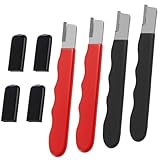
Four pocket sharpeners for the price of one mid-tier single unit. Each uses a V-groove tungsten carbide blade that works on pruning shears, hedge shears, sickles, and scissors. The value proposition is obvious: distribute one to each household member or keep spares at different work zones.
- Pro: Cost per unit is extremely low, making it a reasonable stocking-stuffer or tool-club giveaway.
- Pro: The V-groove handles both straight and modestly curved edges without requiring angle adjustment.
- Con: Build quality per unit reflects the price; threads and housing feel less robust than single-product alternatives, and owners report some variability between units in the pack.
Skip it if you need consistent long-term performance from a primary sharpener; these are better as backups or secondary tools.
Buying Guide
Abrasive Material Determines Lifespan
Garden tool edges are hardened steel. Soft abrasives like stamped carbon steel or low-grade ceramic wear flat within dozens of uses, producing a rounded edge that feels sharp briefly but fails quickly. Diamond-coated and tungsten-carbide cutters maintain their geometry hundreds of times longer. If you sharpen a dozen times per season, the premium material pays for itself within a year through sustained performance rather than replacement frequency.
Blade Profile Compatibility Is Non-Negotiable
A flat pull-through will not sharpen a curved secateur blade without leaving a dead spot along the inner radius. Before buying, check whether the product lists support for concave edges, convex edges, and the specific angle of your tools. Mower blades add another dimension: many have a beveled or flat geometry that demands a dedicated wide slot. The Orange Ninja and SHARPAL 103N address this breadth explicitly; pocket files do not.
Field Use vs. Workbench Use Changes the Decision
If you sharpen once per season after removing all your tools, a bench unit with guided slots and multiple stations gives you the most consistent results with the least skill required. If you need to touch up a pruner mid-session because you hit a thick branch and nicked the edge, a pocket carbide pull-through in your belt loop will save the afternoon. Many experienced gardeners keep both: a bench unit for annual servicing and a pocket sharpener for in-field emergencies.
Our Verdict
The SHARPAL 103N All-in-1 is the best garden tool sharpener overall for the widest range of users. It handles mower blades, hand tools, and common garden geometries in one compact bench unit at a mid-range price. For budget buyers who only maintain a couple of pairs of shears and loppers, the Corona Tools Handheld at eight dollars is a no-brainer. The one scenario where another product wins outright: if you want a single sharpener for garden tools and kitchen knives without cluttering a drawer, the Orange Ninja 7-in-1 justifies its premium by replacing three or four separate tools.
FAQ
How often should I sharpen garden tools?
For pruning shears and loppers, a light touch-up every fifteen to twenty cuts restores the edge before it degrades. Full sharpening once per season, typically at the start of spring, handles most homeowner workloads. Mower blades should be sharpened every twenty to twenty-five mowing hours or whenever you notice torn rather than clean grass tips.
Can I sharpen garden tools with a kitchen knife sharpener?
Not effectively. Garden tool blades are thicker, harder, and often curved in ways kitchen slots cannot accommodate. A chef’s pull-through will leave a rounded bevel or simply not accept the blade width. Dedicated garden sharpeners use wider slots, harder abrasives, and curvature-compatible profiles that match pruning and digging geometries.
Do I need to oil the blade after sharpening?
Yes, a light coat of any solvent-free oil on a freshly sharpened edge prevents flash rust and reduces sap adhesion during the next few sessions. Many gardeners keep a small oil cloth in the same apron pocket as their sharpener for this reason.
Is diamond or carbide better for garden tool sharpeners?
Both outperform soft steel alternatives. Diamond coatings excel at fine honing and sustained sharpness on softer garden steels. Tungsten carbide cuts faster on harder blades and resists loading with sap. For most gardeners, either material works well; what matters more is that the abrasive is actually bonded to a durable substrate rather than a cheap plated layer that flakes after ten uses.