Our Top Picks


What's inside
As an Amazon Associate I earn from qualifying purchases. This post may contain affiliate links at no extra cost to you.
The WORKPRO Premium Utility Knife, the all-metal retractable model with quick blade change and 10 spare blades, is the best overall pick for shop work: it is built for repeated daily cutting and keeps spare blades with the knife. If you want a folding knife that stores blades inside an aluminum handle, the red WORKPRO folder is the closer match, and multipacks from M MEEPO, REXBETI and KATA suit shops that want a knife at every bench. A shop utility knife is a blade holder meant for cutting cardboard, tape, sheet goods, packaging and similar material, and the right one comes down to handle strength, blade change speed and locking.
Quick List
- WORKPRO Folding Utility Knife (red) – best for blade storage inside the handle
- M MEEPO 4-Pack Folding Box Cutters – best for stocking several benches or a team
- REXBETI 2-Pack Box Cutters – best for a retractable knife with a large blade supply
- KATA 3-Pack Folding Utility Knives – best for zinc-alloy handles with a lock-back
- WORKPRO Premium Retractable Utility Knife – best for all-metal, heavy daily use
- WORKPRO 2-in-1 Wood Handle Folding Knife – best for a hybrid utility and pocket folder with a belt clip
Which One Is Right for You?
| If you… | Choose |
|---|---|
| Want spare blades tucked inside the handle | WORKPRO Folding Utility Knife (red) |
| Need several knives for a shop, crew or household | M MEEPO 4-Pack |
| Prefer a retractable blade and a big stack of replacements | REXBETI 2-Pack |
| Like a metal handle and a lock-back folder | KATA 3-Pack |
| Cut cardboard and packaging all day | WORKPRO Premium Retractable |
| Want a knife that also works as a belt-clip folder | WORKPRO 2-in-1 Wood Handle |
If you only buy one, decide between a retractable fixed-handle knife, which is the sturdiest, and a folder, which is safer in a pocket or apron. Multipacks make sense when knives tend to walk away from the bench, and the cost of losing one is small.
Think about where the knife lives. A knife that stays on a pegboard or a bench can be bulky and heavy, so an all-metal retractable model works well. A knife that lives in an apron pocket, a truck door or a backpack should fold or retract fully and carry a clip. A shared shop benefits from bright colors and multipacks, since a knife that is easy to spot is easier to return, and a shop with apprentices benefits from knives that lock firmly and change blades without tools.
All 6 Picks in Detail
1. WORKPRO Folding Utility Knife (Red) – Best for Blade Storage in the Handle
As an Amazon Associate we earn from qualifying purchases at no extra cost to you.

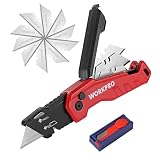
This red WORKPRO folder is a quick-change box cutter that holds spare blades inside its aluminum handle, and the listing says 13 extra blades are included. For shop work, that means the knife carries its own supply, so a dull blade is a thirty-second fix rather than a trip to the toolbox. It suits woodworkers, DIYers and warehouse staff who want one knife in the apron. Because the listing text cuts off, check the lock type and blade style on the product page.
- Type: folding utility knife with quick blade change
- Handle: aluminum, with internal blade storage per the listing
- Blades: 13 extra blades included per the listing
- Color: red
- Lock type and blade standard: confirm on listing
Pros:
- Spare blades travel with the knife
- Folding body protects the blade when carried
Cons:
- Folding mechanisms add a pivot point to wear over time
- Details of the lock are not visible in the listing name
Compared with the WORKPRO Premium, it trades the one-piece rigidity of a fixed handle for pocket safety.
2. M MEEPO 4-Pack Folding Box Cutters – Best for Stocking Several Benches
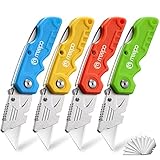
The M MEEPO set gives you four colorful folding box cutters and 10 blades. The bright handles make it easy to spot a knife on a cluttered bench or in a drawer, and the pack size lets you keep one in the shop, one in the truck and one in the kitchen. It suits households, small crews and classrooms where a single knife would be lost within a week. The listing name does not state the handle material, lock type or blade style, so confirm them before buying.
- Pack: four folding utility knives
- Blades: 10 blades included per the listing
- Style: colorful folding box cutters
- Handle material and lock: confirm on listing
- Blade compatibility: confirm on listing
Pros:
- Multiple knives for the price of a single premium tool
- Bright colors are easy to find
Cons:
- Fewer blades per knife than other sets
- Lighter-duty feel is likely for the pack category
It is the best value-by-count choice, while the KATA 3-pack is the metal-handle alternative.
3. REXBETI 2-Pack Box Cutters – Best for a Retractable Knife with Many Blades

The REXBETI set comes with two box cutters and 18 blades, with blade storage and a push button to retract the blade, according to the listing. The retractable style appeals to people who dislike folders and want the blade to disappear with one push. The generous blade count suits a shop that cuts abrasive materials and burns through edges quickly. As with other multipacks, check the handle material and the blade style on the product page.
- Pack: two box cutters
- Blades: 18 blades included per the listing
- Storage: blade storage in the handle per the listing
- Mechanism: push button, retractable per the listing
- Handle material and lock: confirm on listing
Pros:
- Large supply of spare blades
- Retractable blade is quick to secure
Cons:
- Push-button mechanisms can wear with heavy use
- Material specifics are not in the listing name
Choose it over the M MEEPO pack when blade supply matters more than the number of knives.
4. KATA 3-Pack Folding Utility Knives – Best for Zinc-Alloy Handles

KATA’s three-piece set describes heavy-duty folding box cutters with zinc alloy handles, quick-change blades and a lock-back. Zinc alloy adds weight and rigidity compared with plastic, which many users prefer for pressure cuts. The lock-back style is a familiar design from pocket folders: it holds the blade open under load. It fits shops that want a sturdy folder in several places. The listing name is truncated, so confirm included blade count and any belt clip.
- Pack: three folding utility knives
- Handle: zinc alloy per the listing
- Blade change: quick-change per the listing
- Lock: lock-back per the listing
- Blade count: confirm on listing
Pros:
- Metal handle feels solid in the hand
- Lock-back keeps the blade steady during cuts
Cons:
- Heavier than plastic folders
- The three-pack size may be more than a home shop needs
Compared with the WORKPRO folder, it gives you more knives, while the WORKPRO keeps spare blades in the handle.
5. WORKPRO Premium Retractable Utility Knife – Best for Heavy Daily Use

This WORKPRO is described as a premium, all-metal, heavy-duty retractable box cutter with quick blade change and 10 extra blades. A fixed, one-piece handle is generally the sturdiest design for shop cutting, because there is no hinge to flex. It suits people who open cartons, trim materials and cut underlayment every day. Confirm the blade standard and how the retraction mechanism locks on the product page, since the listing name does not spell it out.
- Type: retractable fixed-handle utility knife
- Construction: all metal per the listing
- Blade change: quick-change per the listing
- Spare blades: 10 extra blades per the listing
- Blade standard and lock details: confirm on listing
Pros:
- All-metal build for rigid, controlled cuts
- Retractable blade is easy to secure between cuts
Cons:
- Cannot fold, so it is bulkier in a pocket
- Single knife only
It is the sturdiest choice on the list, so it beats the folders for pressure cuts while losing to them on carry safety.
6. WORKPRO 2-in-1 Wood Handle Folding Knife – Best Hybrid Knife (Runner-Up for Pure Shop Cutting)

The WORKPRO 2-in-1 is part utility knife, part pocket folder: it has a wood handle, a quick-change mechanism, a liner lock, a belt clip and 10 SK5 blades, and the listing mentions carton cutting and camping. It is a runner-up for pure shop work because the hybrid design is aimed at versatile everyday carry rather than a dedicated shop tool. SK5 is a high-carbon steel often used in blades; the listing does not describe the heat treatment, so confirm that on the product page. It suits people who want a single good-looking knife for the shop, a trip and a pocket.
- Type: 2-in-1 folding knife and utility knife
- Handle: wood per the listing
- Lock: liner lock per the listing
- Blades: 10 SK5 blades per the listing
- Extras: belt clip, quick-change mechanism
Pros:
- Liner lock and belt clip suit everyday carry
- SK5 blades are a decent choice for general cutting
Cons:
- Wood handles need more care around moisture
- Wood and a folding pivot call for a little more care than an all-metal body
It is the most versatile knife here, but the Premium WORKPRO is the more dedicated shop tool.
Specs Compared
| Model | Type | Pack size | Handle | Lock or mechanism | Blades included |
|---|---|---|---|---|---|
| WORKPRO Folding (red) | Folding, quick change | 1 | Aluminum | Confirm on listing | 13 extra, stored in handle |
| M MEEPO 4-Pack | Folding | 4 | Confirm on listing | Confirm on listing | 10 |
| REXBETI 2-Pack | Retractable, push button | 2 | Confirm on listing | Push button | 18 |
| KATA 3-Pack | Folding, quick change | 3 | Zinc alloy | Lock-back | Confirm on listing |
| WORKPRO Premium Retractable | Retractable, quick change | 1 | All metal | Confirm on listing | 10 extra |
| WORKPRO 2-in-1 | Folding knife and utility | 1 | Wood | Liner lock | 10 SK5 |
How We Chose These
This guide is based on desk research of listing information, not on cutting tests. We began with the six listings supplied for the topic and compared what each states about handle material, locking or retraction style, blade storage and the number of included blades. Where a listing was cut off or silent, we say to confirm the detail on the product page instead of assuming. We sorted the knives by how a shop actually uses them: pressure cuts, quick blade changes, pocket safety and the ability to keep spare blades close. The wood-handled hybrid is labeled a runner-up because it is built more for everyday carry than for dedicated shop cutting.
What to Look For
Fixed Retractable Versus Folding
Retractable knives have a one-piece handle that slides the blade in and out, and many shop users prefer them for firm, controlled cuts. Folding knives hide the blade inside the handle, which makes them safer to carry in a pocket or apron and easier to clip to a belt. The tradeoff is the pivot, which can develop play after heavy use. For a bench knife that rarely leaves the shop, a retractable all-metal body is hard to beat, while folders make more sense for pocket carry.
Locks and Blade Security
A lock-back or liner lock stops a folding blade from closing on your fingers during a pressure cut, while a retractable knife locks the blade at one or more positions. Avoid any knife where the blade wobbles side to side, because slop makes the cut wander and raises the chance of slipping. Test a new knife by extending the blade, applying firm side pressure with the handle held in a vise or a hand and making sure nothing shifts.
Blade Style, Steel and Replacement
Most shop knives accept a trapezoid blade, the same type commonly sold in dispensers, though some brands use their own shape, so confirm compatibility before stocking up. High-carbon steels such as SK5 take a keen edge but can rust if left damp, and thicker blades resist snapping while thinner ones cut more cleanly. Plan on changing a blade as soon as it drags or tears, because a dull blade needs more force and slips more often. Quick-change mechanisms let you do this without a screwdriver, which is why blade storage in the handle is such a useful feature.
Safety and Handling
Keep the blade retracted or folded whenever you are not cutting, and always cut away from your body and from the hand holding the material. Use a cutting mat or a scrap board under the work so the blade does not hit your bench. Cut in several light passes through thick material rather than one forceful stroke, and dispose of used blades in a sealed container such as a metal can or a dedicated blade bank. Never leave a loose blade in a drawer, and never carry an open knife in a pocket.
Worked example: a shop that cuts about 30 cartons a week can plan on one blade per week for each person doing the cutting. A knife that stores 10 spare blades therefore covers a quarter of the year before you need to restock.
Handle Material, Grip and Weight
Handle material changes how a knife feels over a full shift. Plastic handles are light and cheap to replace but can flex under hard pressure. Zinc alloy and aluminum add stiffness and weight, which many people like for pressure cuts through thick cardboard, foam or underlayment. Wood looks good and feels warm in the hand, but it can swell if it gets wet and does not tolerate solvents well. A textured or rubberized grip helps when your hands are dusty or oily, and a lanyard hole or belt clip keeps the knife from wandering. If you have large hands, look for a handle long enough that your pinky does not hang off the end.
Matching the Knife to the Material
Different shop materials ask different things of a knife. Corrugated cardboard and tape need a sharp, thin edge and quick blade swaps, so a knife with spare blades in the handle shines. Rubber, vinyl flooring and foam need a firm handle and a blade that does not flex, which favors a retractable all-metal body. Roofing felt, drywall paper and underlayment dull blades quickly, so you want a large supply of cheap replacement blades. Fine work such as trimming veneer, cutting gaskets or marking wood is easier with a short blade exposed and a knife that locks solidly. Scoring and snapping drywall is a classic utility knife job where a fixed handle and a straightedge make cleaner cuts.
A practical approach is to keep two knives. Use a sturdy retractable knife for rough cutting, and a folder in your apron for quick jobs and trips away from the bench. If you share a shop, color-code or mark each knife and keep a blade bank near the door so spent blades never end up in the trash.
Storing and Maintaining Your Knives
A utility knife lasts longer if you take a minute to maintain it. Wipe the blade and the channel with a dry cloth after cutting adhesive or resin, since residue makes the blade drag. Apply a drop of light oil to pivot points and sliders a couple of times a year, and keep spare blades in a dry spot so the edges do not rust. If a locking mechanism feels loose, stop using the knife until you have checked it, because a lock that fails under load is the main cause of cut hands. Store knives closed or retracted in a drawer, tool roll or magnetic holder where the edge cannot rub against other tools.
Questions
What is the safest type of utility knife for a shop?
A retractable knife that locks its blade in position and retracts fully is generally the safest for fixed bench use. Folding knives with a reliable lock are safest in a pocket or apron. The best safety feature is still a fresh, sharp blade and good cutting habits.
How often should I change a utility knife blade?
Change it as soon as it tears, drags or needs more pressure than usual. Cutting abrasive materials such as cardboard dulls an edge quickly, so a bench that cuts a lot may use a blade every few days.
Are multipacks worth it?
They are for shops where knives get lost or borrowed, since you can place one at every station. If you want a single dependable tool, a single all-metal knife is the better choice.
Do all utility knives use the same blades?
No. Many take standard trapezoid blades, but some use proprietary shapes. Check the product page for blade compatibility before you buy replacements.
What does SK5 steel mean?
SK5 is a Japanese high-carbon steel grade used for knife blades and tools. It holds a sharp edge well but benefits from being kept dry and lightly oiled to prevent rust.
How should I dispose of used blades?
Put them in a rigid, sealed container, such as a metal can with a slot in the lid, and label it. Never throw loose blades into a trash bag, where they can injure someone handling it later.
Is a heavier utility knife better?
A little extra weight helps the knife stay steady in a pressure cut, which is why all-metal bodies are popular for shop work. Too much weight tires your hand during long sessions, so choose the lightest knife that still feels rigid.
Can I sharpen utility knife blades?
You can touch up some thicker blades, but most users replace them because blades are inexpensive and a fresh edge is safer and faster. If you do sharpen, use a fine stone and keep the angle consistent.
Are folding utility knives allowed in every workplace?
Rules vary by employer and site. Some warehouses and job sites require retractable or safety knives with auto-retracting blades, so check your workplace policy before bringing a folder.
What should I do if a utility knife blade gets stuck?
Stop, set the knife down on a bench and release the blade-lock or retraction mechanism as the manual describes. Never pry the blade with your fingers. If a mechanism sticks repeatedly, replace the knife.
Update History
- October 20, 2026 – Initial publication; product set drawn from current catalog listings.
- Check the product page for current specifications and availability before buying.
Sources
- Retailer listing titles and specification fields for all six products
- Manufacturer-supplied listing descriptions for WORKPRO, M MEEPO, REXBETI and KATA
- General knife-safety and blade-disposal practice as commonly recommended in workshop safety guidance